
Modutek

Wet Bench Manufacturer | Wet Process Equipment | Modutek

Modutek Offers an Individualized Approach to KOH Etching

KOH etching is a wet anisotropic etching process that uses potassium hydroxide to remove silicon along specific crystal planes, forming cavities, membranes, and V-grooves with sharply defined sidewalls. This etching process has been studied extensively in both research and real-world applications. Modutek provides individualized solutions for customers who want to use this process with an etching tank alongside their existing wet bench equipment. Modutek manufactures all etching tanks on-site and builds them to your specifications. All PFA material is used for cleanliness and compatibility.
KOH-Etching-in-Teflon-Tank--1
KOH-Etching-in-Wet-Bench

Definition of KOH Etching

Potassium Hydroxide (KOH) etching is a wet chemical etching process used to create cavities in silicon. It is a highly corrosive alkaline chemical compound (pH > 12) used with DI water and thermal regulation. The etch rate depends on bath temperature and concentration, and Si etching precision depends on consistency throughout the process. The process enables optimal precision in fabricating Si wafers. In addition, the KOH etching process can be automated to increase efficiency and reduce cost.

Brief Overview of the KOH Etching Process

The KOH process is implemented in wet bench equipment using Modutek’s TFa or TT series of PFA Teflon tanks. The anisotropic nature of Si etching provides greater flexibility and control once the process is established.

The desired end product depends on the etching temperature. Factors include the percentage of KOH used, the use of crystal planes as an etch stop, the degree of anisotropy, the presence of atomic defects in the Si crystal, and other impurities naturally found in the Si crystal. Si doping concentration also affects KOH etching. Boron-doped Si can act as an etch stop if the boron doping concentration exceeds certain parameters.

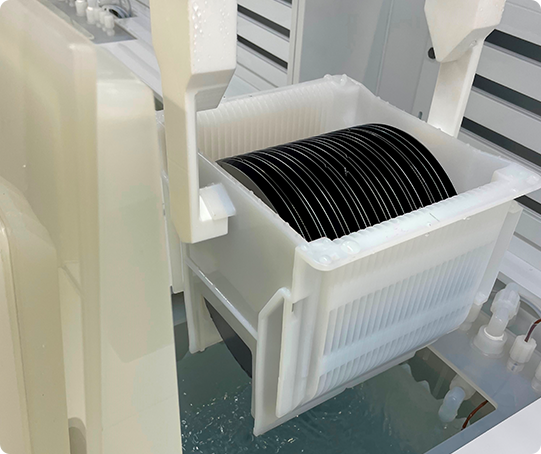
KOH-Etching-using-Teflon-Tanks
KOH-4th-sec

Benefits of KOH Etching Process

The KOH process has notable advantages compared to dry etching and other silicon nitride etching processes used to create nanostructures.

Benefits Include:

Other anisotropic wet etchants, such as hydrazine and EDP, carry greater toxicity and explosion risks, and KOH avoids those hazards. Like KOH, Tetramethylammonium Hydroxide (TMAH) is an anisotropic wet etchant. KOH etches faster and leaves smoother surfaces than TMAH, which etches more slowly and may form hillocks. TMAH is the better choice only where potassium contamination of circuitry is a concern.

Advantages of Modutek’s Individualized Approach to the KOH Process

Modutek’s Teflon Tanks are designed to reduce impurities and unwanted byproducts due to advanced welding techniques with PFA sheet material. After the initial KOH process has been established, continuous adjustments to the etching process are not necessary. Modutek builds all products to individual customer specifications and routinely designs products compatible with a customer’s existing wet bench equipment.
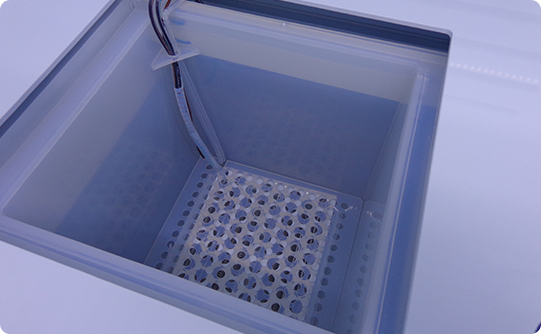
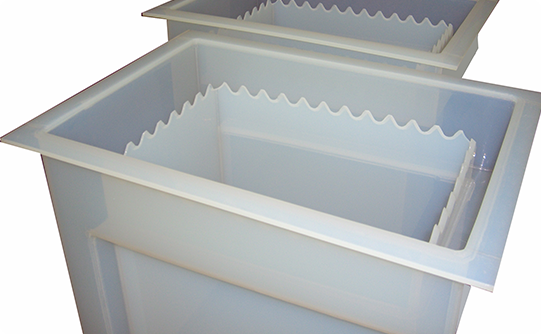
Teflon-Tank-for-KOH-Etching
Teflon-Tanks-for-KOH-Etching

Notable Modutek Design Features for KOH Etching

FAQs on KOH Etching

What Etch Rate Should I Expect From KOH Etching?

In a 28 wt% KOH bath, (100) silicon etches at about 0.4 µm/min at 60 °C, 0.7 µm/min at 70 °C, and 1.3 µm/min at 80 °C, so the rate roughly triples over a 20 °C span. Planes etch at very different rates, with (110) near 2.5 µm/min at 80 °C and the (111) planes almost inert. Hold the bath temperature tightly, because drift shows up directly as etch depth error.

What Masks Work for KOH Etching?

Photoresist does not survive hot KOH, so KOH etching needs a hard mask. LPCVD silicon nitride is the usual choice because it etches extremely slowly, with selectivity to (100) silicon above 10,000:1. Thermal oxide also works for shallow etches, but it etches at roughly 7.5 nm/min at 80 °C, so deep etches need a thick oxide.

Why Is KOH Etching Not Used Near CMOS Circuitry?

KOH can leave mobile potassium ions that contaminate silicon dioxide and gate oxides, so it is generally avoided on wafers that already carry CMOS circuitry. TMAH contains no alkali metal and is the usual alternative there, though it etches more slowly. Where KOH is used, a post-etch clean such as an RCA clean is recommended to remove potassium and metal residues.

How Does a Boron Etch Stop Work in KOH Etching?

Heavily boron-doped silicon etches far more slowly in KOH, so a doped layer can act as a built-in stop for membranes and thin structures. The effect becomes useful when the boron concentration exceeds about 10^19 atoms per cm3. Some labs further improve selectivity by saturating the bath with IPA at around 70 °C.

Why Use PFA Instead of Polypropylene for a KOH Etching Tank?

KOH etching typically runs at 60 to 80 °C, and hot KOH and TMAH degrade polypropylene faster than PFA, which is why Modutek builds its KOH tanks in PFA Teflon. Modutek’s heated PFA tanks operate from 30 to 100 °C with ±0.5 °C control, which covers the usual KOH bath range.

Request a Quote for Your KOH Etching Tank

Modutek builds every etching tank at its San Jose facility to your process specifications and to fit your existing wet bench equipment. Share your KOH concentration, bath temperature, wafer size, and target throughput, and the Modutek team will recommend the right PFA Teflon tank configuration. Request a quote for your process.