
- Home
- About Us
- Products
- Applications
- Support
- Blog
Wafer Cleaning Process
The wafer cleaning process is the sequence of chemical and mechanical steps used to remove particle, organic, and metallic contamination from silicon wafers during semiconductor and MEMS manufacturing. Modutek supports the full range of these processes, including RCA clean, SC1 and SC2 (Standard Clean 1 and 2), Piranha etch clean, pre-diffusion clean, and newer methods such as ozone cleaning and megasonic cleaning, for both research and high-volume production.
The Objective of Wafer Cleaning
The objective of the wafer cleaning process is to remove chemical and particle impurities without altering or damaging the wafer surface or substrate. Wafer surfaces must be maintained and unaffected by roughness, corrosion, or pitting, as this will negate the effectiveness of the cleaning process.
The yield of a silicon wafer is inversely related to the defect density (cleanliness and particle count) from the processing done on the wafer. One way to reduce defect density and increase yields is to utilize efficient wafer-cleaning processes that effectively remove particle contaminants. As semiconductor devices and geometries shrink, removing smaller particles from silicon wafers has become more critical. Small particles can be difficult to remove since strong electrostatic forces exist between the particles and the wafer substrate.
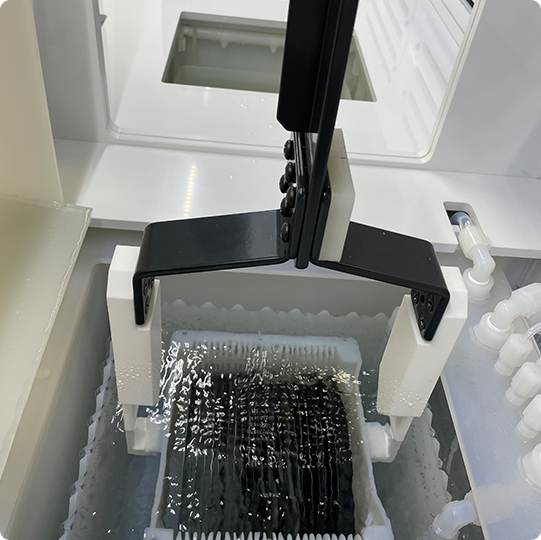
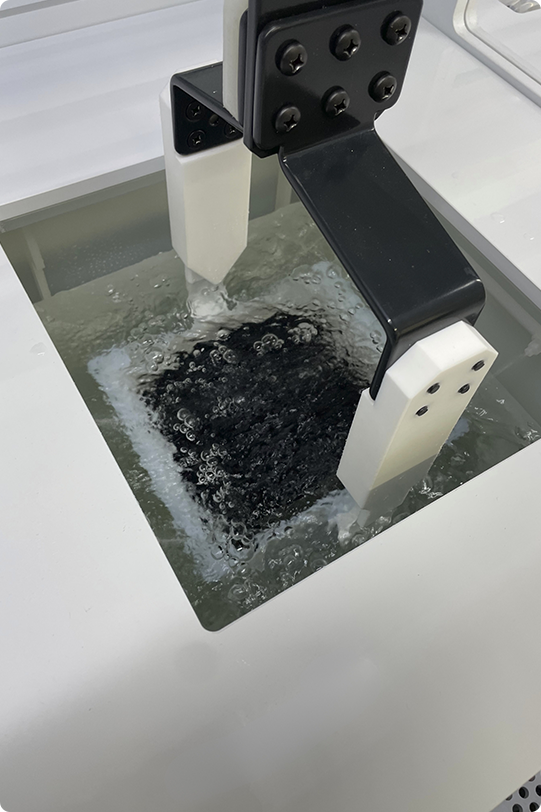
Wafer Cleaning Techniques
The chemistry used in standard wafer cleaning has remained largely unchanged since Werner Kern developed the RCA clean process at RCA in 1965. It is based on the RCA clean process, which uses acidic hydrogen peroxide and ammonium hydroxide solutions. While this remains the industry’s primary method, recent changes include implementing new optimized cleaning technologies, such as ozone cleaning and megasonic cleaning systems. Manufacturing integrated circuits requires many precise processing steps depending on the specific device type. Most steps are completed as single processes on the complete wafer before dicing into individual chips. About 20% of the steps are wafer-cleaning processes, highlighting the importance of wafer cleaning and substrate surface conditioning.
RCA Clean
The RCA clean process was originally developed by RCA Corporation and is a cleaning method to remove organic residue from silicon wafers. The cleaning solution comprises five parts: water, 1 part 30% hydrogen peroxide, and 1 part 27% ammonium hydroxide. These ratios can vary depending on whether megasonic energy is used. It effectively removes organic contaminants and leaves a thin layer of oxidized silicon on the wafer surface.
Standard Clean 1 and 2 (SC1 Clean, SC2 Clean)
The RCA cleaning process is carried out in two steps: SC1 and SC2. SC1 clean process uses the APM solution (ammonia hydroxide-hydrogen peroxide water mixture) of the RCA cleaning method, which removes organic matter and particles. This treatment forms a thin silicon dioxide layer on the wafer surface, along with some metallic contamination, which is removed in subsequent steps. The SC2 cleaning method uses a solution typically comprised of 6 parts deionized water, 1 part hydrochloric acid, and 1 part hydrogen peroxide or HPM (hydrochloric/peroxide mixture). This step effectively removes the remaining traces of metallic (ionic) contaminants, some of which were introduced in the SC1 cleaning step. It also leaves a thin passivation layer on the wafer surface that protects it from subsequent contamination. These two steps prepare the silicon wafer for further processing.
Piranha Etch Clean
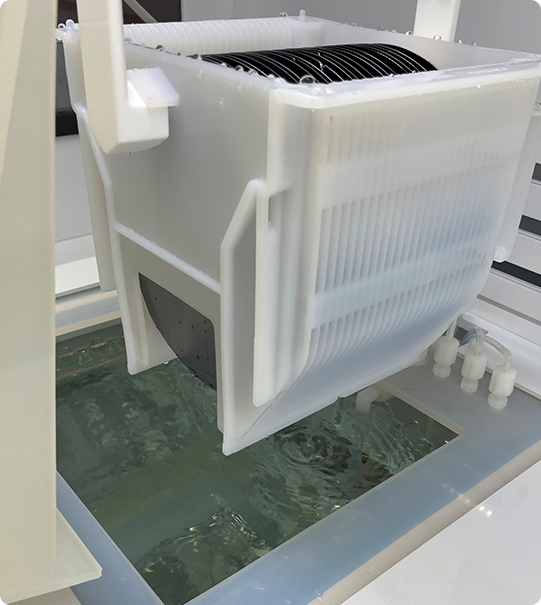
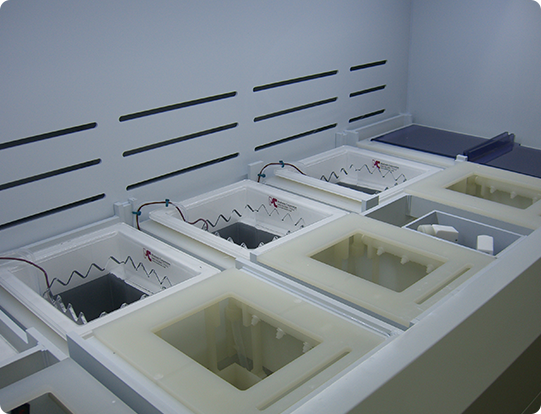
Piranha etch is a popular process for cleaning silicon wafers, but it must be tightly controlled to be effective. Piranha etch clean, also known as Piranha solution, removes large amounts of organic residues from wafer substrates. It effectively removes photoresist and other hard-to-remove organic materials. The typical mixture ratio is three parts sulfuric acid and 1 part 30 percent hydrogen peroxide. Different protocols use higher sulfuric acid ratios, such as 4 to 1 or as high as 7 to 1. Since the mixture is a strong oxidizing agent, it removes most organic matter, hydroxylates most surfaces, and makes them hydrophilic (water-compatible). The mixture is highly corrosive and must be prepared and handled with special care. The piranha etch process can be done in heated Quartz Tanks where both temperature and chemical concentration affect the etch rate. Modutek provides a process control strategy that delivers improved results; for more details, refer to the article “How Piranha Etch is Used in Silicon Wafer Cleaning“.
Pre-Diffusion Clean
Pre-diffusion cleans are critical steps during the wafer manufacturing process. They are done several times during manufacturing and require significant equipment capacity. They are performed as the final step before the silicon wafer enters a diffusion furnace. Particle and metallic contamination must be minimized, and etch uniformity must be optimized while maintaining high throughput.
Depending on the contaminant, various aggressive chemicals, including those from the cleaning methods mentioned above, may be used to achieve clean surfaces. Pre-diffusion cleaning is critical because particles or contaminants on the wafer surface can be driven into the wafer, leading to unpredictable electrical properties and defective or low-quality semiconductor output.
Megasonic Cleaning
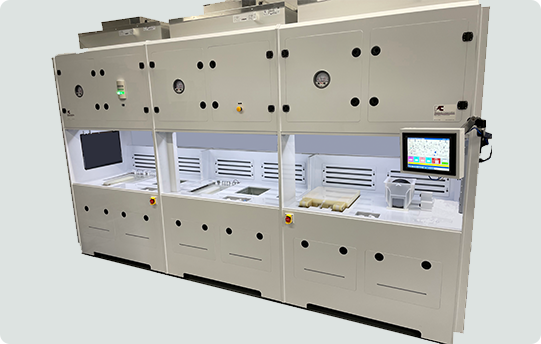
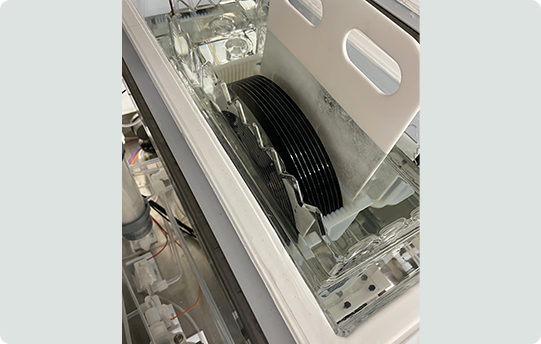
Wafer manufacturing facilities and research centers require stringent wet-process contamination-control protocols and use various methods to clean wafers. These methods include mechanical and wet chemical baths combined with high-frequency megasonic cleaning equipment.
Megasonic cleaning of silicon wafers uses complex mechanisms, including mechanical vibration and cavitation within a cleaning tank. It requires no expensive chemicals and removes both contaminant films and submicron particles.
Ozone Cleaning
The Ozone cleaning process can clean or strip wafers faster and more cost-effectively than traditional cleaning processes. Modutek’s proprietary Advanced Ozone Cleaning Process requires no expensive chemicals and improves process performance while reducing environmentally harmful waste. The process uses DI water in Modutek’s DryZone gradient dryer to clean wafer substrates and eliminate inorganic impurities before exposing them to an ozone chamber. The process converts all traces of organic materials into carbon dioxide. The resulting substrate surfaces are free from particles, trace organic materials, and moisture, with a stable hydrophilic surface.
Wafer Cleaning Process FAQs
1. What Equipment Does Modutek Provide to Support Wafer Cleaning Processes?
Modutek provides wet benches, quartz tanks, and specialized equipment to support processes such as RCA, SC1/SC2, Piranha etch, pre-diffusion, megasonic, and ozone cleaning processes, with tank materials and configurations customized to each chemistry.
2. How Do I Choose the Right Wafer Cleaning Process for My Application?
The right process depends on the contamination type being targeted – organic residues, metallic ions, or particles – along with the wafer’s sensitivity to chemical exposure and the production volume. Most fabrication lines combine several of these methods in sequence rather than relying on a single process.
3. Can Wafer Cleaning Equipment Be Customized for R&D Versus Production-Scale Needs?
Yes. Modutek’s wafer cleaning systems can be configured differently for benchtop R&D use than for high-volume production, adjusting tank size, throughput, and automation level to match the scale of the operation.
4. What Safety Precautions Are Needed When Handling RCA Clean or Piranha Etch Chemicals?
Both RCA clean solutions and Piranha etch mixtures are strongly oxidizing and corrosive and require proper ventilation, chemically compatible equipment, and adherence to facility safety protocols. Confirm specific handling procedures with your facility’s safety officer and the chemical manufacturer’s safety data sheets.
5. How Does Ozone Cleaning Reduce Environmental Impact Compared to Traditional Wet Chemical Cleaning?
Ozone cleaning converts organic contaminants directly to carbon dioxide rather than relying on large volumes of process chemicals, reducing both chemical consumption and the environmentally harmful waste associated with traditional wet chemical cleaning methods.
Request a Consultation to Discuss Your Wafer Cleaning Process Requirements
Modutek has designed and built semiconductor wet processing equipment in San Jose, California, since 1980, supporting customers from large semiconductor manufacturers to small research facilities with wafer cleaning systems customized to each application’s contamination control needs.
Contact Modutek’s engineering team to schedule a free consultation on improving your wafer cleaning process and manufacturing yields.