
Wet Bench Equipment
The semiconductor device fabrication process has a long cycle time, typically taking about 12 weeks to complete and 14-20 weeks for advanced processes. As such, any wet bench systems used for wafer fabrication must be reliable and precise to meet all manufacturing process requirements. Modutek builds each wet bench system around the customer’s specific process requirements.
Modutek’s Expertise and Experience
Wet Bench Equipment Options
Microfabrication rarely has a “one-size-fits-all” solution. That’s why Modutek offers a wide variety of wet bench station options to meet your specific needs.
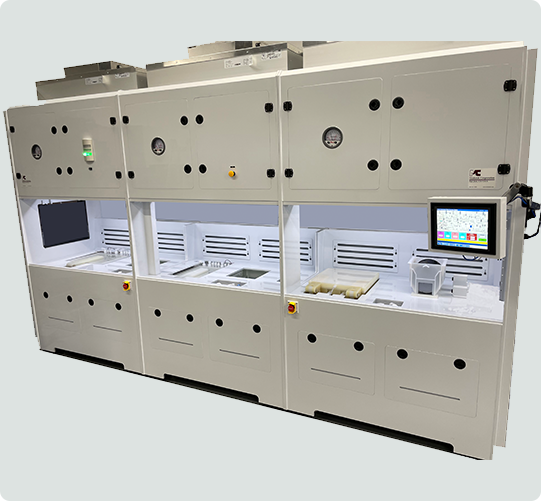
- Automated wet bench systems: Our fully automated wet bench systems are designed using SolidWorks Simulation Professional and SolidWorks Flow Simulation. These models predict process flow and chemical dosage before the system is built. Full automation suits high-throughput production and improves yield by removing operator variability. These systems handle all standard process sizes, from standard wafer carriers to glass substrates and large-format panels.
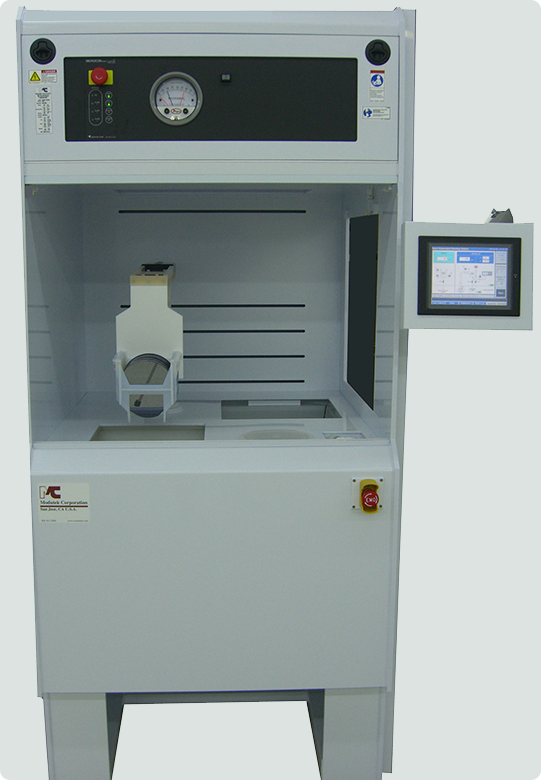
- Semi-automated wet bench systems: Our semi-automated systems are also available in various configurations to help with wafer processing. These stations offer more precision than a manual station without the higher costs of fully automated equipment. They use servo motor automation with encoder feedback for precise wafer positioning, and all robotic and software design is handled in-house.
- Manual wet process stations: Our manual wet process stations offer the same features as our automated systems without using robotics. This provides customers with low-cost equipment that is effective and configured to allow for future expansion, if necessary.
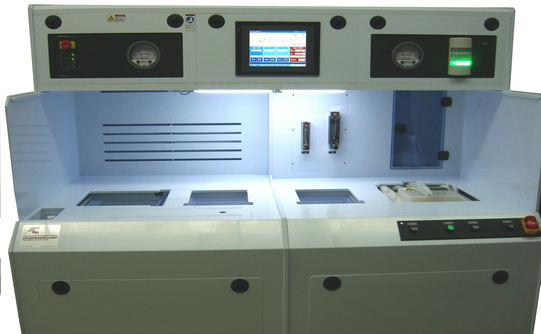
- Dry-to-Dry Wet Process: Our dry-to-dry wet benches incorporate our MVD Series IPA Dryer, which allows for drying without using a separate tool. This shortens the overall manufacturing process and improves yields. The IPA Dryer is also available for purchase as a stand-alone tool.
Equipment Designed to Meet Your Specific Requirements
FAQs About Wet Bench Equipment
Which Processes Run on a Wet Bench?
Wet benches are mainly used for etch, clean, and strip steps in front-end and back-end manufacturing. Modutek lists KOH etching, buffered oxide etch, hot phosphoric nitride etching, SC1 and SC2 cleaning with megasonics, and SPM (piranha) cleaning among the processes its automated benches run, and its semi-automated stations also list developing.
How Do You Choose Between Manual, Semi-Automated, and Automated Wet Benches?
Match the automation level to your volume and process control needs. Modutek recommends full automation for large production runs where consistency matters, semi-automated stations for batch processing or prototype development because operators can take manual control, and a manual bench for small, low-volume operations. Cassette transfer also matters, because manual versus automated handling affects both process efficiency and contamination risk.
Why Do Wet Benches Use FM 4910 Rated Materials?
FM 4910 is a fire performance standard from FM Global for cleanroom materials, and materials that pass show very low flame spread and smoke density. A fire in a process tool can contaminate production and cause major losses, and Modutek recommends using 4910-tested materials for wet benches or adding built-in fire detection and suppression. Modutek lists FM4910 construction as standard for acid and base processes, while its stainless steel solvent stations have fire suppression integrated into the design.
Which Safety and Compliance Options Can a Wet Bench Include?
Modutek’s automated, semi-automated, manual, and dry-to-dry benches are wired to NFPA 70 and 79 and include an emergency power-off with safety interlocks, a nitrogen head case purge, and exhaust on every process tank as standard. Listed options include HEPA fan filter units, fire suppression on automated and dry-to-dry benches, SEMI standard, CE mark, and NEC certification, third-party NFPA 70 and 79 certification, seismic zone 4 structural certification, and dedicated drains to a carboy with DOT containment. Availability varies by model, so confirm the options for your configuration.
How Does a Wet Bench Differ from a Single-Wafer Wet Processing Tool?
A wet bench is a batch tool that moves wafer cassettes through shared chemical baths, while a single-wafer tool treats one wafer at a time with programmable spray and rotation. Industry and vendor sources generally rate batch tools higher on throughput and single-wafer tools higher on wafer-level control, uniformity, and cross-contamination risk. Claims about chemical use differ by source and process, and batch wet benches have historically dominated front-end cleans such as nitride and oxide removal and resist strip, so the better choice depends on the process step.
Request a Quote for Your Wet Bench Equipment
Modutek designs and builds manual, semi-automated, automated, and dry-to-dry wet bench equipment at its San Jose facility to match your process. Share your chemistry, substrate size, throughput, and any safety or certification requirements, and the Modutek team will recommend the right configuration. Request a quote for your process.