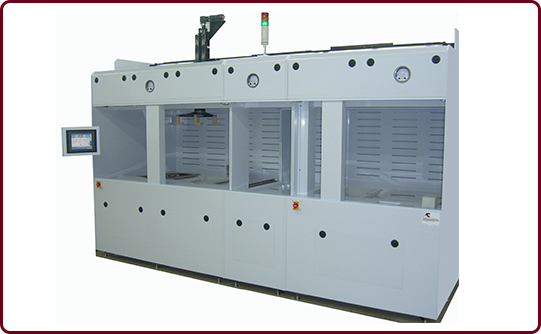
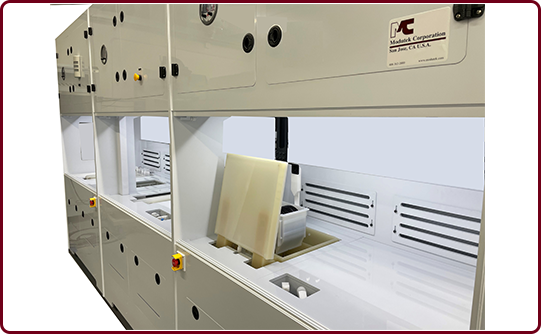
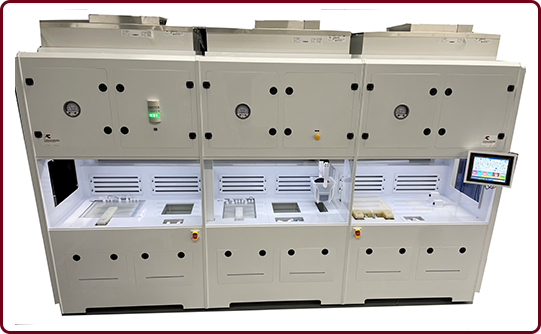
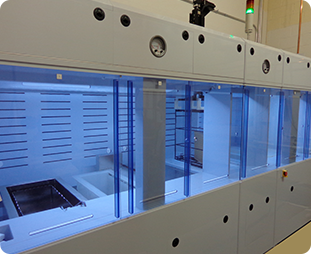
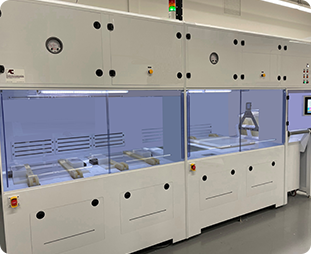
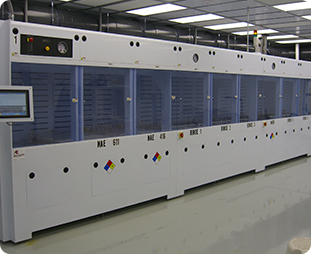
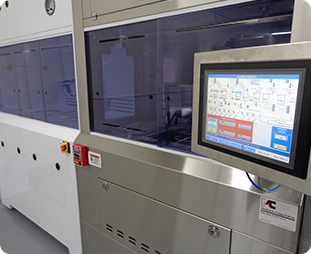
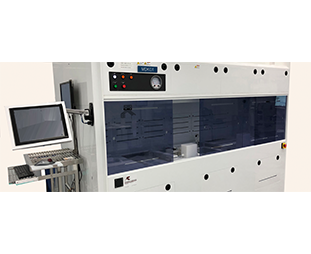
A fully automated wet bench system is a wet processing station that handles both wafer transfer and process sequencing through programmed recipes, with robotic handling executing each step automatically, without operator interaction between baths. A fully automated system is the right choice for high-throughput production environments where process repeatability, chemical-use accuracy, and the elimination of human error are the primary requirements.
Modutek’s automated wet bench systems are designed, assembled, and tested entirely in-house at the San Jose facility, with no outsourcing of robotic or software development. SolidWorks Simulation Professional and SolidWorks Flow Simulation are used to model process flow characteristics and calculate chemical dosage before manufacture. Systems handle both acid and solvent applications and accommodate all standard process sizes, from standard wafer carriers and glass substrates.
Modutek’s engineers work directly with each customer to configure wet bench systems around specific process requirements. As device geometries shrink and component densities increase, precise control over process timing and chemical dosage becomes critical for maintaining yield. Full automation removes operator variability from the equation, ensuring that each wafer batch moves through the process sequence under identical controlled conditions.
Chemical waste tracking is built into the system, reducing usage and ensuring correct dosage according to the specific application. SolidWorks Flow Simulation models the process environment before manufacturing.
Standard equipment modules and software are customized for wet-bench processing, etching, or cleaning applications. All software is written in-house by Modutek’s software engineers. All robotic equipment is designed, assembled, and tested at Modutek’s San Jose facility using deionized water before shipment. Final acceptance testing is available at the facility, with after-sales support provided as standard.


KOH etching requires tight temperature control and consistent immersion timing to produce repeatable anisotropic etch profiles in silicon wafers. Fully automated systems eliminate bath-to-bath transfer variability, making them well suited for production environments where KOH etch uniformity directly affects device yield.
The RCA clean sequence is a multi-step process that requires sequential immersion in SC1 and SC2 chemistries to remove particle, organic, and metallic contamination. Automated wet benches execute the full sequence under programmed recipe control, ensuring consistent dwell times, transfer intervals, and rinse cycles across every batch.
Ozone-based processes are used to remove organic contamination and prepare surfaces prior to gate oxide growth. Automated systems support both ozone cleaning and ozone etching workflows, maintaining the precise gas concentration and exposure timing required to achieve repeatable surface-conditioning results.
Sulfuric acid and hydrogen peroxide mixture (SPM) cleaning, also known as piranha etch, is used to remove photoresist and organic contamination from wafer surfaces. The aggressive chemistry involved makes automated handling preferable over manual operation, as programmed sequencing reduces operator exposure and ensures consistent process execution.
Buffered oxide etch uses a hydrofluoric acid-ammonium fluoride mixture to selectively remove silicon dioxide. Automated systems provide the consistent transfer timing and chemistry control required for repeatable BOE results across high-volume production batches.
Hot phosphoric acid etching is used to selectively remove silicon nitride layers in MEMS and semiconductor fabrication. The process requires precise temperature maintenance at elevated levels, typically above 150°C, and consistent immersion timing. Fully automated systems manage temperature regulation and transfer sequencing to maintain the process stability required for selective nitride removal.
Automated wet bench systems support a range of additional applications including precision parts cleaning, electroplating, and quartz tube cleaning. Each application can be configured into a programmed recipe sequence, allowing the same platform to serve multiple process types within a single facility.
Modutek’s automated wet bench systems are customized as needed to meet your specific process requirements.
A fully automated wet bench executes both wafer transfer and process sequencing through programmed recipes with no operator intervention required between steps. A semi-automated system automates wafer transfer using robotics but relies on the operator to manage process parameters directly. Full automation is the correct choice for high-throughput production environments where batch-to-batch repeatability and elimination of human error are the primary requirements.
Yes. All Modutek automated wet bench systems are tested at the San Jose facility using deionized water prior to shipment. Final acceptance testing with customer sign-off is available, and all robotic and software development is completed in-house, ensuring that any adjustments required during acceptance can be made directly by Modutek’s engineering team.