Modutek

Wet Bench Manufacturer | Wet Process Equipment | Modutek

Manual Wet Process Station

Home / Wet Benches / Manual Wet Processing Benches

Manual Wet Bench Stations for Semiconductor and Clean Room Applications

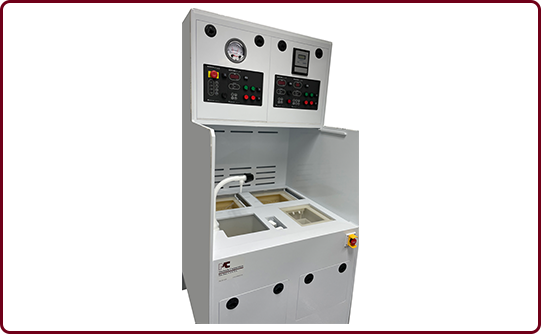
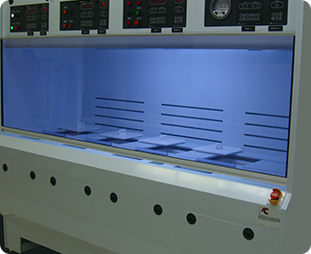
A manual wet process station is a chemically rated workstation that gives operators direct hands-on control over each step of a wet processing sequence, without the robotic handling systems used in automated or semi-automated wet benches. Manual stations are the correct choice for lower-throughput environments, prototype development, and process applications where operator-controlled sequencing is preferred over programmed automation.

Modutek’s manual wet process stations are available in FM4910 construction for acid and base applications and stainless steel for solvent processes. Each station includes the same process and safety features found on Modutek’s fully automated systems, including EPO interlocks, photohelic exhaust monitoring, and NFPA 70 and 79 wiring compliance, without the added cost of robotics. All stations are designed, assembled, and tested in-house at Modutek’s San Jose facility, with electrical and mechanical engineers signing off on drawings for every order.

Wet-Processing-Bench-3

Manual Wet Bench Stations for Clean Room Applications

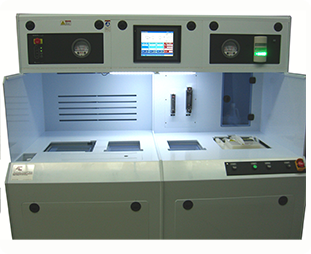
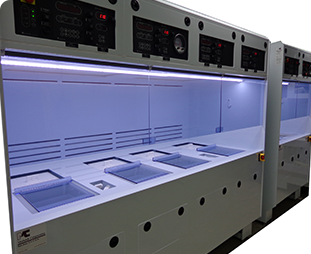
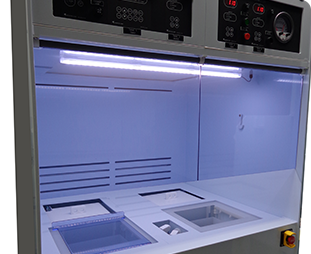
Modutek’s wet process manual stations are available in a wide variety of configurations and can be tailored to meet your requirements. Standard construction will support both acid and solvent applications. Our standard wet bench stations give you all of the process and safety features as our fully automated or semi-automated wet benches without the additional cost for robotics. Our electrical and mechanical engineers prepare sign off drawings for each wet bench station order. Our 40 plus years of continues business operation gives you the satisfaction you deserve. All process, etching or cleaning components are built and designed in-house giving you complete turnkey support.
Wet-Processing-Bench-3

Benefits

Features

Options

Applications

Benefits

Features

Options

Applications

Benefits

Benefits

Features

Features

Options

Options

Applications

Applications

Where Manual Wet Process Stations Are Used

KOH Etching and Anisotropic Silicon Etching

Potassium hydroxide (KOH) etching is an anisotropic process used to create precise geometric features in silicon wafers for MEMS and microelectronics applications. Manual wet bench stations are well suited for KOH etching in research and low-volume production settings, where operator control over immersion timing and temperature monitoring is more practical than full automation.

RCA Clean and SC1/SC2 Processes

The RCA clean sequence, comprising SC1 and SC2 chemical steps, is a standard wafer surface preparation process used before oxidation, diffusion, and deposition steps. Manual stations support RCA clean workflows in university labs and R&D environments where batch sizes are small and process flexibility is more important than automated throughput.

Buffered Oxide Etch

Buffered oxide etch (BOE) uses a hydrofluoric acid and ammonium fluoride mixture to selectively remove silicon dioxide from wafer surfaces. Manual wet bench stations are commonly used for BOE in prototype development and research applications, where precise operator control over etch time is critical and automated sequencing is not required.

Megasonic Cleaning

Megasonic cleaning uses high-frequency acoustic energy to remove sub-micron particles from wafer surfaces without mechanical contact. Plating processes deposit thin metal films onto wafer surfaces for interconnect and MEMS applications. Both processes are supported on Modutek manual stations, which can be configured with the necessary chemical baths, electrical connections, and containment options for each application.

Prototype Development

Manual wet bench stations are the standard choice for prototype development environments because they allow engineers to test and adjust process parameters directly without programming automated sequences. The low cost of ownership relative to automated systems makes them practical for facilities that run varied, low-volume process development work.

Modutek’s manaul Wet Processing Benches can be customized as needed to meet your specific wet process requirements.

FAQs About Manual Wet Process Stations

What Is the Difference Between a Manual and Semi-Automated Wet Bench?

A manual wet process station requires the operator to move wafers through each chemical bath by hand, with full control over timing and sequencing. A semi-automated wet bench uses robotics to handle wafer movement between baths while the operator manages process parameters. Manual stations are lower cost and more flexible for varied or low-volume work, while semi-automated systems are better suited for higher-throughput or repeatable process sequences.

Can a Manual Wet Bench Handle Both Acid and Solvent Processes?

Not within the same unit. Modutek manual stations are available in FM4910 material construction for acid and base chemistries or stainless steel construction for solvent applications. The two material types are specified separately because the chemical compatibility and safety requirements for solvents, including fire suppression and Nitrogen purge systems, are fundamentally different from those for acid processes.

What Does EPO Mean on a Wet Bench Station?

EPO stands for Emergency Power Off. It is a safety system that immediately cuts power to the station when a hazardous condition is detected. On Modutek manual stations, the EPO is triggered by a mushroom button and is interlocked with the photohelic exhaust gauge, so a drop in airflow automatically initiates a shutdown to prevent chemical vapor accumulation.

Are Manual Wet Bench Stations Compliant With Semiconductor Industry Standards?

Yes. Modutek manual wet process stations are wired per NFPA 70 and 79 as standard. Optional third-party certification is available for NFPA, SEMI standards, CE mark, NEC, and seismic zone 4 structural requirements for facilities with formal compliance mandates.