Modutek

Wet Bench Manufacturer | Wet Process Equipment | Modutek

Sub-Ambient Baths for Buffered Oxide Etch

Home / Wet Processing Equipment Components / Sub-Ambient Baths for Buffered Oxide Etch
A sub-ambient bath for buffered oxide etch (BOE) is a filtered, temperature-controlled tank that holds and continuously filters BOE etchant or positive resist developer below room temperature. This extends bath life and reduces acid consumption compared to an unfiltered, ambient-temperature tank. Because BOE and resist developer chemistry break down and consume acid faster at higher temperatures, running the bath sub-ambient with continuous filtration is what keeps the particulate count down and extends usable bath life.

F Series

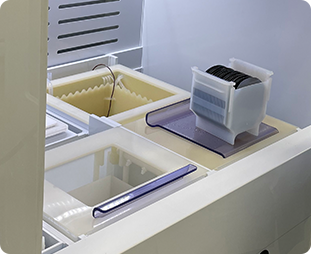
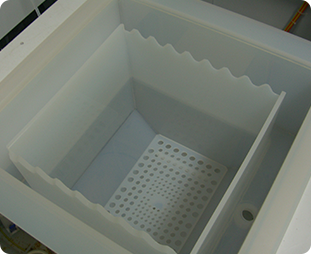
Filtered Sub-Ambient Circulation Bath for BOE Applications. The F SERIES sub-ambient filtered etch bath is our time-tested solution to providing continuous filtration while reducing acid consumption in your BOE (Buffered Oxide Etch) or positive resist development processes. We engineered a low cost of ownership into every detail of our filter etch bath, making it one of our most consistent performers. Our F-SERIES will significantly reduce acid consumption while providing continuous 10.0 to 0.2 micron filtration for reduced particulate count & improved yields. The two basic models available are the L & H versions, constructed of natural polypropylene or polyvinylidene fluoride (P.V.D.F), and will operate in the 10-40ºC and 10-80ºC range, respectively. Both models will maintain precise ±1ºC control, or 0.4ºC under certain conditions. Using our F SERIES in your BOE process will dramatically reduce acid consumption. Connecting our F SERIES with our RCe heat/chiller gives your BOE bath sub-ambient control. Several sizes are available to accommodate all wafer sizes. Numerous options will let you order an F SERIES bath to meet your process requirements.

Sub-Ambient-Baths-for-Buffered-Oxide-Etch

Benefits

Features

High flow pump *

Ultra Efficient Filtration

Semiconductor Grade Environment

Rugged Process Pump

Uniform Flow Return System

Excellent Temperature Control

User-Friendly Servicable Components

No Cost Extras

Options

Specifications

Construction Materials

  1. Pumps: Pneumatic or Electric (process driven to be determined later)
  2. Filter Housing: Will accept any 10” or 20” cartridge filter.
  3. N2 Purge Fitting: Creates a positive N2 atmosphere to protect the motor.
  4. All pump/filter assemblies are accessible for ease of maintenance
  5. Process tank: Fabricated Design
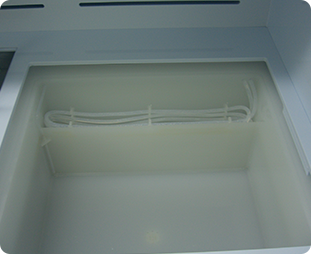
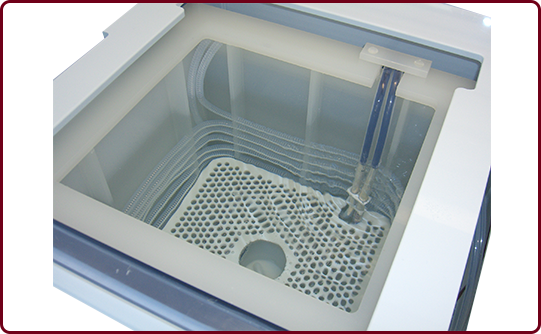
  6. Temperature Control Coils: For circulating temperature-controlled media (corrugated polypropylene or P.V.D.F. ).
  7. Flow Sensor: For determining filter loading (optional)
  8. Drain Valve: Pneumatically, remotely actuated (standard).
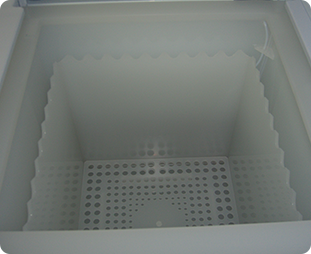
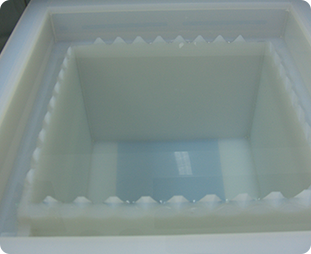
  9. Inner Process Tank: Isolated, with diffuser plate for uniform flow, 360º overflow for effective particulate removal.
  10. Process Thermocouple: From temperature control circulator, Teflon-encapsulated for long life.
  11. Process Cover: Clear P.V.C., retractable, hide-away.

Sub-Ambient BOE Bath FAQs

Request a Quote for Your Sub-Ambient BOE Bath

Modutek designs and builds its F Series sub-ambient baths in-house at its San Jose, California, facility, sizing the tank, filtration, and temperature range to the customer’s BOE or positive resist development process.

For help specifying an F Series bath and RCe heat/chiller pairing for your process, contact us, and a member of the Modutek team will follow up.

1.Why Does a BOE Bath Need Sub-Ambient Temperature Control?

Buffered oxide etch and positive resist developer chemistry react faster as temperature rises, increasing both etch rate and the rate at which the chemistry breaks down and needs replacement. Holding the bath below room temperature slows that breakdown, extending usable bath life and reducing how often acid must be replenished compared to running the same chemistry at ambient temperature.

2. What Is the Difference Between the F Series L and H Models?

The L model is built in natural polypropylene and covers a 10 to 40 degree Celsius range, while the H model is built in polyvinylidene fluoride (PVDF) and covers a wider 10 to 80 degree Celsius range. The switch from polypropylene to PVDF lets the H model run at the higher end of that range without degrading, so the choice between models comes down to the temperature the process actually requires.

3. Why Is Continuous Filtration Important for BOE and Resist Developer Baths?

Particles suspended in the etch or developer chemistry can redeposit on the wafer surface during processing, contributing to defects and yield loss. Continuous filtration down to 0.2 microns, rather than filtering only on a schedule or not at all, keeps particle counts low throughout the entire time wafers are in the bath, not just at the start of a batch.

4.What Does Connecting an F-Series Bath to an RCE Heat/Chiller Add?

The F Series bath itself handles filtration and holds the process chemistry, but sub-ambient cooling comes from pairing it with Modutek’s RCe heat/chiller. The chiller supplies the temperature control circulating through the bath’s temperature-control coils, which lets the F Series reach and hold temperatures below ambient rather than just above it.

5. How Does Filter Loading Get Detected During Operation?

The F Series includes a digital flowmeter and an adjustable alarm that triggers based on flow rate, so a drop in flow caused by a loading or plugging filter is flagged before it affects process consistency rather than being caught only during a scheduled inspection.