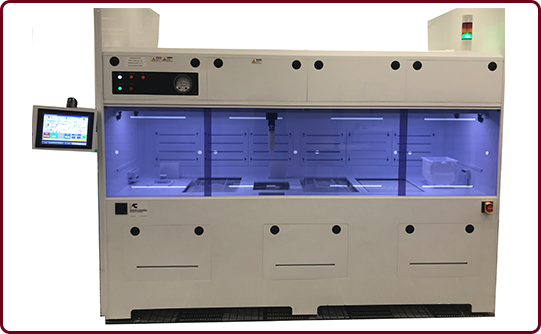
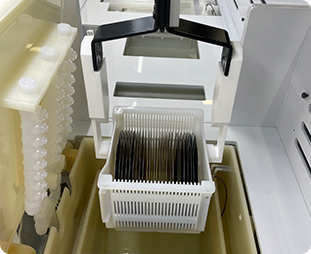
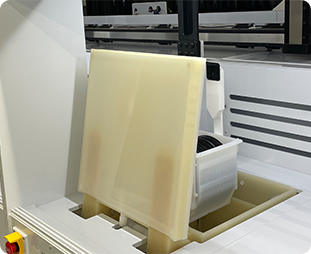
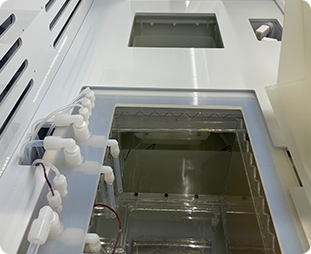
A dry-to-wet process moves a wafer through its wet process steps, such as etching, cleaning, and rinsing, and returns it fully dried and ready for the next step, with no separate drying tool required. The name describes the wafer’s state. It enters the system dry and leaves dry. Removing the transfer to a standalone dryer reduces handling time and particle exposure between steps, improving both throughput and yield.
Modutek builds dry-to-dry process equipment for acid, base, etching, and cleaning applications in cleanroom fabs. Each system integrates an MVD Series IPA vapor dryer directly into the process station, so the wafer is dried in place. Systems are designed, assembled, and tested in-house in San Jose, California, and handle substrate sizes from standard wafer carriers up to 30 x 60-inch glass solar panels.
All robotic equipment in Modutek’s dry-to-dry equipment is designed, assembled, and tested at our San Jose, CA facility. We do not outsource or subcontract our robotic design. Final acceptance testing at Modutek is always available. All testing is performed using DI water.
Modutek’s Dry to Dry process equipment like our Fully Automated Equipment is available in a wide verity of configurations for your wet process requirements. We work with your engineering team to design the best wet processing / etching or cleaning equipment for your application. We handle all process sizes from standard wafer carriers, glass substrates to 30” x 60” glass solar panels. All wet process, etching or cleaning components are built and designed in-house giving you complete turnkey support. Our dry to dry process station utilizes our MVD Series IPA Dryer. This feature allows you continue to the next process step without having to dry in a separate drying tool. Eliminating transfer time is one very quick way to improve throughput and yield. Our SolidWorks Simulation Professional and SolidWorks Flow Simulation give you the process flow characteristic you require. This advanced software will improve your etch rates and throughput and also increases your yields. All robotic equipment is designed, assembled and tested at our San Jose, CA. We do not outsource or subcontract our robotic design. Final acceptance testing at Modutek is always available. All testing is performed using DI water.


A standard wet bench finishes with the wafer wet, requiring a separate drying tool before the next step. A dry-to-dry wet process completes drying within the same system using an
integrated IPA vapor dryer, so the wafer is ready to move directly to the next process without transfer to a standalone dryer.
Every transfer between tools is an opportunity for particles to land on the wafer surface. By drying the wafer in place, a dry-to-dry system eliminates one transfer step, reducing particle exposure and helping protect yield in contamination-sensitive processes.
Yes. Because each system is custom-built, tank materials, chemical handling, exhaust, and process controls are configured for the specific chemistries a fab runs, including acids, bases, etchants, and cleaning solutions. A single system can support several process recipes.

Modutek builds systems for a wide range of substrate sizes, from standard wafer carriers up to 30 x 60-inch glass solar panels. The process station, carriers, and tank dimensions are sized to the substrate during the design stage.
Modutek Corporation designs and builds custom dry-to-wet process systems for semiconductor and solar fabrication. Every system is configured for your substrate sizes, chemistries, and throughput requirements, then assembled and tested in-house in San Jose, California. To discuss your process needs or request a quote, contact Modutek.