
TMAH etching is a wet process that removes silicon with tetramethylammonium hydroxide (TMAH), an organic, metal-ion-free alkaline solution. Run at about 70 to 90°C, it etches {100} planes quickly and {111} planes very slowly, so it cuts trenches, cavities, and membranes with sidewalls at 54.74° to the wafer surface. Because it adds no potassium or sodium, it is the usual choice for wafers with CMOS circuitry.
This guide covers how the chemistry works, which process variables decide the result, how a TMAH etch fits into a wet bench workflow, and what equipment keeps it repeatable. It is written for process engineers who run production wet benches and for R&D teams designing new etch steps. Modutek, which has designed and built wet process equipment since 1980, builds PFA Teflon etch tanks for both KOH and TMAH processes.
Table of contents
- What Is TMAH Etching and Why Is It Used for Anisotropic Silicon Etching?
- TMAH Etching Chemistry and the Silicon Etching Reaction Mechanism
- Key Process Variables That Affect TMAH Etch Results in Anisotropic Wet Etching
- Practical Application of TMAH Etching in a Wet Process Environment
- Equipment Needed to Support a TMAH Wet Etch Process and How Modutek Delivers It
- TMAH Etching FAQs
- Sources
What Is TMAH Etching and Why Is It Used for Anisotropic Silicon Etching?
TMAH etching dissolves silicon in a hot, water-based bath of tetramethylammonium hydroxide. TMAH is a widely used anisotropic silicon etchant, which means it does not remove material equally in every direction. Silicon is a crystal, and its atoms are packed more tightly on some planes than others. TMAH attacks the open {100} and {110} planes far faster than the dense {111} planes.
On a (100) wafer, that difference shapes the result. The slow {111} planes become the sidewalls of the etched feature, and they meet the surface at 54.74°, as Figure 1 shows. The outcome is V-grooves, pyramidal pits, and flat-bottomed cavities with predictable geometry. For a wider comparison of directional and non-directional etching, see Modutek’s guide to isotropic and anisotropic silicon wet etching processes.
TMAH etching at a glance
- Typical bath:5 to 25 wt% TMAH at 70 to 90°C, the window most published recipes use
- Best known for:74° sidewalls on (100) silicon, so feature geometry can be designed in from the mask layout
- Watch for:hillocks in weak baths and attack on exposed aluminum, both manageable with the right bath recipe
Safety: toxic through skin contact, with fatalities reported at 4 to 25 wt%, so treat any skin contact as a medical emergency
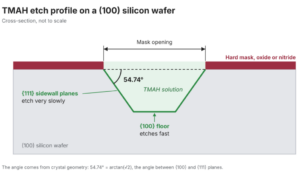
Figure 1. TMAH etch profile on a (100) silicon wafer, with {111} sidewalls at 54.74°.
Engineers usually weigh TMAH against potassium hydroxide, the other common anisotropic etchant. KOH etching is faster and more strongly directional, but it can leave mobile potassium ions in oxides, which rules it out for wafers with active CMOS circuitry. TMAH has no alkali metal ions, so it suits CMOS-compatible work, at the cost of a slower etch and a higher chemical price. Table 1 compares the two.
Table 1. TMAH and KOH compared for anisotropic silicon etching
| Factor | TMAH | KOH |
| Alkali metal ions | None, CMOS compatible | Potassium can contaminate devices |
| (100) etch rate | Moderate, about 0.6 µm/min (20 wt%, 80°C) | High, about 1.4 µm/min (20 wt%, 80°C) |
| Anisotropy, (100) to (111) | High, about 37:1 (20 wt%, 80°C) | Highest, up to several hundred to one |
| Silicon dioxide mask | Very low etch rate, thin oxide works | Etched faster, needs thicker oxide |
| Exposed aluminum | Attacked unless the bath is modified | Attacked quickly |
| Relative chemical cost | Higher | Lower |
Typical published figures. Exact values shift with concentration, temperature, and additives.
2. TMAH Etching Chemistry and the Silicon Etching Reaction Mechanism
Silicon etching in TMAH is a hydroxide-driven reaction. TMAH dissociates in water, and the hydroxide ions attack the silicon-silicon bonds at the wafer surface. The silicon converts to soluble silicate species, and hydrogen gas is released. TMAH follows the same basic mechanism as KOH, without the metal ion.
Two settings dominate the rate. Etch rate rises with temperature, and across the usual 5 to 25 wt% range it falls as TMAH concentration rises. Tabata (2001) measured a (100) rate of about 1.0 µm/min in 22 wt% TMAH at 90°C.
Additives tune surface finish, with mixed published results. In a silicon-loaded 25 wt% bath, isopropyl alcohol (IPA) had little effect on hillocks (Sarro et al.). Triton X-100 above about 100 ppb changes the etch rate and roughness of {110} surfaces and the undercutting at convex mask corners (Microsystem Technologies, 2017). Treat any additive as a recipe change that needs its own qualification.
Byproducts matter at the bench. Hydrogen bubbles form on the wafer as silicon dissolves, and bubbles that cling to the surface act as micro-masks and seed hillocks, which is one reason agitation matters. Dissolved silicon also builds up in the bath as wafers are processed, lowering the bath’s pH and changing its etch behavior.
3. Key Process Variables That Affect TMAH Etch Results in Anisotropic Wet Etching
Anisotropic wet etching is predictable only when bath conditions stay fixed. Table 2 summarizes the variables that move the result, and the sections below cover the ones that cause the most trouble.
Table 2. Variables that move a TMAH etch result
| Variable | Effect in TMAH etching | What to control |
| Concentration (5 to 25 wt%) | Higher concentration slows the (100) etch and smooths the surface, while weak baths etch faster and form hillocks | Hold concentration steady for the whole run |
| Temperature (70 to 90°C) | Higher temperature speeds the silicon etch and also speeds the attack on masks | Keep the bath at set point |
| Dissolved silicon and pH | Protects exposed aluminum but lowers the (100) etch rate, and hillocks increase if pH falls too far | Qualify the recipe on test wafers |
| Additives | IPA and surfactants can change surface finish and corner undercutting, with mixed results | Treat each one as a recipe change |
| Mask material | Oxide and nitride hold up, photoresist does not | Match mask thickness to etch depth |
3.1 Etch Rate and Anisotropy Control Through Concentration and Bath Temperature
A hotter bath etches faster but also attacks the mask faster, and a stronger bath etches more slowly but leaves a smoother surface. Most production recipes settle at 20 to 25 wt% and 80 to 90°C, which gives about 0.6 to 1.0 µm/min with a smooth floor.
3.2 Etch Selectivity and Compatible Mask Materials
Thermal silicon dioxide and LPCVD silicon nitride are the standard masks. Silicon dioxide etches at roughly 0.2 nm/min, almost four orders of magnitude slower than silicon, and silicon nitride etches at a negligible rate, so thin films survive long etches. Denser furnace films outlast PECVD films, which are usable but etch faster.
3.3 Sidewall Angle, Undercut, and Surface Roughness
The 54.74° sidewall comes from crystal geometry, so it holds regardless of recipe when the mask is aligned to the crystal planes. The recipe decides the rest. Convex mask corners undercut, and weak baths grow hillocks.
3.4 Aluminum and CMOS Compatibility for Mixed-Process Wafers
TMAH is CMOS compatible because it adds no alkali metal ions. That does not make it gentle on metal, because plain TMAH attacks exposed aluminum. Dissolving silicon into the bath, or lowering its pH with a buffer, can suppress that attack, but both change the etch behavior. Run aluminum-bearing wafers only with a recipe qualified for them, and see the FAQ below for typical numbers.
3.5 Repeatability and Process Control for Data-Trackable Results
A repeatable etch needs a bath that holds temperature and concentration for the whole run. Record bath temperature, concentration or replenishment, etch time, and measured depth for every lot. Because dissolved silicon changes the bath as wafers pass through, also track wafers per bath and refresh it on a schedule your own data supports.
4. Practical Application of TMAH Etching in a Wet Process Environment
TMAH etching shows up wherever a fab or lab needs controlled, angled cuts in silicon without metal-ion contamination. Most work falls into three groups.
4.1 Common Applications
- Membranes and diaphragms:thickness set by etch time or a boron-doped etch stop, for MEMS pressure and other sensors
- Cavities, trenches, and V-grooves:the crystal fixes the sidewall angle, so dimensions are predictable from the mask
- Post-CMOS micromachining:releases MEMS structures on finished CMOS wafers without alkali contamination
4.2 A Typical Wet Bench Workflow
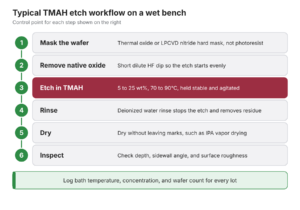
Figure 2 shows the usual sequence on a wet bench. Bath preparation comes first, because the bath must reach its set temperature and concentration before any wafer goes in. A short, dilute HF dip then removes the native oxide, so the etch starts evenly. Wafers etch in an agitated, temperature-controlled bath, move to a deionized water rinse to stop the etch and remove residue, and finish with a dry step. Depth, sidewall angle, and roughness checks after drying feed the data you record. This sequence sits within Modutek’s broader wafer etching process capabilities.
4.3 Handling TMAH Safely
TMAH needs more respect than its routine use suggests. The tetramethylammonium ion is absorbed through the skin and can affect nerves and muscles, and skin contact with TMAH solutions has caused deaths, with reported cases at concentrations from 4 to 25 wt%. Handle it with the same seriousness as hydrofluoric acid, and treat any skin contact as a medical emergency, even after prompt rinsing. Use splash-proof protective equipment, never work alone, keep emergency showers close, and follow your facility’s safety data sheet and EHS procedures, which govern the actual handling steps. This article gives general awareness only.
5. Equipment Needed to Support a TMAH Wet Etch Process and How Modutek Delivers It
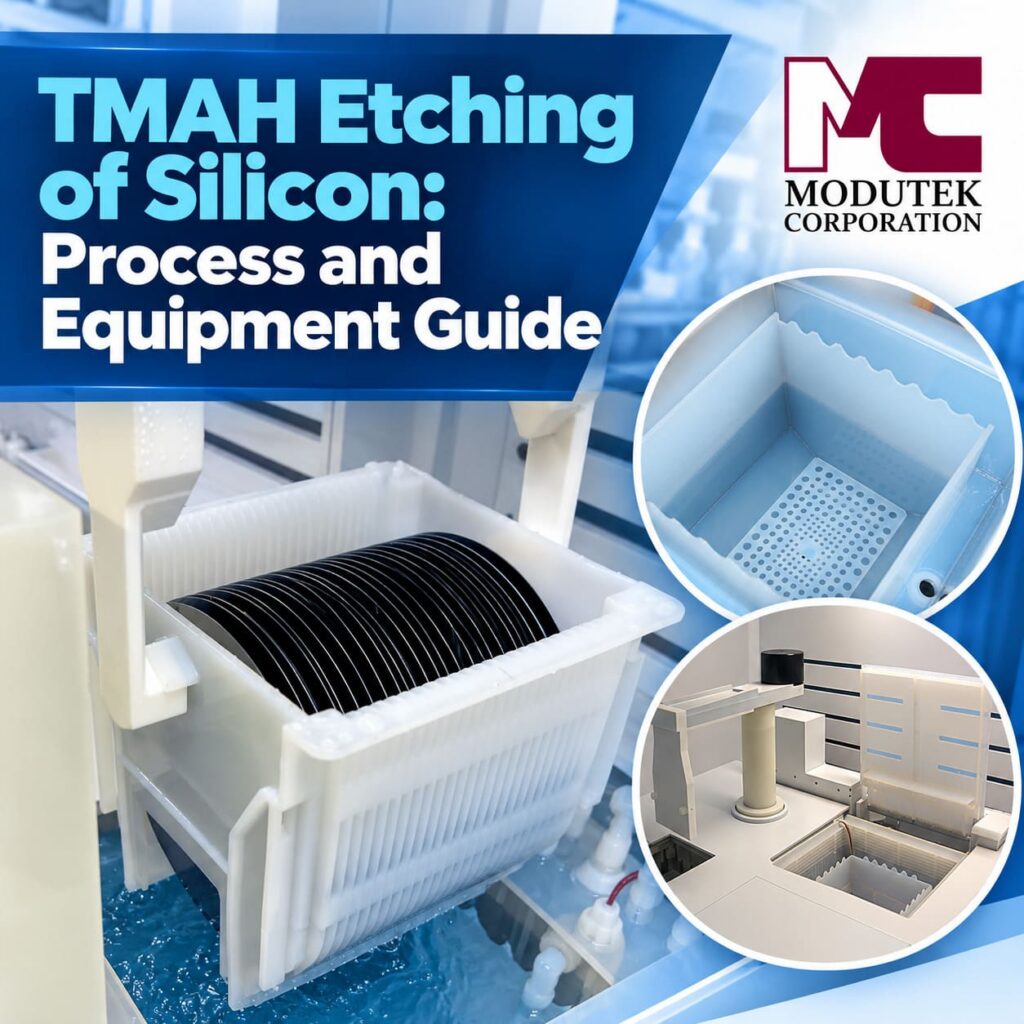
A TMAH etch is only as repeatable as the station that runs it. Figure 3 shows the main elements, and Table 3 lists what each one does for the process and what Modutek builds.
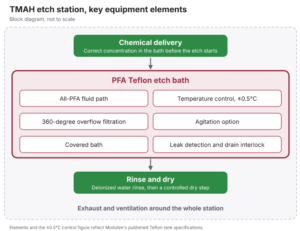
Figure 3. Key equipment elements of a TMAH etch station.
Table 3. What a TMAH etch station needs and what Modutek builds
| Requirement | Why it matters for TMAH | What Modutek builds |
| PFA Teflon tank | Resists the hot alkaline solution and adds no contamination | TFa recirculating and TI static PFA Teflon tanks, built to customer specification |
| Temperature control | Etch rate rises with temperature, so the bath must hold set point | 30 to 100°C operating range, ±0.5°C control, 2 to 3°C per minute heat-up depending on system size |
| Concentration stability | Evaporation at 80 to 90°C raises concentration and shifts the etch rate | Water-condensing refluxor option on all baths, plus DI water spiking |
| Filtration | Keeps the solution clean and uniform | 360-degree overflow filtration |
| Agitation | Gives every part of the wafer even exposure | Magnetic stirrer option on TI and TT series tanks |
| Safety features | TMAH is toxic and the bath runs hot | Cover with overlapping seal, leak detection, level and temperature limits, and a drain interlock |
| Process uniformity | Every wafer in the lot should reach the same depth | Published wafer-to-wafer etch uniformity under 2% |
Modutek builds its Teflon tanks built for TMAH etching in-house at its San Jose facility, to each customer’s specifications. A chemical delivery system brings each bath to the correct concentration before the etch starts, and the full tank specifications are on the PFA Teflon tanks page.
Modutek has designed and built wet process equipment since 1980, and every wet bench system is checked with deionized water before delivery, with factory acceptance testing available before shipment. For process engineers, that means stable bath conditions, lower contamination risk, and support that covers on-site startup, operator training, preventive maintenance, and remote diagnostics. For R&D teams, tanks can be built to any size, with options such as magnetic stirring, a refluxor, an automatic lid, and DI water or IPA spiking, so one platform can adapt as experiments change.
If you are scoping TMAH etching or other silicon etching on a wet bench, start with selecting the right silicon wet etching equipment, then contact Modutek for a free consultation on your process and chemical-compatibility requirements.
6. TMAH Etching FAQs
1. Can Photoresist Be Used as a Mask for TMAH Etching?
No. Hot alkaline solutions attack even cross-linked photoresist, so it degrades in the bath and cannot hold a pattern through the etch. Use a hard mask instead, and match its thickness to the etch depth, since mask etch rates rise with temperature.
2. Why Do Hillocks Form During TMAH Etching?
Hillocks are small pyramids bounded by {111} planes. They are densest in weak baths around 5 wt% and fade as concentration rises, with very smooth surfaces above about 22 wt%. Hillocks also increase when heavy silicon loading or a buffer lowers the bath pH, and Sarro et al. saw many hillocks in silicon-saturated baths near pH 12. Hydrogen bubbles that cling to the surface are a common trigger, so agitation helps.
H3. How Can a TMAH Bath Be Modified to Protect Exposed Aluminum?
Dissolving silicon into the bath is the most common route. Published studies report aluminum etch rates falling to negligible levels at roughly 90 to 120 g/L of dissolved silicon in 22 to 25 wt% TMAH at 70 to 90°C. Some recipes add a pH-lowering buffer or an oxidizer such as ammonium persulfate alongside the silicon. Each change shifts the silicon etch rate and surface finish, so qualify the recipe on test wafers before running product.
4. Does Heavily Boron-Doped Silicon Stop a TMAH Etch?
Heavily boron-doped silicon etches far more slowly than lightly doped silicon, so a boron-doped layer can work as an etch stop. Alkaline etchants generally slow sharply above about 10¹⁹ boron atoms/cm³, but the exact level depends on the etchant and recipe, so confirm it on your process before relying on it.
5. Is TMAH Used for Etching the Same as TMAH in Photoresist Developer?
It is the same chemical at a very different strength. Developers typically run near 2.38 wt% TMAH, while etch baths run 5 to 25 wt%. Skin contact is hazardous at both strengths, and fatal exposures have been reported at concentrations from 4 to 25 wt%.
Sources
- Tabata, “Anisotropic Etching of Silicon in TMAH Solutions,” Sensors and Materials 13(5), 2001
- Sarro et al., TMAH silicon etching with Al passivation, Sensors and Materials 10(4), 1998
- IIT Hyderabad, “Silicon micromachining in 25 wt% TMAH without and with surfactant concentrations ranging from ppb to ppm,” Microsystem Technologies 23(1), 2017
- Garra et al., dual-doped TMAH for aluminum-compatible etching, Sensors and Materials, 2001
- University of Pennsylvania, Wet-Chemical Etching and Cleaning of Silicon (etch-rate compilation)
- MicroChemicals, Silicon Etching application note
- Rogue Valley Microdevices, TMAH vs. KOH Silicon Etch
- BG RCI, Fatalities caused by skin contact with tetramethylammonium hydroxide
- Review of dermal TMAH exposure cases, BMC Pharmacology and Toxicology, 2020
- University of Waterloo QNFCF, TMAH toxicity findings (citing a Berkeley safety bulletin)