
The total cost of ownership of a wet bench rarely shows up on the quote you get from a vendor. Purchase price is the number procurement budgets against, but it’s only the opening figure in a much longer-running total that includes installation, chemicals, energy, maintenance, and the downtime a facility absorbs when a system underperforms. Two wet benches that look nearly identical on a spec sheet and cost about the same to buy can diverge sharply in what they actually cost to run over a five- to ten-year service life. This guide breaks that real cost down by category: upfront capital and installation, ongoing chemicals and utilities, maintenance and downtime, and how automation level and equipment lifespan shift the number, then gives a framework for comparing vendor quotes on that basis instead of the sticker price alone. It’s written for the buyers actually evaluating wet bench systems, process engineers, facilities managers, and procurement leads comparing quotes side by side.
Table of Contents
- What Total Cost of Ownership Means for a Wet Bench
- The Capital and Installation Costs Buyers See Upfront
- The Operating Costs Buyers Often Underestimate
- How Automation Level and Equipment Life Span Change the TCO Calculation
- A Practical Framework for Comparing TCO Across Vendors
- When the Lowest Quote Isn’t the Lowest Total Cost
- Building a Wet Bench Investment That Pays Off Over Its Full Life
- Frequently Asked Questions
1. What Total Cost of Ownership Means for a Wet Bench
Total cost of ownership covers every cost a piece of capital equipment generates across its working life, not just the number on the invoice. For a wet bench, that means the purchase price, installation and facility integration, chemicals and consumables, energy and utilities, maintenance and service, and the cost of downtime all compound over a service life that typically runs seven to ten years or longer. Comparing two vendors on quote price alone is exactly how a buyer ends up with a station that costs less to purchase and more to own. The table below breaks total cost of ownership into the categories worth asking about before you sign a purchase order: what each one typically includes and what tends to drive it up or down.
| Cost Category | What It Includes | What Drives It Up or Down |
| Purchase Price and Configuration | Base unit, tank count and material, automation level, chemical delivery, and process controls | Automation level, customization, number of process modules |
| Installation and Facility Integration | Rigging, exhaust, plumbing, electrical tie-in, cleanroom compatibility, applicable compliance, and certification costs | Site readiness, existing infrastructure, certification requirements |
| Chemicals and Consumables | Etchants, cleaning chemistries, DI water, rinse cycles | Bath design, recirculation and filtration efficiency, process recipe |
| Energy and Utilities | Heating, recirculation, exhaust, DI water systems | Automation level, bath design, duty cycle |
| Maintenance and Service Plans | Scheduled maintenance, spare parts, service contract terms | Service plan structure, parts lead time, vendor responsiveness |
| Downtime and Lifecycle | Lost production time, delayed lots, early replacement | Equipment reliability, spare parts availability, upgrade path |
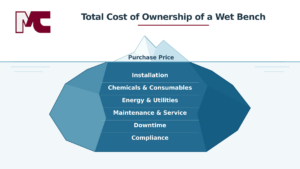
Figure 1. Where the total cost of ownership of a wet bench actually accumulates over its service life, purchase price above the line, the higher recurring costs below it.
2. The Capital and Installation Costs Buyers See Upfront
Purchase price and installation are the two costs procurement typically budgets for first, since both show up before a wet bench ever runs a wafer. They’re also the two costs that vary more from quote to quote than most buyers expect, driven less by the base unit than by configuration choices and site conditions that don’t always make it onto a first-pass estimate. Both are worth understanding in enough detail to compare quotes apples to apples.
Purchase Price and Configuration
Wet bench pricing depends far more on configuration than most first-time buyers expect. The biggest drivers are:
- Automation level(manual, semi-automated, or fully automated), usually the single biggest driver of purchase price
- Tank count and material
- Chemical delivery and process control systemsspecified
- Overall degree of customizationbuilt into the station
Modutek is a custom-quote manufacturer, so this article covers cost structure and what drives it, not published prices. There isn’t a standard number to quote because there isn’t a standard configuration. Two quotes that look close on price can represent very different systems once automation level and chemical delivery are actually matched, which is why comparing the configuration behind the number matters as much as the number itself. Modutek builds both automated wet bench systems and semi-automated systems.
Installation and Facility Integration
Installation is the upfront cost buyers most often underestimate. Exhaust, plumbing, electrical tie-in, and cleanroom compatibility all have to be assessed against the specific site the equipment is going into, not a generic facility, and rigging and setup add to that figure before the system ever processes a wafer. Certification requirements, such as UL, NFPA, or SEMI compliance where applicable, can add further cost and lead time during commissioning depending on the facility and jurisdiction. None of this is fixed across projects, which is why a site assessment ahead of a formal quote and access to custom fabrication when a standard configuration doesn’t fit the space produces a more accurate installed cost than a base unit price alone.
3. The Operating Costs Buyers Often Underestimate
Operating costs, not the purchase price, are usually where total cost of ownership actually diverges between two systems that look similar on a spec sheet. A wet bench that costs slightly more to buy can cost meaningfully less to run, and the reverse holds just as often. The three categories below, chemicals and consumables, energy and utilities, and maintenance, service plans, and downtime, are where that difference tends to show up first and where it compounds fastest over a multi-year service life.
Chemicals and Consumables
Chemical consumption is the largest recurring operating cost for most wet processes, and it scales with more than just throughput. Bath design, recirculation and filtration efficiency, and the specific process recipe all affect how much etchant, cleaning chemistry, and DI water a system consumes over a run and over a year. A wet bench engineered for chemical efficiency, tighter recirculation, better filtration, and well-matched bath geometry can meaningfully lower this line item across the equipment’s service life, even when the base unit costs the same to purchase as a less efficient alternative. The chemical delivery system specified with the bench has a direct effect on this number, and it’s worth evaluating alongside the tank and bath configuration, not as an afterthought.
Energy and Utility Demand
Energy and utility demand rarely shows up on a vendor quote, but it’s a real, ongoing cost. Heating, recirculation pumps, exhaust systems, and DI water all draw utility costs continuously, and both automation level and bath design affect how much. A facilities team sizing utility budgets across a fab benefits from asking about this directly rather than assuming it’s negligible simply because it isn’t itemized. It’s a smaller line item than chemicals for most processes, but it adds up over years of operation.
Maintenance, Service Plans, and Downtime
Scheduled maintenance, spare parts availability, and service plan structure affect two numbers at once: the direct maintenance line item and how much unplanned downtime a facility should expect to absorb. Downtime is a real cost even when no invoice gets issued for it. A production line waiting on a part, or a lot sitting idle because a bath is down, carries a cost in lost throughput and delayed shipments, whether or not that cost appears on a balance sheet. That’s why service plan terms and spare-parts lead time belong in a total cost of ownership comparison alongside the maintenance contract price itself, not as an afterthought once the equipment is already installed. Modutek’s field service and equipment repair teams are worth asking a prospective vendor to match on response time and parts availability, not just contract price.
4. How Automation Level and Equipment Life Span Change the TCO Calculation
Two decisions a buyer actually controls shift the total cost of ownership of a wet bench more than any other factor: automation level, chosen at purchase, and how the equipment is maintained and upgraded afterward. Both are covered in more depth elsewhere: in Modutek’s comparison of automated and semi-automated systems and in the context of service and upgrade planning, but both belong in a TCO discussion because of how directly they affect the categories above.
Automation Level and Long-Term Cost
Automation level affects nearly every operating cost category above. Automated systems typically have a higher purchase price but lower labor costs and higher throughput over time, which can offset the higher upfront cost within a few years, depending on production volume. Semi-automated systems cost less to purchase and suit lower-volume operations better, trading some throughput and labor efficiency for a smaller initial investment. Which option has a lower total cost of ownership depends on production volume and labor cost at the specific facility, not a fixed rule, so it’s worth working through with real throughput numbers rather than assuming automation always wins over a long enough timeline. Modutek’s comparison of automated and semi-automated wet bench systems covers that decision in more depth.
Equipment Life Span and Upgrades
A wet bench’s effective total cost of ownership isn’t fixed at purchase. Upgrade paths, spare parts availability, and service plan continuity all extend usable service life, and a system that can be upgraded rather than replaced spreads its original capital cost over more years of production. That lowers the effective cost per year of ownership even when nothing about the original purchase price changes. Buyers evaluating TCO upfront should ask what a vendor’s upgrade path actually looks like five or ten years out, not just what the system costs to install today. Modutek’s wet bench upgrade service is built around exactly that, extending the working life of an existing system rather than requiring a full replacement.
5. A Practical Framework for Comparing TCO Across Vendors
None of this is useful without a way to actually apply it to a real vendor comparison. Rather than a formula or a calculator, which depends on process specifics a vendor needs to assess directly, the more reliable approach is a short list of questions asked consistently across every quote:
- What’s actually included in the installed price, and what counts as a separate line item
- What chemical and utility consumptionto expect at the buyer’s real throughput, not a generic figure
- What the service plan covers, and what its response time actually is when something goes down
- What spare parts lead timelooks like in practice, not just on paper
- What upgrade pathsexist for the specific configuration being quoted
Asking the same five questions of every vendor turns a stack of quotes that look different on the surface into a genuine side-by-side comparison.
6. When the Lowest Quote Isn’t the Lowest Total Cost
A lower purchase price that comes with higher chemical consumption, more downtime, or a thinner service plan is often the more expensive system by year three or four, even though it looked like the better deal on day one. This is the mistake a line-item comparison makes easy to fall into, and the total cost of ownership of a wet bench is exactly the number that catches it. A buyer who only compares quotes on price is comparing the wrong number, and the gap tends to show up quietly, in an unplanned service call, a chemical bill that runs higher than expected, or a bath that needs replacing sooner than planned, rather than in anything that would have shown up on the original purchase order. Modutek’s guide to evaluating a wet bench manufacturer covers the vendor side of this same decision in more depth.
7. Building a Wet Bench Investment That Pays Off Over Its Full Life
The total cost of ownership of a wet bench is set by far more than the number on a quote. Purchase price, installation, chemicals, energy, maintenance, and downtime all compound over a service life measured in years, and a system engineered for chemical efficiency, uptime, and a real upgrade path costs less to own even when it doesn’t cost less to buy. Modutek designs, builds, and supports its wet bench systems in-house and can walk a buyer through the real cost structure for their specific process before a quote gets signed, not after. For a broader view of how to get more from a wet process line, including throughput and automation ROI, see Modutek’s wet processing efficiency guide. If you’re evaluating a new wet bench purchase, contact Modutek to talk through the total cost of ownership of a wet bench for your actual process requirements, not just the number on a spec sheet.
8. Frequently Asked Questions
How Is Total Cost of Ownership Calculated for Capital Equipment Like a Wet Bench?
There’s no single formula that applies across every facility, because the categories that matter (chemical consumption, utility draw, labor, service response time) carry different weight depending on production volume and process. The more reliable approach is tracking actual cost by category over a defined period, typically a full year of operation, then comparing that run rate against the original purchase price to see how quickly operating costs catch up to or exceed the capital cost.
Does a Lower Priced Wet Bench Always Cost Less Over Time?
No. A lower purchase price commonly reflects a system with fewer efficiency features built in, which usually means higher chemical or utility consumption, less automation, or a thinner service plan. Whether that trade-off actually costs more over time depends on production volume and how long the facility plans to run the equipment; a lower-volume operation may never reach the point where the more expensive system pays for itself.
What Is the Typical Service Life of a Semiconductor Wet Bench?
Most wet benches are specified for a service life of seven to ten years, though well-maintained systems with an active upgrade path frequently run longer. Actual service life depends heavily on maintenance discipline, chemical compatibility of wetted materials, and whether the system receives upgrades as process requirements change, rather than being replaced outright.
Can Upgrading an Existing Wet Bench Lower Total Cost of Ownership Compared to Buying New?
Often, yes, particularly when the existing tank structure and framework are still sound, and the upgrade addresses a specific bottleneck (automation, chemical delivery, or process control) rather than the whole system. An upgrade avoids the installation and facility integration costs of a full replacement, which is frequently one of the larger line items in a new purchase.
Does Automation Level Affect the Total Cost of Ownership of a Wet Bench?
Yes, more than almost any other single specification decision. Automation level affects purchase price, labor cost, throughput, and often chemical efficiency simultaneously, which is why it’s worth evaluating against actual production volume rather than defaulting to the most automated option available or the least expensive one.