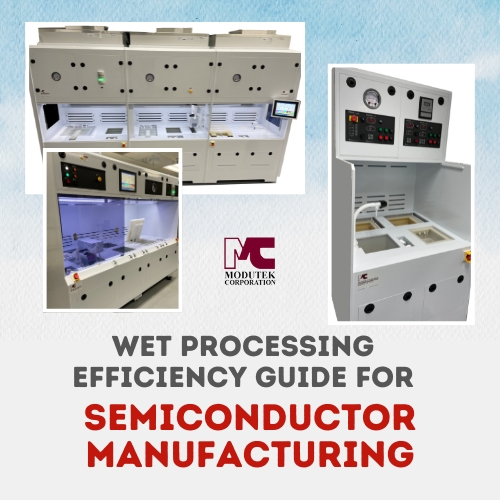
 Summary: Semiconductor fabrication facilities lose millions in production capacity when wafer throughput decreases. This guide shows process engineers and facilities managers how to recover that capacity through advanced process control (APC), strategic wet bench layouts, and data-driven maintenance programs that increase WPH by 10-20% while reducing downtime and defect rates.
Table of Contents
- Why Efficiency and Reliability Matter: Understanding Performance Metrics
- Advanced Process Control: Reducing Variability Through APC and Robotics
- Optimized Equipment Layouts: Cutting Cycle Time
- Maintenance Programs That Increase Uptime
- Manual vs. Semi-Automated vs. Fully Automated Wet Benches
- Integration Requirements: Chemical Delivery, Monitoring, and Data Systems
- ROI Calculator: Measuring Your Efficiency Gains
- Why Choose Modutek
1. Why Efficiency and Reliability Matter: Understanding Performance Metrics
Wafer processing efficiency directly impacts yield, delivery predictability, and total cost of ownership. Every percentage point of throughput improvement affects your bottom line. Fabrication facilities must simultaneously maximize throughput while maintaining contamination control and meeting SEMI S2 and FM 4910 safety standards.
Four Critical Metrics Determine Wafer Processing Performance:
- WPH (wafers per hour) – Raw throughput capacity that determines production volume and revenue potential
- Cp and Cpk values – Process capability indices measuring consistency; higher values mean fewer defects and lower scrap rates
- Uptime percentage – Equipment availability that directly impacts delivery schedules and customer satisfaction
- Rework rate – Percentage of wafers requiring reprocessing; each 1% reduction saves material costs and labor hours
These four metrics multiply together to determine your facility’s production capacity and profitability.
Contamination control remains critical throughout wet processing operations. Particle counts, metallic impurities, and organic residues must stay within specification limits to protect device performance. Wet benches, designed with proper chemical compatibility, filtration systems, and ergonomic layouts, help maintain the cleanliness standards required in modern fabrication environments.
Safety compliance protects personnel and operations. Equipment must comply with SEMI S2 safety standards and FM 4910 approval requirements while protecting operators from chemical exposure and minimizing environmental risks. Non-compliant equipment delays production startup and increases insurance costs.
2. Advanced Process Control: Reducing Variability Through APC and Robotics
Advanced process control (APC) reduces process variability while improving throughput and yield (see improvement table below). Run-to-run (R2R) control algorithms analyze the results from each wafer batch and automatically adjust process parameters to maintain target specifications, creating self-correcting systems that reduce operator-dependent variation.
Real-time control loops monitor critical variables continuously:
- Temperature sensors track bath conditions within ±0.1°C tolerance, preventing thermal variation defects
- Concentration monitors measure chemical strength and trigger automatic dosing before bath depletion affects wafer quality
- Flow meters verify rinse water delivery rates, ensuring complete chemical removal
- Timer systems ensure precise process duration, eliminating human timing errors
Auto-dosing systems eliminate manual chemical management errors. As concentrations drift, automated systems add fresh chemicals or deionized water to maintain target chemistry. Bath refresh cycles replace spent solutions before contamination affects wafer quality—reducing operator-to-operator variability.
Robotics integration delivers benefits across three areas:
- Process Consistency:Robot arms move wafers with repeatable positioning accuracy, ensuring consistent immersion depth and agitation patterns—eliminating handling variation.
- Safety:Automated handling protects operators from chemical exposure, reducing incident rates and simplifying SEMI S2 compliance.
- Throughput:Reduced transfer times between process baths increase effective WPH.
Data traceability supports quality assurance and customer audits. Modern wet bench systems capture time-stamped data for every process step: chemical lot numbers, bath temperatures, immersion durations, and concentration readings. These audit trails support ISO certification requirements and enable root-cause analysis during yield excursions. When customers request process qualification data, facilities with automated data capture respond within hours rather than days.
Modutek designs automation controls and software in-house, ensuring tight integration between mechanical systems, sensors, and control logic. This single-source approach eliminates compatibility issues common in multi-vendor assemblies and reduces commissioning time, as equipment arrives thoroughly tested and ready for production.
3. Optimized Equipment Layouts: Cutting Cycle Time
Equipment layout has a direct impact on cycle time, contamination risk, and operator efficiency. Poor layouts create three costly problems: bottlenecks where wafers queue for available stations, extended transfer distances that increase handling time, and restricted maintenance access. Strategic layout optimization can improve throughput by 10-20% (see improvement table below).
Balanced station loading prevents bottlenecks. Distributing processing volume across multiple baths ensures no single station becomes a constraint. For example, using three parallel cleaning baths instead of one eliminates queuing delays. Strategic bath placement sequences process steps in logical order—minimizing backtracking and cross-contamination opportunities.
A well-designed dry-to-dry flow moves wafers from cassette input through cleaning, etching, rinsing, and drying stages in a continuous path. This arrangement reduces moisture carryover between incompatible chemistries and decreases the risk of watermark defects on finished wafers.
Four Layout Strategies That Increase Throughput and Safety:
- Group high-throughput stations near wafer input/output points to minimize travel distance for the highest-volume process steps
- Position chemical-intensive baths away from traffic areas to reduce operator exposure risk and simplify emergency response access
- Design service corridors behind equipment rows, allowing technicians to access pumps, heaters, and controls without disrupting production or violating cleanroom protocols
- Install emergency shutoff controls at multiple locations, enabling rapid response from any location in the facility
Custom wet bench systems accommodate both retrofit installations in existing facilities and new construction projects. Space-optimized footprints maximize processing capability within available cleanroom square footage—critical when construction costs exceed $1,000+ per square foot.
Modutek engineers work directly with customers to develop layouts that fit facility constraints while optimizing wafer processing efficiency. This collaborative design process accounts for:
- Ceiling height restrictions and overhead crane clearances
- Chemical delivery infrastructure and bulk storage locations
- Exhaust capacity and scrubber tie-in points
- Electrical service capacity and panel locations
- Cleanroom classification boundaries
- Future expansion zones and modular addition pathways
This upfront planning prevents costly re-work during installation.
4. Maintenance Programs That Increase Uptime
Preventive maintenance programs increase equipment uptime by 5-15% compared to reactive repair strategies (see improvement table below). Effective programs align maintenance schedules with mean time between failure (MTBF) data and establish calibration intervals for sensors, robotics, and control systems—addressing wear items before failures occur.
Bath health monitoring tracks key parameters that indicate when maintenance is needed:
- Concentration tracking – Regular testing verifies chemical strength remains within specification, preventing bath depletion before it affects quality
- Filtration monitoring – Pressure differentials indicate when filters require replacement to maintain particle control
- Sparging checks – Flow measurements confirm nitrogen purge systems operate correctly, preventing contamination
- Level sensors – Automated alerts prevent overflow (safety hazard) and dry-run conditions (pump damage)
Mean time to repair (MTTR) depends heavily on the availability of spare parts and the expertise of technicians. Facilities that stock critical components on-site resolve failures more quickly than those that order parts after a failure. For a wet bench processing a significant wafer volume, downtime represents a substantial loss of production capacity.
A comprehensive spares strategy includes:
- High-wear items (pumps, heaters, valves) kept in on-site inventory to prevent extended downtime
- Critical sensors with calibrated backups ready for swap-out; sensor drift causes process excursions
- Chemical delivery components (tubing, fittings, filters) in standard sizes; chemical incompatibility failures can contaminate entire baths
- Robot end-effectors and drive components for handling systems; a single failure can halt entire automated lines
Remote diagnostics capabilities reduce response time for many common problems. Network-connected equipment transmits alarm data, performance trends, and maintenance logs to Modutek’s technical team in real-time. Common issues—such as sensor calibration drift, recipe parameter errors, and communication faults—are diagnosed and resolved remotely. For problems requiring physical intervention, technicians arrive with the correct parts and repair procedure already identified.
Modutek provides factory-trained service technicians and maintains spare parts inventory to support rapid response. Service level agreements define response times, spare parts availability, and preventive maintenance schedules customized to your equipment configuration, process chemistry, and production volume—optimizing the balance between maintenance costs and equipment reliability.
📊 Key Takeaways: Maintenance Programs
- Preventive maintenance increases uptime by 5-15%
- MTBF data determines optimal maintenance schedules
- Spare parts availability minimizes repair time
- Remote diagnostics reduce response time
- Customized programs balance cost and reliability
5. Manual vs. Semi-Automated vs. Fully Automated Wet Benches
Selecting the right level of automation requires matching equipment capabilities to production requirements based on five factors: production volume, recipe mix, cleanliness targets, available labor, and budget constraints. The comparison table below illustrates the differences between manual, semi-automated, and fully automated wet benches in terms of performance metrics.
Wet Bench Automation Comparison – Performance and Cost Tradeoffs
| Feature | Manual Wet Benches | Semi-Automated Systems | Fully Automated Systems |
| Throughput | 10-25 WPH | 25-60 WPH | 60-150+ WPH |
| Process Variability | Operator-dependent | Reduced through timers and sensors | Minimized with closed-loop control |
| Operator Involvement | Continuous hands-on handling | Monitoring and cassette loading | Supervisory only |
| Safety Profile | Higher chemical exposure risk | Reduced handling, improved containment | Minimal operator exposure |
| Lifecycle Cost | Lower capital, higher labor | Balanced capital and operating costs | Higher capital, lower operating costs |
| Recipe Complexity | Limited to simple sequences | Moderate complexity supported | Handles complex multi-step processes |
| Cleanroom Class | Class 1,000-10,000 | Class 100-1,000 | Class 10-100 |
| Best Application | R&D, low-volume production | Medium-volume production, mixed recipes | High-volume, stable recipes |
Selection guidance depends on several factors:
- Production volume – Higher volumes justify automation investment through labor savings
- Recipe mix – Frequent changeovers favor flexible manual systems; stable production suits automation
- Cleanliness targets – Advanced nodes requiring Class 10 environments demand automated handling
- Available labor – Tight labor markets increase the value of automation
- Budget constraints – Capital availability affects initial equipment investment capacity
Many facilities follow a staged migration path, starting with manual wet process stations during R&D, upgrading to semi-automated wet processing systems as volume grows, then transitioning to fully automated wet benches for high-volume production. This staged approach spreads capital investment over multiple years, allowing operators to gain experience with each technology level and reducing training requirements at each upgrade.
Modutek’s portfolio spans all three automation levels, featuring compatible designs that enable seamless transfer of process recipes during upgrades. Compatible chamber geometries, chemical delivery logic, and control architecture allow recipes to be transferred with minimal modification, thereby protecting months of process development investment and reducing qualification time for new equipment.
💡 For Process Engineers:
Compatible designs across automation levels ensure that your process development work is transferable when upgrading to new systems. Chamber geometries, chemical delivery logic, and control architecture remain consistent—reducing requalification time.
💰 For Facilities Managers:
Staged automation migration spreads capital investment over multiple years while building operator expertise at each level. This reduces training requirements and accelerates time-to-production with each upgrade.
6. Integration Requirements: Chemical Delivery, Monitoring, and Data Systems
Poor integration between wet benches and facility systems causes production interruptions despite perfectly functioning equipment. Reliable integration requires coordinating chemical delivery architecture, safety systems, monitoring networks, data interfaces, and facility exhaust management.
Chemical Delivery Architecture: Two Primary Configurations
Central Chemical Supply
- Bulk storage tanks feed multiple wet benches through distribution piping
- Best for: High-volume production with limited recipe variety
- Advantages: Centralized chemical management, lower per-gallon costs
- Considerations: Higher infrastructure investment, less recipe flexibility
Point-of-Use Blending
- Chemical concentrates are mixed with deionized water at each station
- Best for: Facilities running diverse recipe mixes
- Advantages: Maximum recipe flexibility, lower infrastructure cost
- Considerations: More operator touchpoints for chemical handling
Chemical delivery systems include chemical-compatible pumps (PTFE or PFA construction), mass flow controllers (precise concentration control), distribution manifolds (prevent incompatible chemical mixing), and purity maintenance systems (inline filtration, nitrogen blanketing). Material selection depends on chemistry: HF requires PFA, sulfuric acid uses PTFE, and solvents require PVDF or stainless steel.
Safety Integration Connects Four Critical Systems:
- Leak detection sensors trigger facility alarms and emergency shutdowns
- Fume scrubbers tie into building exhaust management
- Chemical containment sumps link to facility waste treatment
- Fire suppression systems interface with process equipment interlocks
All safety interlocks must meet the requirements of SEMI S2 and FM 4910, with documented functional testing.
Station-level monitoring tracks concentration, temperature, and flow rate with closed-loop control. Temperature maintains ±0.1°C accuracy. Concentration monitoring triggers auto-dosing when chemistry drifts. Flow verification ensures complete rinse cycles.
Data integration connects equipment to facility systems. SECS/GEM protocols enable MES communication, SPC dashboards display real-time control charts, audit trails record all events for quality certification, and recipe management systems prevent outdated recipes from being run.
Modutek provides single-source design and build services with a single engineering contact for wet benches, chemical delivery, robotics, and software. Integrated factory testing validates all subsystems before shipment—eliminating multi-vendor integration issues.
7. ROI Calculator: Measuring Your Efficiency Gains
Equipment improvements without ROI quantification rarely receive capital approval. Finance teams require payback calculations before authorizing investments exceeding six figures. This section provides the formulas and improvement ranges needed to build compelling business cases.
Effective WPH Formula (The Only Throughput Metric That Matters):
Effective WPH = Raw WPH × Availability × Yield
Where:
- Raw WPH: Maximum wafers processed per hour under ideal conditions
- Availability: Percentage of time equipment is operational (uptime)
- Yield: Percentage of wafers meeting quality specifications (first-pass yield)
Example: A system with 100 raw WPH at 85% availability and 95% yield delivers only 81 effective WPH—improvements compound to enhance overall performance.
Expected Performance Improvements from Common Initiatives
| Initiative | WPH Gain | Availability Gain | Yield Gain |
| Advanced process control | 5-10% | 2-5% | 1-3% |
| Layout optimization | 10-20% | 1-2% | 0.5-1% |
| Preventive maintenance programs | 0-5% | 5-15% | 0.5-2% |
Note: Improvements multiply together. Implementing all three initiatives can yield a combined improvement of 15-20% in effective WPH. Improvement figures are typical ranges and not guaranteed results.
Financial Impact at Different Production Scales:
50,000 wafers/year @ $500 contribution margin:
- Baseline value: $25 million annually
- 15% improvement: +$3.75 million capacity
100,000 wafers/year @ $500 contribution margin:
- Baseline value: $50 million annually
- 15% improvement: +$7.5 million capacity
25,000 wafers/year @ $500 contribution margin:
- Baseline value: $12.5 million annually
- 15% improvement: +$1.88 million capacity
Modutek offers pre-project modeling of cycle time and chemical consumption using your actual process recipes and facility constraints—generating realistic performance projections that support capital approval processes.
8. Why Choose Modutek
Choosing a wet process equipment supplier is a long-term decision. The equipment you install today will require support for 10 to 15 years. Modutek brings 45 years of wet processing expertise to every customer engagement. This includes designing, fabricating, integrating software and robotics, and conducting in-house final acceptance testing. This vertically integrated approach ensures quality control at every stage and guarantees your supplier will be here when you need support.
In-House Capabilities That Protect Your Investment:
- Mechanical design and fabrication of stainless steel and polymer wet benches – Custom sizing without third-party fab shops
- Control system programming and HMI development – Software optimized for wet processing, not generic PLC code
- Robotics integration and motion control optimization – Programmed for your specific wafer sizes
- Chemical delivery system design – Seamless integration with existing facility infrastructure
- Final acceptance testing using your actual process recipes – Equipment arrives proven to work
Factory Acceptance Testing (FAT) – Conducted at Modutek’s Facility:
FAT runs your actual process recipes on assembled equipment using deionized water (DI), verifies that all safety interlocks function correctly, confirms the accuracy of chemical delivery and temperature control performance, and tests automation sequences and data communication protocols. Equipment ships only after passing rigorous testing.
Safety Compliance Documentation:
Modutek engineers document compliance with SEMI S2, SEMI S8, FM 4910, and NFPA requirements through design reviews, risk assessments, and validation testing—supporting facility permitting, insurance requirements, and corporate EHS audits.
Responsive Lifecycle Support:
Service level agreements define response times, spare parts availability, and preventive maintenance schedules. Factory-trained technicians provide on-site service, remote diagnostics, and application support.
Contact Modutek for a complimentary consultation and customized quote for the systems and equipment required to meet your process needs.
Frequently Asked Questions
Q1: What is the difference between manual, semi-automated, and fully automated wet benches?
Manual wet benches (10-25 WPH) require continuous operator handling and are suitable for R&D or low-volume production. Semi-automated systems (25-60 WPH) use timers and sensors to reduce operator involvement while maintaining flexibility for mixed recipes. Fully automated systems (60-150+ WPH) offer closed-loop process control with minimal operator exposure, making them ideal for high-volume production that requires Class 10-100 cleanroom standards.
Q2: How much can I improve wafer processing efficiency with advanced process control and layout optimization?
Advanced process control typically delivers 5-10% WPH gains, 2-5% improvement in availability, and 1-3% increase in yield. Layout optimization adds 10-20% WPH gains with 1-2% availability improvements. Combined with preventive maintenance programs (5-15% availability gains), facilities commonly achieve 15-20% overall improvement in effective wafer throughput.
Q3: What safety compliance standards do wet bench systems need to meet?
Wet bench systems must comply with SEMI S2 (equipment safety), SEMI S8 (ergonomics), FM 4910 (chemical storage and handling), and NFPA 318 (semiconductor fabrication facilities). Compliance requires documented safety interlocks that halt chemical delivery, activate exhaust, and secure wafers during alarm conditions, with functional testing every 6 months.
Q4: How do I calculate ROI for wet processing equipment upgrades?
Calculate Effective WPH (Raw WPH × Availability × Yield) to determine actual production capacity, then multiply throughput improvement by your wafer contribution margin to find annual value added. For example, a 15% improvement on 50,000 wafers/year at $500 contribution margin adds $3.75 million in annual production capacity. Divide the capital investment by the annual savings to determine the payback period.
Q5: What is Factory Acceptance Testing (FAT) and why does it matter?
Factory Acceptance Testing (FAT) runs your actual process recipes on assembled equipment using deionized water (DI) before shipment, verifying that performance meets specifications. FAT confirms safety interlocks function correctly, validates chemical delivery accuracy and temperature control, and tests automation sequences and data communication protocols. This ensures equipment arrives proven to work with your specific chemistries and parameters, reducing commissioning time and eliminating the risk of purchasing equipment that doesn’t meet your requirements.