Summary: Single-wafer wet-processing systems provide semiconductor manufacturers with aut omated, repeatable chemical processing that delivers precise control over critical fabrication steps, including etching, cleaning, and surface preparation.
Table of Contents
- What a Single Wafer Wet Process System Does
- How Automated Chemical Spray Processing Works
- Achieving Tight Process Control Through System Design
- Why Process Engineers Choose Single Wafer Wet Processing Systems
- Frequently Asked Questions
Introduction
Semiconductor manufacturers processing advanced nodes face a persistent challenge: batch wet processing systems can introduce wafer-to-wafer variability that impacts yield. When multiple wafers share a chemical bath, process engineers have limited control over individual wafer treatment.
Single-wafer wet-process systems address this challenge by treating each wafer individually using automated chemical spray delivery. This approach gives process engineers precise, repeatable control over chemical flow rates, wafer rotation speeds, and processing times—supporting consistent, trackable process parameters that help optimize yield.
1. What a Single Wafer Wet Process System Does
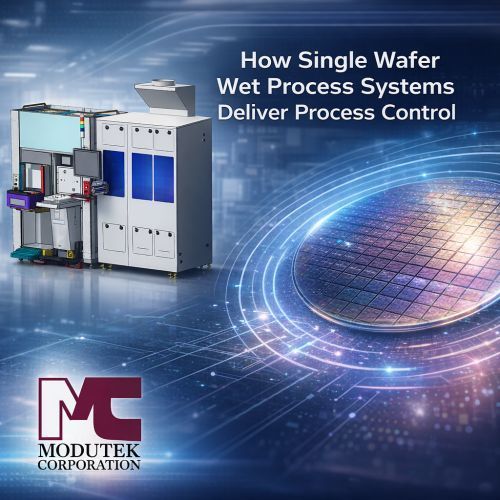
A single-wafer wet-process system treats one wafer at a time by delivering controlled chemistries through automated spray nozzles onto a rotating wafer surface. Unlike traditional wet benches, where multiple wafers share chemical baths, single-wafer systems provide individual wafer-level control, significantly reducing batch-related variability.
This approach delivers three key advantages:
- Uniform processing across wafers – Each wafer receives identical chemical treatment under tightly controlled conditions
- Programmable process parameters – Chemical flow rate, rotation speed, dispense time, and rinse sequences are recipe-driven
- Reduced cross-contamination risk – Individual wafer processing minimizes contamination transfer between wafers
Typical applications include silicon etching, pre-diffusion cleaning, post-CMP cleaning, and surface preparation.
2. How Automated Chemical Spray Processing Works
Automated chemical spray processing delivers precisely metered volumes of chemicals through programmable spray nozzles positioned above a rotating wafer.
Wafer rotation speed is a critical variable influencing process outcomes:
- Higher speeds (typically above ~1,500 RPM) promote rapid chemical spreading and efficient removal of spent chemistry
- Mid-range speeds (hundreds to ~1,500 RPM) balance chemical distribution with controlled reaction time
- Lower speeds (tens to hundreds of RPM) extend chemical contact time for applications requiring longer reaction windows
Actual rotation speed ranges and results depend on wafer size, chemistry, and process requirements.
Nozzle-to-wafer distance is another important control parameter. Typical spray distances are configured to achieve uniform full-wafer coverage. Improper positioning can lead to radial non-uniformity, while modern systems are designed to maintain consistent nozzle positioning through automated calibration and mechanical controls.
Recipe-driven automation ensures that once a process is validated, every wafer is processed using the same parameters.
3. Achieving Tight Process Control Through System Design
Automated single-wafer wet-process systems execute validated recipes with consistent parameters for every wafer, helping reduce operator-dependent variability that can contribute to wet-processing defects.
Process recipes typically define:
- Chemical type and concentration
- Flow rate and dispense timing
- Wafer rotation speed profiles
- Temperature setpoints
- DI water rinse sequences and resistivity targets
Programmable recipe management supports both R&D flexibility and production consistency. Engineers can switch between recipes without hardware changes, while access controls, audit trails, and version tracking support quality system requirements.
Safety and chemical compatibility considerations include:
- Materials of construction: PTFE, PFA, and PVDF selected for compatibility with standard semiconductor chemistries such as HF, HNO₃, H₂SO₄, and HCl
- Vapor containment: Enclosed processing chambers with dedicated exhaust connections
- Standards alignment: Systems are designed to support compliance with SEMI S2, SEMI S8, and NFPA 318 requirements, depending on final configuration and facility integration
4. Why Process Engineers Choose Single Wafer Wet Processing Systems
Process engineers choose single-wafer wet-process systems to improve process repeatability, tighten control of critical parameters, and reduce resource consumption compared to batch processing.
Precision advantages may include:
- More consistent chemical concentration at the wafer surface
- Improved temperature stability during processing
- Tighter control of process timing through automated recipes
In many applications, these improvements translate into measurable yield gains, often in the low single digits, depending on process sensitivity and baseline conditions.
Lower total cost of ownership
Single wafer processing can also reduce operating costs:
| Cost Factor | Batch Processing | Single Wafer Processing | Typical Advantage |
| Chemical usage | Large shared baths | Metered per-wafer delivery | Reduced chemical consumption |
| DI water usage | High-volume bath rinses | Targeted spray and rinse | Lower water usage |
| Maintenance downtime | Longer service windows | Modular, automated systems | Reduced downtime |
| Floor space | Large wet benches | Compact tool footprint | Smaller cleanroom footprint |
Actual savings vary by process, chemistry, and facility practices.
5. Frequently Asked Questions
Q1: What is the difference between single wafer and batch wet processing?
Batch processing treats multiple wafers simultaneously in shared chemical baths, which can introduce wafer-to-wafer variability. Single-wafer wet-processing equipment treats one wafer at a time with automated spray delivery, providing tighter control and improved uniformity.
Q2: How does wafer rotation speed affect results?
Rotation speed influences chemical distribution, film thickness, and reaction time. Higher speeds improve uniformity, while lower speeds increase chemical contact time. Optimal settings depend on the specific process.
Q3: Why is nozzle-to-wafer distance important?
Nozzle distance affects spray pattern and uniformity across the wafer surface. Proper positioning helps maintain consistent chemical delivery, while automated calibration supports repeatable results.
Q4: Are systems suitable for both R&D and production?
Yes. R&D environments benefit from flexible recipe development and low chemical volumes, while production environments gain from automated operation, repeatability, and reduced downtime.
Q5: How do automated systems improve repeatability and yield?
Automated systems execute validated recipes with consistent parameters, reducing operator variability and improving process control: enclosed chambers and controlled delivery further support uniform, repeatable results.
Ready to Improve Process Control and Yield?
Modutek’s single-wafer wet-processing equipment delivers the precision, repeatability, and automation that process engineers need. Each system undergoes factory acceptance testing and is configurable to meet a wide range of R&D and production requirements.
Explore Modutek’s wet-processing solutions or contact us to discuss your application requirements.