 A single compliance gap in wet bench operations can trigger an audit, halt production, or expose your facility to regulatory action. This guide covers the regulatory standards, installation requirements, chemical handling obligations, and supplier criteria that Environmental, Health & Safety (EHS) managers need to stay ahead of.
Table of Contents
- Understanding the Regulatory Landscape for Wet Bench Operations
- Key Installation Requirements EHS Managers Must Verify
- Chemical Handling Equipment Standards and Hazardous Material Obligations
- What to Look for in a Compliance-Ready Wet Bench Supplier
- Maintaining Ongoing Compliance After Installation
- Frequently Asked Questions (FAQ)
1. Understanding the Regulatory Landscape for Wet Bench Operations
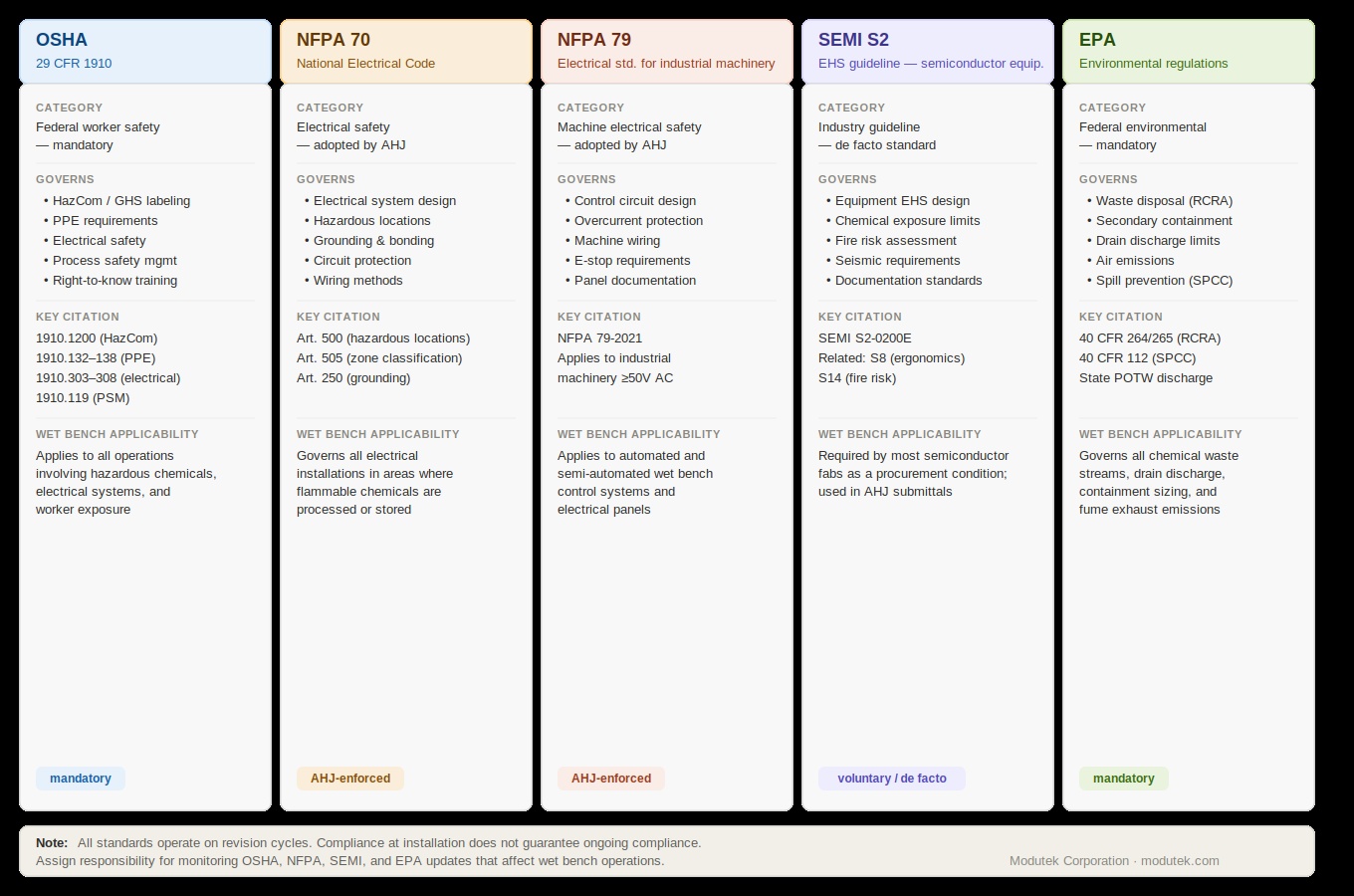
In semiconductor manufacturing, wet bench operations sit at the intersection of federal OSHA requirements, EPA discharge rules, NFPA fire codes, SEMI S2 guidelines, and local AHJ authority, and no single document reconciles them. For EHS and facilities managers running lean teams, keeping those frameworks aligned across procurement, installation, and ongoing operations is one of the most consequential compliance challenges in the facility.
The following regulatory frameworks directly govern wet bench station operations:
- OSHA 29 CFR 1910 (General Industry Standards) — Covers hazard communication (HazCom), personal protective equipment (PPE), and electrical safety. This is the federal baseline for worker protection in semiconductor fab environments.
- NFPA 45 (Standard on Fire Protection for Laboratories Using Chemicals) — Applies to chemical use zones and governs fire risk management in areas where flammable or reactive chemicals are in use. Applicability depends on facility classification — confirm with your AHJ.
- NFPA 70 / National Electrical Code (NEC) — The foundational U.S. electrical safety standard governing the design, installation, and inspection of electrical systems. For wet bench environments, NEC Article 500 addresses electrical equipment in hazardous locations where flammable chemicals are processed. Modutek designs wet bench electrical systems to comply with NEC requirements.
- NFPA 79 (Electrical Standard for Industrial Machinery) — Establishes electrical safety requirements specifically for industrial machinery, including automated wet bench systems. NFPA 79 governs wiring, grounding, overcurrent protection, and control circuit design for equipment used in semiconductor manufacturing environments.
- EPA and State Environmental Regulations — Govern chemical waste disposal, emissions, and discharge. State-level requirements frequently exceed federal minimums and vary significantly by jurisdiction.
- SEMI S2 — The semiconductor industry’s primary Environmental, Health, and Safety guideline for semiconductor manufacturing equipment. While voluntary, it functions as the de facto baseline that customers, auditors, and insurers rely on. SEMI also publishes related guidelines, including S8 (Ergonomics) and S14 (Fire Risk Assessment), that may apply depending on your processes. Learn more at org.
- Local Fire Marshal and Building Code Requirements — Vary by jurisdiction and must be satisfied independently of federal standards. The Authority Having Jurisdiction (AHJ) has final approval authority over installations.
A critical point: these standards are not static. OSHA, NFPA, SEMI, and EPA all operate on revision cycles, and a facility that was compliant at installation can fall out of compliance as standards evolve. Non-compliance consequences extend well beyond fines. Violations can trigger operational shutdowns, expose responsible managers to personal liability, and cause lasting reputational damage with regulators and customers.
2. Key Installation Requirements EHS Managers Must Verify
Before a wet bench station goes live, a systematic pre-installation review of both facility-side and equipment-side requirements is non-negotiable. Skipping this process is one of the most common and most preventable sources of compliance failures.
2.1 Electrical Requirements
- Confirm proper grounding, correct voltage ratings, and circuit protection specifications.
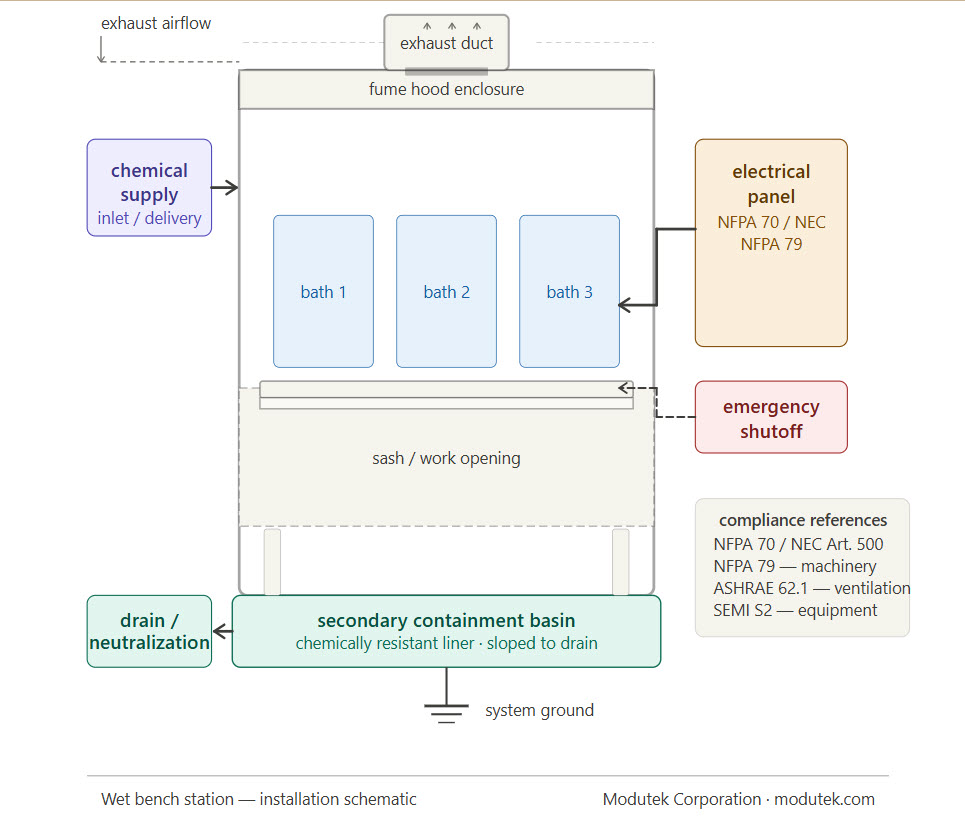
- NFPA 70 / NEC Article 500 governs electrical installations in hazardous locations where flammable chemicals are processed. Note that Article 505 (Zone Classification) is an alternative system also recognized by NEC — confirm which classification applies in your jurisdiction.
- NFPA 79 applies specifically to the electrical systems of industrial machinery, including automated and semi-automated wet bench systems. It governs control circuit design, overcurrent protection, and machine wiring — requiring full electrical schematics from the supplier before installation.
- Require complete electrical schematics and panel documentation from the supplier before installation to support both NFPA 70 and NFPA 79 compliance reviews.
2.2 Plumbing and Drain Specifications
- Ensure all plumbing materials are chemically resistant and compatible with the specific chemistries in use.
- Verify secondary containment is in place to meet EPA and local spill prevention requirements.
- Confirm compatibility with the facility’s existing drainage system and any neutralization requirements at the drain point.
2.3 Ventilation and Exhaust Requirements
- Validate minimum exhaust volumes against the chemicals being processed. ASHRAE standards — particularly ASHRAE 62.1 (Ventilation and Acceptable Indoor Air Quality) and guidance from the ASHRAE Handbook of HVAC Applications — are used by industrial hygienists and AHJs to establish minimum ventilation rates and exhaust system performance requirements for facilities handling hazardous chemicals. Modutek designs wet bench ventilation connections in accordance with applicable ASHRAE and ACGIH guidelines.
- Confirm ductwork materials are rated for the corrosive or reactive gases involved.
- Ensure proper connection to the facility’s exhaust system before equipment startup.
2.4 Physical Footprint and Safety Clearances
- Verify aisle spacing meets emergency egress requirements.
- Confirm adequate clearance from ignition sources for solvent-based processes.
- Assess proximity to fire suppression systems and sprinkler coverage.
2.5 Equipment Labeling and Documentation
- Confirm SDS (Safety Data Sheets) are accessible at the point of use.
- Verify hazard communication signage and equipment-specific safety placards are in place.
- Require complete documentation packages from the supplier, including wiring diagrams and material certifications.
Pre-installation coordination between the supplier, facilities team, and the AHJ is not optional. It is the mechanism for verifying and approving compliance with installation requirements. Modutek supports this process by providing full documentation packages, electrical schematics, and pre-delivery testing designed to streamline AHJ approval. Learn more about Modutek’s wet bench systems.
3. Chemical Handling Equipment Standards and Hazardous Material Obligations
Chemical handling is the highest-risk area for EHS compliance gaps in wet bench environments. Chemicals common in semiconductor wet processing, including H₂SO₄, H₂O₂, KOH, and solvents, require rigorous controls at every stage: delivery, use, containment, and disposal.
3.1 OSHA HazCom / GHS Requirements
- Maintain current SDS for every chemical in use and ensure they are accessible to all personnel who work with or near those chemicals.
- Implement proper chemical labeling on all containers, tanks, and delivery lines.
- Document and deliver employee right-to-know training as required under 29 CFR 1910.1200.
3.2 Chemical Compatibility
- Verify that tanks, tubing, fittings, and chemical delivery systems are rated for the specific chemistries in use.
- Material incompatibility is a direct source of equipment failure, chemical release, and regulatory violation.
3.3 Secondary Containment
- EPA and state environmental regulations require secondary containment for hazardous chemical storage above applicable threshold quantities, governed at the federal level by RCRA (40 CFR Parts 264/265) for hazardous waste, and by state-specific discharge and spill-prevention rules for process chemicals. Containment must be sized to hold the capacity of the largest single container plus adequate freeboard, and must be compatible with all chemicals in the system. Undersized or incompatible containment is a common finding in regulatory inspections.
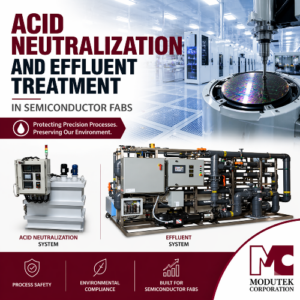
3.4 Acid Neutralization and Waste Stream Management
- Facilities that discharge chemical waste to the drain must meet local POTW (Publicly Owned Treatment Works) discharge limits.
- Acid neutralization systems treat waste streams before discharge and must be correctly sized and maintained.
- Permitting requirements vary by municipality — confirm requirements with the local authority before commissioning.
3.5 Fume Management
- Acid fume scrubbers are required for processes that generate hazardous airborne emissions.
- Exhaust monitoring and compliance with Threshold Limit Values (TLVs) established by ACGIH are critical to worker safety and regulatory compliance.
Modutek’s chemical handling equipment, including fume scrubbers, neutralization systems, and chemical delivery systems, is designed to support full regulatory compliance, reducing the need for post-installation modifications that add cost and delay.
4. What to Look for in a Compliance-Ready Wet Bench Supplier
Not all wet bench manufacturers design compliance into their systems from the start. Some treat secondary containment, exhaust connections, and emergency shutoffs as options rather than engineering fundamentals. That distinction has direct consequences at AHJ review and during the first audit cycle. Use the following criteria when evaluating any semiconductor equipment manufacturer you are considering.
4.1 Documentation Standards
- Does the supplier provide complete compliance documentation, including wiring diagrams, material certifications, NFPA 70/79 alignment statements, and SEMI S2 documentation? Incomplete documentation is a direct obstacle to AHJ approval and operational startup.
4.2 Design-Stage Compliance Integration
- Are safety features — secondary containment, grounding, exhaust connections, emergency shutoffs — engineered into the system, or added as afterthoughts?
- Systems designed for compliance from the start require fewer modifications and carry lower total installation risk.
4.3 Customization Capability
- Can the supplier modify standard configurations to meet your facility’s specific electrical, plumbing, or footprint requirements without compromising compliance?
- Rigid, off-the-shelf designs rarely fit the specific constraints of an existing semiconductor fab or research facility.
4.4 Factory Acceptance Testing (FAT)
- FAT documentation provides a verifiable compliance baseline from day one — confirm the supplier conducts pre-shipment testing and provides documentation that validates compliance before the system leaves their facility.
4.5 Post-Installation Support
- Does the supplier offer field service, equipment upgrades, and operator training to maintain compliance over the system’s operational life?
- A supplier relationship that ends at delivery leaves your team to manage long-term compliance without technical backup.
4.6 Track Record with Regulated Facilities
- How many semiconductor fabs, research facilities, and universities has the supplier served?
- Request references and ask specifically about compliance support experience, and U.S.-based manufacturing and supply chain continuity.
Since 1980, Modutek has been designing and manufacturing compliance-ready wet bench systems, using in-house engineers, U.S.-based manufacturing, and a full support infrastructure that extends well beyond delivery. Review Modutek’s compliance and standards credentials for additional detail.
5. Maintaining Ongoing Compliance After Installation
Installation approval is the starting point of compliance, not the endpoint. Treating compliance as a one-time event consistently produces avoidable problems — equipment degradation, failed audits, and regulatory actions that routine operational discipline would have prevented.
5.1 Preventive Maintenance Schedules
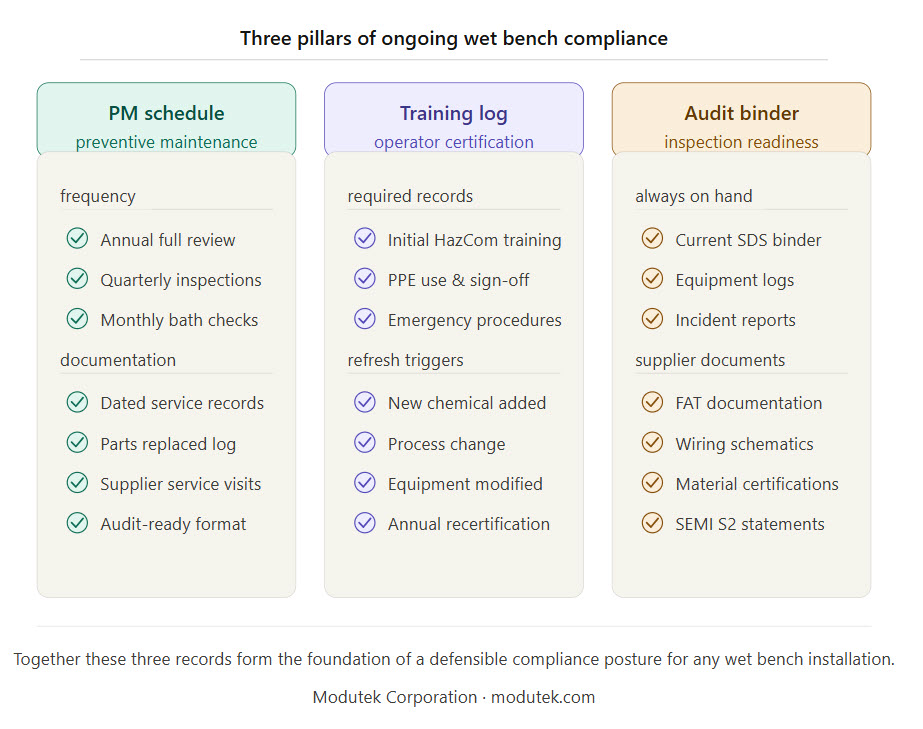
- Regular maintenance of wet bench stations prevents both equipment degradation and compliance drift — the gradual gap between equipment condition and applicable standards. This is one of the most common causes of failed audits in facilities with aging wet bench installations.
- Establish documented PM schedules and maintain service records in audit-ready condition.
5.2 Operator Training Requirements
- OSHA mandates documented training for all personnel working with hazardous chemicals under 29 CFR 1910.1200. Training must be refreshed whenever processes change, new chemicals are introduced, or equipment is modified.
- Modutek’s customer support and training programs support facilities in meeting these ongoing training obligations.
5.3 Change Management Protocols
- Any modification to process chemistry, operating parameters, or equipment configuration may trigger re-evaluation under SEMI S2 or local AHJ requirements.
- Document all changes and assess compliance implications before implementation, not after.
5.4 Inspection and Audit Readiness
- Maintain equipment logs, SDS binders, maintenance records, and incident reports in a format that can be reviewed on short notice.
- An audit that finds disorganized or missing records can be as damaging as finding a non-compliant system.
5.5 Regulatory Update Monitoring
- Assign responsibility for tracking updates to OSHA, EPA, SEMI, and NFPA standards — including NFPA 70 and NFPA 79 revision cycles — that affect wet bench operations.
- Standard revision cycles are predictable — a proactive monitoring process prevents compliance surprises.
A supplier who offers ongoing field service, equipment upgrades, and technical support becomes a long-term compliance partner — not just a transactional equipment vendor.
Ready to Discuss Your Facility’s Requirements?
Your facility’s compliance obligations don’t stop at installation, and neither does Modutek’s involvement. Since 1980, Modutek has designed and manufactured wet bench systems for semiconductor fabs and research facilities that need equipment built to code from the start, not retrofitted to meet it.
Contact Modutek to discuss your facility’s specific wet bench equipment requirements for electrical, chemical, footprint, or compliance documentation, and get a direct answer from an engineer, not a sales deck.
6. Frequently Asked Questions (FAQ)
Q1. What OSHA standards apply specifically to wet bench station operations in semiconductor manufacturing?
The primary OSHA standards applicable to wet bench operations include 29 CFR 1910.1200 (Hazard Communication / GHS), 29 CFR 1910.132–138 (PPE), and 29 CFR 1910.303–308 (Electrical Safety). Where highly hazardous chemicals are present at or above OSHA’s specified Threshold Quantity (TQ) as listed in Appendix A of the standard, 29 CFR 1910.119 (Process Safety Management) may also apply. SEMI S2 complements these requirements with equipment-level safety criteria specific to semiconductor manufacturing.
Q2. Is SEMI S2 compliance mandatory or voluntary?
SEMI S2 is a voluntary industry guideline, not a federal regulation. However, it functions as the de facto baseline in semiconductor equipment procurement. Many customers, facility auditors, and insurers treat SEMI S2 alignment as a minimum requirement. Suppliers who can demonstrate compliance carry a significant credibility advantage during procurement and AHJ approval.
Q3. Who is responsible for ensuring a wet bench station meets local code requirements — the supplier or the facility?
Regulatory responsibility rests with the facility. However, a compliance-aware supplier plays a critical role by providing accurate documentation, designing systems that meet applicable code requirements, and supporting the AHJ approval process. Modutek supports this shared responsibility model through comprehensive documentation packages, pre-delivery testing, and installation coordination.
Q4. What chemical handling equipment is required to support wet bench compliance in a semiconductor fab?
A compliant chemical handling infrastructure typically includes secondary containment, acid neutralization systems, acid fume scrubbers, chemical delivery systems, and chemically compatible tank and plumbing materials. Specific requirements depend on the chemistries in use, process volumes, and local regulations. Modutek’s chemical handling equipment integrates directly with wet bench systems to support full regulatory compliance.
Q5. How often should wet bench stations be inspected or re-evaluated for compliance?
A formal compliance review should occur at a minimum annually, plus event-driven reviews whenever process chemistry changes, equipment is modified, or applicable standards are revised. Modutek’s preventive maintenance and field service programs support both scheduled and event-driven compliance reviews, providing documented service records that strengthen audit readiness.