 Wet process yield loss is not random — it concentrates at specific steps, and equipment precision determines whether those steps hold or fail.
Table of Contents
- Why the Wet Process Zone Is Where Yield Is Won or Lost
- The Three Yield-Critical Wet Process Steps Every Fab Must Control
- Four Non-Negotiable Equipment Requirements for Precision Wet Processing
- Wet Processing Equipment Designed for Compound Semiconductors
- How Modutek Wet Processing Systems Reduce Downtime and Protect Yield
- Frequently Asked Questions
1. Why the Wet Process Zone Is Where Yield Is Won or Lost
In semiconductor fabrication, yield loss is not evenly distributed across the production line. A disproportionate share concentrates in the wet process zone, where wafers are etched, cleaned, and stripped using liquid chemistries that interact directly with device-critical surfaces. For process engineers who own those outcomes, this is not a peripheral concern. Equipment precision, not process chemistry alone, is what separates a controlled wet process from one that produces variable results, lot to lot. It is the central challenge of wet process management.
The fundamental challenge is that defects introduced during wet processing are rarely recoverable. A contaminated surface before epitaxial growth, an inconsistent etch depth, or residual chemistry following a strip step does not stay contained — it propagates into downstream processes and compounds yield loss across the lot.
As device geometries continue to shrink and compound semiconductor materials — including GaN, SiC, GaAs, and InP — see growing adoption in power electronics, RF, and photonics applications, process variation that was once acceptable is no longer within spec.
Wet processing equipment must be evaluated with that standard in mind. This article covers the process steps where equipment performance matters most, the criteria that separate capable equipment from generic alternatives, and how Modutek’s wet bench systems for semiconductor manufacturing are built to meet those requirements.
2. The Three Yield-Critical Wet Process Steps Every Fab Must Control
The three steps below carry the highest yield risk in the wet process sequence. Each one connects specific process requirements directly to equipment performance.
2.1 Etching
Bath temperature is the primary driver of etch rate, and temperature variations across the bath volume directly translate into variations in etch depth and critical-dimension control. A bath that runs ±2°C across its volume does not produce the same result from wafer to wafer. For engineers managing tight process windows, this is not a minor deviation — it is a yield event in progress.
Equipment that cannot maintain tight temperature uniformity introduces variability that no amount of chemistry optimization can fully compensate for. The wafer etching process requires wet processing systems with temperature control engineered to hold uniformity under real production conditions.
2.2 Resist Strip and Clean
Incomplete resist removal or residual contamination at the strip-and-clean stage does not remain isolated. Carry-forward contamination from this step reaches downstream processes — sometimes multiple steps later — before its effect on yield becomes visible. By then, the root cause is difficult to isolate, and the affected wafers are already committed to further processing.
Chemistry concentration management and rinse effectiveness are the two equipment variables most directly linked to strip and clean outcomes. Equipment that allows bath concentration to drift or delivers inconsistent rinse performance creates conditions in which residual contamination can persist.
2.3 Pre-Epitaxy Wet Clean
Surface cleanliness before epitaxial growth carries some of the highest stakes in the entire process flow. Even trace levels of metallic or organic contamination on the wafer surface can disrupt crystal lattice quality during epitaxial deposition.
For compound semiconductor substrates, this requirement is even more demanding. GaN, SiC, GaAs, and InP surfaces are more sensitive to oxidation and contamination than silicon surfaces, and the process window for a successful pre-epitaxy clean is correspondingly narrower. Silicon wafer cleaning equipment designed for standard silicon processing may not provide the level of contamination control required by compound semiconductor workflows.
3. Four Non-Negotiable Equipment Requirements for Precision Wet Processing
With those process steps in mind, the equipment evaluation criteria become clear. These four requirements are baseline expectations for any wet processing equipment operating in a yield-critical environment.
3.1 Bath Temperature Uniformity
±0.5°C or tighter uniformity across the bath volume is the standard for repeatable etch rate control. Equipment that cannot sustain this level of precision introduces lot-to-lot variability, making root cause analysis difficult and yield improvement elusive. Modutek’s temperature control circulators are engineered specifically to maintain this level of uniformity under sustained production conditions.
3.2 Ultra-Low Contamination Control
Tank materials, fittings, filtration systems, and ultra-pure water (UPW) integration all contribute to the contamination baseline of the wet process environment. Equipment that introduces particles or leaches contaminants from its own construction undermines process cleanliness regardless of how well the chemistry is managed. Particle filtration, UPW compatibility, and tank construction standards must all be verified during equipment evaluation — not assumed.
3.3 Chemically Compatible Materials
Tanks, manifolds, and fluid-handling components must be fabricated from materials that resist chemical attack. PVDF, quartz, and PFA/Teflon are the materials of choice for most aggressive wet process applications. Modutek offers both quartz tanks and Teflon tanks configured for specific process chemistry requirements. Material incompatibility is not just a contamination risk — it is an equipment failure mode that results in unplanned downtime and costly replacements.
3.4 Repeatable Process Control
Engineers need equipment that supports programmable process recipes, consistent chemical dosing, and data logging for traceability. Demonstrating repeatability is increasingly a requirement of quality systems. Equipment that cannot support process documentation shifts the audit burden onto the team and obscures process drift until it becomes a yield event.
| Working with compound semiconductors or advanced materials?
Talk to a Modutek wet processing specialist about your specific fab requirements. |
4. Wet Processing Equipment Designed for Compound Semiconductors
The shift toward compound semiconductor materials is accelerating across power electronics, RF devices, and photonics — exposing a gap in the capabilities of conventional wet-process equipment. Equipment optimized for silicon wafer processing often does not meet the requirements of GaN, SiC, GaAs, and InP fabrication.
Each of these materials presents distinct challenges:
- GaN and SiC require demanding process chemistry and tight temperature control, combined with high resistance to chemical attack in the equipment itself. GaN wet processes, for example, typically rely on aggressive alkaline chemistries at elevated temperatures.
- GaAs and InP are particularly sensitive to surface oxidation and require contamination control that is more demanding than standard silicon processes.
- All four materials impose stricter cleanliness thresholds before epitaxial growth than silicon-era process flows typically require.
Standard wet bench configurations may lack the material compatibility, temperature precision, or contamination management needed to process these substrates reliably. Inconsistent etch results, surface contamination, and epitaxial defects from underspecified equipment translate into yield losses that accumulate quickly at production volumes.
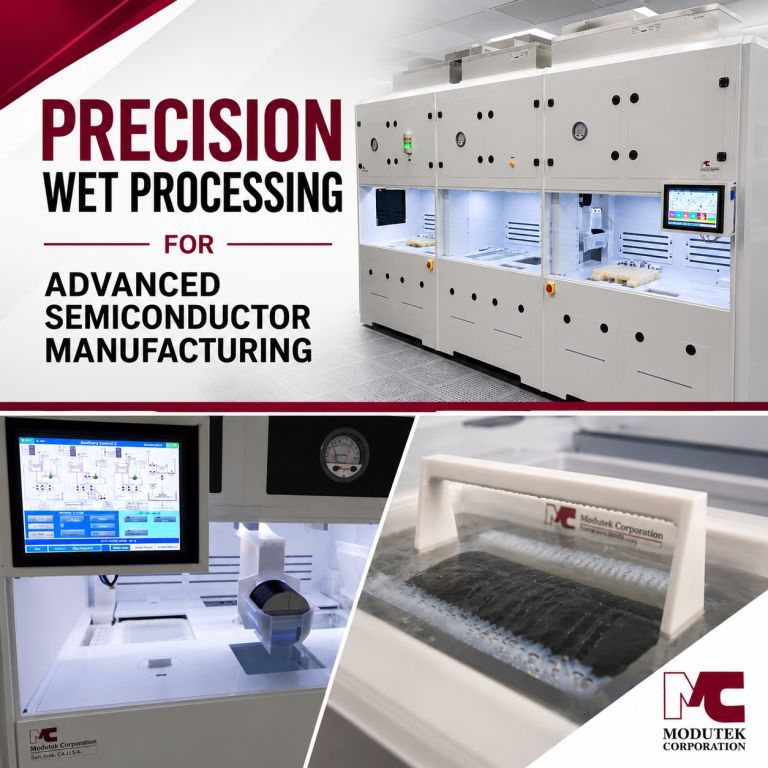
Modutek’s wet processing equipment is purpose-built to support these demanding material sets. Systems are configurable with compatible tank materials, process-appropriate bath chemistries, and recipes tailored to compound semiconductor workflows. Modutek offers automated wet-processing equipment, as well as semi-automated and manual configurations, giving process engineers the flexibility to meet throughput requirements without compromising process integrity.
Every Modutek system is built and tested in San Jose, California, before delivery and validated against the customer’s specified process requirements. For process engineers responsible for equipment acceptance, this pre-delivery testing directly addresses one of the most common procurement pain points: receiving equipment that does not perform to spec on arrival. Modutek has been engineering wet process solutions since 1980. These systems are purpose-built for compound semiconductor requirements, not adapted from silicon-era designs.
5. How Modutek Wet Processing Systems Reduce Downtime and Protect Yield
Equipment specifications matter during evaluation. What matters in production is reliable day-to-day performance with responsive support when issues arise.
5.1 Maintenance and Support
Modutek provides direct customer support, including on-site service, responsive technical assistance, and parts availability for systems in the field. For engineers who have experienced the impact of an unresponsive vendor, after-sales support quality is weighted as heavily as initial equipment performance in the purchasing decision.
5.2 Reliable Design That Reduces Unplanned Downtime
Modutek’s wet processing systems are engineered for durability and field serviceability. Accessible components, documented maintenance procedures, and field-serviceable parts reduce both the frequency and duration of maintenance events. Unplanned downtime in a wet process line does not just affect the tool in question — it affects every downstream process step.
5.3 Safety Compliance Built Into the Design
Safety compliance is incorporated at the design stage, not added as an afterthought. Wet bench fume hoods, chemical containment, and adherence to SEMI S2 environmental, health, and safety guidelines, as well as other applicable standards, are standard elements of Modutek’s wet bench configurations. Equipment arrives ready to meet facility safety requirements without post-delivery retrofits.
5.4 Process Data and Traceability
Modutek systems support data logging and process parameter monitoring, enabling engineers to track process conditions over time, identify drift before it affects yield, and generate documentation for quality reviews and audits. Traceability is not a reporting convenience — it is a yield protection tool.
5.5 Total Cost of Ownership
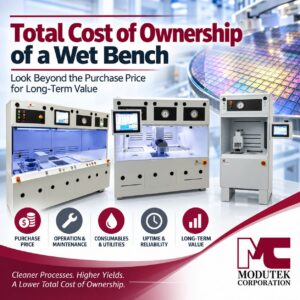
The relevant comparison for facilities managers is not purchase price alone — it is the total cost of ownership over the system’s operating life. Responsive support, durable design, and pre-delivery validation reduce the hidden costs — unplanned downtime, support escalations, and post-delivery retrofits — that inflate the true cost of lower-priced alternatives. Modutek’s U.S.-based manufacturing provides an accountable supply chain with shorter lead times, which is particularly important for fabs where equipment delays directly impact production.
6. Frequently Asked Questions
Q1. What makes wet processing equipment critical to semiconductor yield?
Wet processing steps that include etching, resist strip, and pre-epitaxy clean directly affect surface conditions and material integrity at the most yield-sensitive stages of fabrication. Equipment precision determines whether results are repeatable or variable. Inconsistent temperature control, inadequate contamination management, or poor rinse performance can introduce defects that are difficult to detect and impossible to reverse.
Q2. How does bath temperature uniformity affect the consistency of the etch rate?
Temperature variation across a bath volume translates directly into etch rate variation across the wafer surface. Even deviations as small as ±1°C across the bath volume can produce non-uniform etch depth and increase defect density. Maintaining ±0.5°C or tighter uniformity is the standard for repeatable control of etch rate in precision wet processing.
Q3. Can standard wet processing systems handle compound semiconductor materials like GaN and SiC?
Not reliably. Silicon-era wet processing systems are often not configured with the material compatibility, temperature precision, or contamination control that fabrication of GaN, SiC, GaAs, and InP demands. These materials require purpose-built wet-processing systems with compatible tank materials, tighter process controls, and chemistry configurations specific to compound-semiconductor workflows.
Q4. What should process engineers look for in a semiconductor wet bench supplier?
Key evaluation criteria include: a proven track record with relevant process chemistries and materials; pre-delivery testing and validation against specified process requirements; responsive after-sales technical support; configurable system options (manual, semi-automated, fully automated); built-in safety compliance; and data-logging capability for process traceability.
Q5. How does Modutek support compound semiconductor wet processing?
Modutek has been engineering wet process solutions since 1980. Systems are configured with compatible tank materials (including quartz and PFA/Teflon), process-appropriate chemistries, and recipes tailored to GaN, SiC, GaAs, and InP workflows. Every system is built and tested in California before delivery. Manual, semi-automated, and automated wet bench configurations are available to meet throughput and process requirements.
| Ready to evaluate wet processing equipment built for your process?
Modutek’s team of wet process experts is ready to help you configure the right solution — backed by more than four decades of proven performance and U.S.-based manufacturing. |