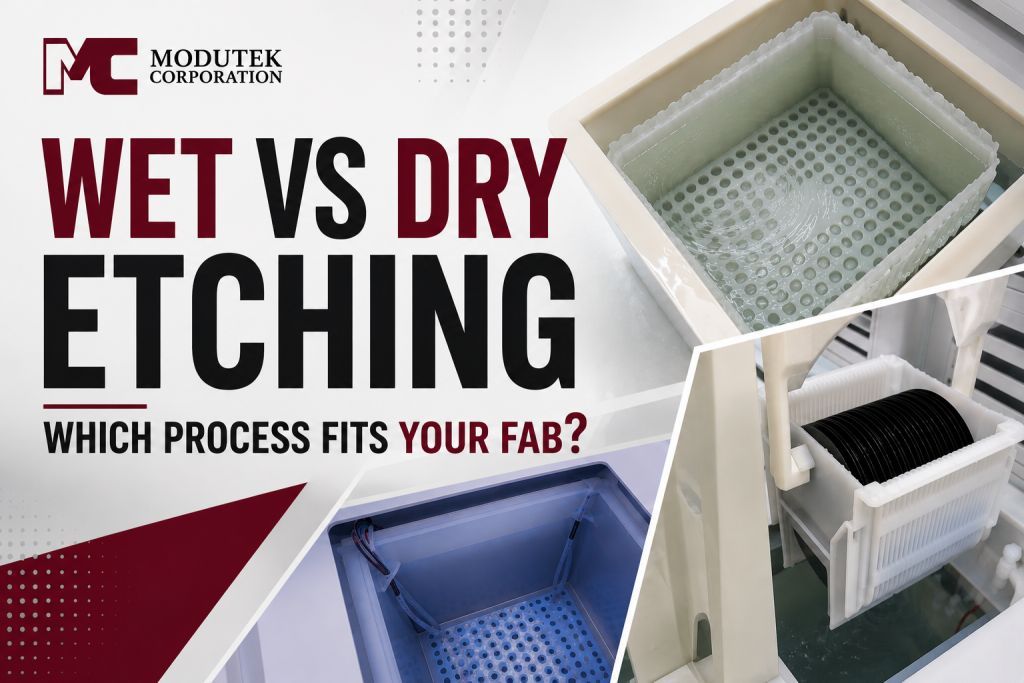
 Wet vs. dry etching usually comes down to one practical question: does this step need selectivity and low damage or tight directional control? Both methods remove material from a wafer, but they get there in different ways, and that difference shows up directly in cost, throughput, and the shape of the features you end up with. This guide covers how each method works in the wafer etching process, how they differ, how to choose between them for a given process step, and when both may be used in the same fabrication flow. Modutek manufactures wet process equipment, not dry or RIE tooling, so the comparison below is neutral technical background to help you scope a process step correctly, not a survey of Modutek’s product line.
Table of Contents
- How Wet Etching Works
- How Dry Etching Works
- Wet vs. Dry Etching: Key Differences
- When to Choose Wet Etching
- When to Choose Dry Etching
- Can Wet and Dry Etching Be Combined in the Same Process Flow?
- Choosing the Right Etch Process for Your Fab
- FAQs
1. How Wet Etching Works
Wet etching removes material through a chemical reaction with a liquid etchant. The wafer sits in a bath of that chemistry; the reaction strips away the target film or substrate, and a rinse step clears the residue before the next process. That’s the mechanism in its simplest form, but the details split into two distinct behaviors worth knowing separately because they lead to very different results on the wafer.
Isotropic Wet Etching
Wet etching is typically isotropic. It removes material at roughly the same rate in every direction, so a masked opening etches straight down and sideways at approximately the same rate, undercutting the mask as it goes. On a circular opening, that undercut is symmetric and often tolerable. On a tight-pitch pattern, it eats into feature spacing fast enough to blur the geometry the mask was supposed to define. That’s less a flaw in the chemistry than a fact of how it works, and it’s exactly why isotropic wet etching earns its keep on blanket film removal or high-selectivity clean-up steps where profile shape doesn’t matter much. Ask it to hold a tight, vertical sidewall, and it won’t.
Anisotropic Wet Etching (KOH and TMAH)
Here’s where most comparison articles get lazy: they treat “wet” as synonymous with “isotropic” and stop there. It isn’t always true. Potassium hydroxide (KOH) and tetramethylammonium hydroxide (TMAH) etch single-crystal silicon anisotropically, because etch rate depends on which crystal plane is exposed. The {111} planes etch far more slowly than the {100} and {110} planes, often by more than an order of magnitude. As faster-etching planes are removed, the slowly etched {111} planes become exposed and form geometrically predictable sloped sidewalls, which is why KOH and TMAH are widely used to create structures like V-grooves and pyramidal cavities. TMAH is chemically distinct from KOH and can offer greater compatibility with silicon-dioxide masking and CMOS-related processing than KOH, so it’s worth treating as its own process rather than a KOH substitute when you’re specifying a chemistry for a new step. Modutek builds Teflon tanks for TMAH and KOH etching that withstand both chemistries.
2. How Dry Etching Works
Dry etching skips the liquid chemistry entirely. A common form, reactive ion etching (RIE), generates a low-pressure plasma of reactive ions and radicals, then accelerates those ions toward the wafer with an electric field. The ions physically bombard the surface while the radicals react chemically, and together they give dry etching its defining trait: strong directional, anisotropic control that isn’t limited to specific crystal planes the way KOH and TMAH are. Unlike wet etching, the dry-etch step itself does not require a liquid rinse bath, although subsequent cleaning may still be required. There’s also no batch tank, since many modern dry-etch tools process wafers individually inside a vacuum chamber, which is a meaningfully different cost and throughput profile than a wet bench running dozens of wafers at once.
3. Wet vs. Dry Etching: Key Differences
Neither method wins across the board, which is exactly why the choice depends on what a specific step actually needs. Here’s how they stack up on the five dimensions that come up most often when a process engineer is deciding between them.
| Dimension | Wet Etching | Dry Etching |
| Selectivity | Can offer very high material selectivity (BOE on oxide vs. silicon is a standard example) | Varies substantially with materials, gas chemistry, plasma conditions, and mask |
| Profile Control | Isotropic by default; KOH/TMAH anisotropic only on specific silicon crystal planes | Directional ion bombardment holds tighter sidewall angles and finer feature definition |
| Cost and Throughput | Batch processing spreads tooling and chemical cost across many wafers, can favor wet at scale | Higher capital cost; many modern tools process wafers individually |
| Surface/Subsurface Damage | No ion bombardment, which eliminates ion-bombardment-related damage mechanisms | Ion bombardment can cause surface or subsurface damage |
| Equipment Complexity | Chemically compatible tanks, plumbing, and delivery systems for the specific chemistry | Vacuum chambers, plasma-generation hardware, and gas-delivery systems |
Selectivity
Wet chemistries can offer very high material selectivity, often making them attractive where selective removal is the primary requirement. Buffered oxide etch (BOE) is a standard example: it removes silicon dioxide while leaving the underlying silicon largely untouched, a clean material-to-material distinction that’s harder to achieve with dry etching, where selectivity varies substantially with materials, gas chemistry, plasma conditions, and mask.
Profile Control
Dry etching’s directional ion bombardment holds tighter sidewall angles and finer feature definition than isotropic wet etching can manage. Anisotropic wet etchants close some of that gap, but KOH and TMAH are limited to crystal-plane-dependent geometries on single-crystal silicon, not arbitrary pattern shapes, so they’re a specialized exception rather than a general answer to the profile-control problem.
Cost and Throughput
Wet etching’s batch processing spreads tooling and chemical costs across many wafers per run, which is a meaningful advantage once volume climbs. Dry etching’s vacuum chambers and plasma-generation hardware carry higher capital costs, and many modern tools process wafers individually, so the cost-per-wafer math can favor wet etching at scale, even before you factor in cycle time.
Surface and Subsurface Damage
Wet etching’s chemical mechanism doesn’t involve the ion bombardment that dry etching relies on, which eliminates ion-bombardment-related damage mechanisms. That matters most on delicate device structures, thin films, or fragile geometries that can’t absorb energetic impact without degrading performance or yield.
Equipment Complexity and Materials
Wet etching needs chemically compatible tanks, plumbing, and delivery systems built specifically for the chemistry in use, since a tank that handles one etchant safely may fail against another. Dry etching needs vacuum chambers, plasma-generation hardware, and gas-delivery systems built to a different set of engineering constraints. Both are demanding to build and maintain. The complexity just shows up in different places.
4. When to Choose Wet Etching
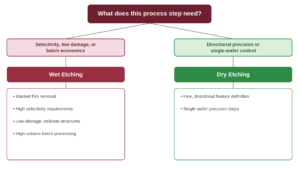
Wet etching is the right call when a step values selectivity, low damage, or batch economics more than tight directional control. Four situations come up often enough to name directly.
Blanket Film Removal
When an entire layer needs to come off without pattern definition, isotropic wet etching is usually the simpler, cheaper route. There’s no profile to control, so the isotropic behavior that’s a liability elsewhere isn’t a problem here.
High Selectivity Requirements
When a step needs to remove one material while leaving another essentially untouched, buffered oxide etch is the standard wet-chemistry solution. Common real-world examples include native oxide stripping and blanket oxide removal before a deposition or diffusion step.
Low-Damage, Delicate Structures
When a device structure can’t tolerate ion-bombardment damage, wet etching’s purely chemical removal mechanism, without energetic ion bombardment, is often the safer choice. This shows up most often on thin films and other geometries where energetic particle impact would degrade performance more than the process gains in profile control. For fragile MEMS structures, wet etching may be preferable when plasma-induced damage is the dominant concern, provided wet-process effects such as undercutting, capillary forces, or stiction are acceptable for the released structure.
High-Volume Batch Processing
When cost per wafer at volume is the priority, wet etching’s batch capability can provide a significant throughput and cost advantage over many single-wafer dry-etch processes. When profile requirements are forgiving enough, this is often the deciding factor.
5. When to Choose Dry Etching
Dry etching earns its place when a step needs directional precision or single-wafer control more than selectivity or batch cost. Two situations come up often enough to name directly.
Fine, Directional Feature Definition
When sidewall angles or feature geometry need to hold tolerances that isotropic chemistry can’t, directional ion bombardment is the standard tool for the job. This is most common on advanced patterning steps where the profile itself is the point, not just the material removed.
Single-Wafer Precision Steps
When a process needs wafer-by-wafer control rather than uniform batch treatment, single-wafer dry etch tools deliver that granularity at a real cost and throughput trade-off worth weighing against the precision gained. That trade-off is usually worth it when a step is sensitive enough that batch-to-batch or wafer-to-wafer variation in a bath process would be unacceptable.
6. Can Wet and Dry Etching Be Combined in the Same Process Flow?
Regularly, yes. Most fabrication sequences don’t standardize on one method; they assign each step to whichever process handles it best. A common pattern uses dry etching for steps that need precise directional profile control, then wet etching downstream for blanket removal or high-selectivity clean-up where damage risk and cost matter more than profile precision. Treating “wet vs dry” as an either-or choice for an entire process flow usually leaves performance or cost savings on the table somewhere in the sequence, since few real processes are uniform enough to be well served by a single etch method from start to finish.
7. Choosing the Right Etch Process for Your Fab
Wet and dry etching solve different problems. The right call comes down to selectivity, profile control, damage tolerance, and volume, not a blanket preference for one method over the other. Modutek designs and builds wet process systems in-house, so if you’re weighing where wet etching fits into a specific process flow, it’s worth having that conversation before you lock in equipment. Contact Modutek’s team to talk through your wet vs. dry etching decision for your next process step.
8. FAQs
1. Can Dry Etching Be Isotropic Too?
Yes. Not all dry etching relies on directional ion bombardment. Xenon difluoride (XeF₂) vapor-phase etching is a dry process that etches silicon isotropically with no plasma and no ion bombardment: a room-temperature gas-phase reaction that’s specifically used for isotropic silicon etching and commonly used to undercut and release suspended structures in MEMS fabrication, the reverse use case from RIE’s directional control. “Dry” and “anisotropic” aren’t strictly synonymous; the same trap the wet-side isotropic/anisotropic distinction above warns against. LNF Wiki
2. Is Wet Etching Always Less Expensive Than Dry Etching?
Not automatically. Capital cost and per-wafer throughput favor wet at volume, but total cost also includes consumables and waste handling. Wet etching uses larger chemical volumes per run and generates spent liquid that needs collection or neutralization, while dry etching uses less gas per run but adds vacuum pump maintenance and exhaust abatement. Which one comes out cheaper depends on chemistry, volume, and a facility’s existing waste-treatment infrastructure, not the process family alone.
3. What Safety Considerations Apply to Wet Etching Chemistries?
They vary widely by chemistry, and HF-based etchants set the upper bound. Hydrofluoric acid attacks glass and many common metals, can injure skin without immediate pain, and gives off vapor that needs active capture, so it calls for chemically compatible tanks and plumbing, engineered containment, and vapor extraction well beyond general acid-safety practice. KOH and TMAH carry their own risks: KOH is highly caustic and attacks aluminum, while TMAH is toxic through skin absorption even though it avoids KOH’s metal-ion contamination problem. Modutek’s guides on Safe chemical handling and disposal with chemical carts and How acid fume scrubbers improve Safety and Compliance in Industries cover the containment and vapor-control equipment side of this, by chemistry.
4. Can the Same Tank Be Used for Both KOH and TMAH Etching?
Materially, yes, Modutek’s Teflon tanks withstand both chemistries. Process-wise, most fabs still dedicate separate tanks per chemistry. KOH contains potassium ions that can contaminate CMOS devices, which TMAH does not, so running both in the same bath risks cross-contaminating a CMOS-sensitive process, even though the tank material itself handles either chemistry fine.
5. How Do I Decide Between Wet and Dry Etching for a New Process Step?
Start with what the step needs most: high selectivity or low damage points to wet; tight directional control points to dry; cost sensitivity at volume favors wet’s batch processing. Then run a small test batch on witness wafers to confirm etch rate, uniformity, and mask compatibility before committing a chemistry or tool to full production. Most fabs use both, matched to the step.