 Editor’s Note: This article was originally published in June 2014, updated in March 2023, and updated again in 2026 to add process-control detail, tank safety features, and related equipment content consolidated from across Modutek’s wet etching products.
KOH (potassium hydroxide) and TMAH (tetramethylammonium hydroxide) are two commonly used chemicals for etching silicon, glass, and other materials. The etching process dissolves the material’s surface, leaving behind a desired pattern or shape. When using these chemicals, choose a tank material resistant to their corrosive properties, such as Teflon®.
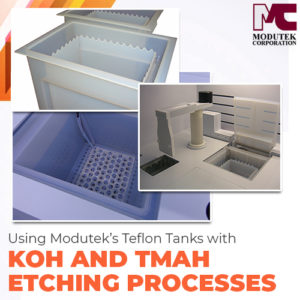
Modutek provides Teflon® tanks well suited for both KOH etching and TMAH etching processes. These tanks resist chemical corrosion, making them a safe and reliable option for handling these caustic substances. However, several additional considerations should be kept in mind when using KOH and TMAH for etching.
Why KOH and TMAH Etching Precision Matters
Both chemistries are essential for producing the well-defined trenches, cavities, and channels used in MEMS components, sensors, and integrated circuits, which is why the etch tank itself, not just the chemistry, directly affects wafer yield.
Key Challenges in KOH and TMAH Etching
- Contamination — even minor impurities in the tank or solution can disrupt the etching process and cause defects.
- Process control — consistent temperature, concentration, and agitation must be maintained for uniform etching across the wafer.
- Safety — the hazardous nature of KOH and TMAH requires robust safety measures to protect both personnel and the environment.
Etching Rates and Material Compatibility
Another important consideration when using KOH and TMAH for etching is the etching rate. Various factors can affect the rate at which these chemicals etch materials, including solution concentration, temperature, and the surface orientation of the material being etched. Optimizing these factors is necessary to achieve the desired etching rate and profile.
Also consider the compatibility of the material being etched with the chosen etchant. While KOH and TMAH can etch a wide range of materials, not all materials are compatible with these etchants, and some may require specialized etching solutions. Before using these chemicals, check whether the material is compatible with the chosen etchant.
After etching, residues may remain on the material surface. You can remove these residues using various techniques, such as rinsing with deionized water or using a plasma cleaner. The choice of technique will depend on the nature of the residue and the material being etched.
Chemical Compatibility and Cleanliness
Tank cleanliness matters as much as the compatibility of the material being etched above. KOH and TMAH are reactive chemicals, and any contamination introduced by the tank itself, not the material, can show up as defects in the etched pattern. Using a non-reactive tank material like Teflon prevents the tank from contaminating the process, keeping the etching environment pure.
What Determines Etch Rate and Direction
Etch rate and etch direction are set by four factors, established before the process starts or adjusted in real time as it runs:
- Concentration — a higher concentration increases etch rate. KOH concentration typically runs around 30% by weight, with a usable range of roughly 10–50%. It’s fixed once etching begins.
- Crystal lattice orientation — silicon’s cubic crystal lattice has different atom densities in different directions, so etching proceeds faster in some directions than others.
- Doping — introducing boron at a specific point in the lattice stops etching in that direction, giving precise control over the final shape.
- Temperature — the only factor that can be adjusted during the process itself, which makes it the main real-time lever for etch-rate control.
The wafer is masked with a material such as silicon nitride, which resists KOH, so the solution only etches the exposed areas. Getting the rate right matters in both directions: too fast, and the KOH etches too far into the silicon; too slow, and the resulting structures come out shallower than intended. Because doping can block etching in one direction while leaving others active, a mid-process temperature change affects the remaining active directions differently—which is why real-time temperature control, not just an accurate starting recipe, determines whether the final etched shape comes out correct.
Modutek’s tanks are built to support this kind of control: the solution heats quickly to a set temperature, holds there precisely until the operator changes the set point, then ramps to the new temperature just as quickly. This combination of fast, accurate ramps and a stable hold lets operators either keep etch rate steady for a fixed recipe or adjust it deliberately mid-process.
Getting this right isn’t just a quality detail. A tight, repeatable etch rate is what keeps particle counts low, reduces wasted material, and keeps defective wafers off the line.
Tank Maintenance and Safety Considerations
Proper tank maintenance is essential for ensuring the longevity of Teflon® tanks used in KOH and TMAH etching processes. Keep the tank surface free of scratches and clean it regularly with appropriate cleaning agents. Also, check the tanks periodically for leaks and other damage to keep them in good condition.
It is important to take appropriate safety precautions when handling and using these chemicals. Both KOH and TMAH can be dangerous if not handled properly, so wear protective gear such as gloves, safety goggles, and lab coats. Use proper ventilation, such as chemical fume hoods. Additionally, follow proper chemical waste disposal procedures to ensure safe disposal of these substances.
Equipment-Level Safety Features
Beyond personal protective equipment, Modutek’s Teflon tanks include equipment-level safeguards: leak detection systems and fail-safes that stop chemical spills before they reach the operator, along with level and temperature limit settings and a drain interlock built into the tank. These features meet relevant industry safety and environmental compliance standards, protecting both personnel and the surrounding facility from KOH and TMAH etching hazards.
Modutek’s Equipment Support for KOH and TMAH Etching
Modutek’s TFa and TI series PFA Teflon® Tanks, and other wet bench equipment, fully support KOH etching and TMAH etching processes. These Teflon® Tanks are designed with other wet bench equipment to reduce impurities and unwanted byproducts through advanced welding techniques with PFA sheet material. Once the initial process is established, continual adjustments to the Si etching process are not necessary. Modutek constructs all Teflon® Tanks and related equipment to individual customer specifications and routinely designs products compatible with a customer’s existing wet bench equipment.
Modutek’s Teflon® Tanks have an operating temperature range from 30 – 100º C, with a process temperature control of ± 0.5º C and a heat-up rate from 2-3º C per minute (depending on the size of the system). The modular design allows new installations or upgrades to any wet etching station configuration.
Teflon® Tank Configurations that Support KOH and TMAH Etching:
- Temperature Controlled Recirculating Baths (TFa Series)
- Temperature Controlled Static Baths (TI Series)
Teflon® Tank design features:
- Manual cover with overlapping seal
- Minimizes water lost
- No concentration deficiency over a long etch time
Heat source options include:
- Teflon® inline heating
- Immersion heating in overflow weir for TFa Series and main tank for TI Series
Custom Teflon® Tanks and Additional Options:
- Custom-size Teflon® tanks can also be built to match any size (no limitations)
- Bottom drain features
- Magnetic stirrer for agitation (TI and TT series)
- Water-condensing refluxor system available on all baths
- Auto lid feature
- DI water or IPA spiking system available
Agitation and Uniform Chemical Exposure
Agitation is a process variable in its own right, not just a tank accessory. Modutek’s tanks support agitation mechanisms that maintain steady chemical flow across the wafer, so every area gets even exposure to the etchant instead of some spots processing faster than others. This is available as the magnetic stirrer option listed above (TI and TT series), and works alongside temperature control to keep the etch uniform across the whole wafer, not just accurate on average.
Chemical Delivery Supports Etch Accuracy
Because etch rate depends partly on getting KOH concentration exactly right, an accurate chemical delivery system matters as much as the tank itself. It ensures the tank contains the correct solution concentration before etching starts. Concentration and temperature are the two variables that determine etch rate once a doped, correctly oriented wafer is placed in the tank. See Modutek’s chemical delivery systems for how this integrates with a KOH or TMAH etch station.
Benefits of Modutek’s Teflon® Tanks:
- Modular design
- Two available heat sources
- All Teflon® fluid path
- Process temperature control of ± 0.5º C
- Process etch uniformity wafer to wafer <2%
- In-house heater maintenance and repair
- 360-degree overflow filtration
- Uniform heating throughout the bath
Why Teflon Tanks Improve Etching Outcomes
Beyond the individual specs above, Teflon’s material properties translate into four practical outcomes:
- Enhanced cleanliness — Teflon’s non-porous surface helps maintain a contaminant-free environment, critical for high-quality etching.
- Improved process control — better control over etching means uniform temperature distribution and consistent chemical concentrations.
- Increased safety — Teflon’s chemical resistance reduces the risk of leaks and spills.
- Durability — Teflon’s robust, non-reactive nature means long-term reliability, with less downtime and lower maintenance costs from repeated exposure to harsh chemicals.
Benefits for Process Engineers
For process engineers specifically, these tanks translate into:
- Efficiency and yield — precise etch-rate control reduces defects and increases yield.
- Lower downtime and maintenance costs — durable, non-reactive construction needs less upkeep, freeing engineers to focus on process optimization instead of tank maintenance.
- Safety and compliance — leak detection and industry-standard compliance reduce exposure and spill risk.
- Flexibility for R&D — the same tank platform adapts to experimental setups as easily as production runs.
- Long-term reliability and support — backed by Modutek’s ongoing customer support for equipment issues.
Using These Tanks in R&D and Tabletop Applications
The same Teflon tank platform used in full-production wet benches is also available in Modutek’s tabletop/prototyping baths, giving R&D and small-batch labs the same chemical resistance, temperature precision, and contamination control in a compact, benchtop format. Testing a new etch chemistry, validating a process change, or running a small experimental batch all need the same accurate, repeatable control as a production line, just at a smaller scale — which is what makes the tabletop version useful for adapting to different chemistries and process changes without sacrificing the accuracy production runs need.
Modutek provides world-class service, installation, and support for all Teflon® Tanks and related wet bench equipment. Modutek also provides quality products focused on reliability, precision, throughput, usability, and uptime. For more information, contact Modutek for a free quote or consultation.