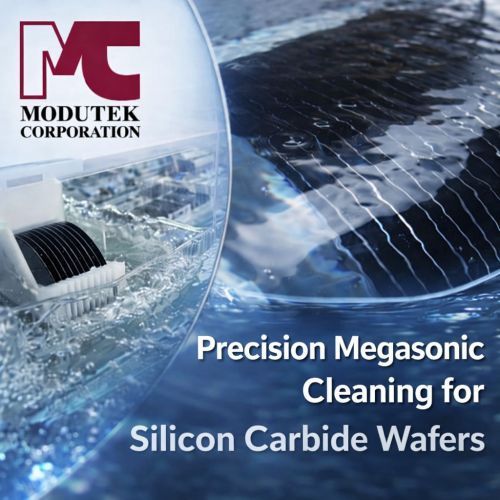
 Summary: Silicon carbide wafers present a cleaning problem that silicon never did: the surface features most sensitive to damage — gate oxides, epitaxial layers, deep trench structures — sit on a substrate harder than almost any other semiconductor material. Megasonic cleaning addresses this directly, delivering controlled acoustic energy precise enough to remove sub-micron contamination without mechanical stress on patterned device structures used in power electronics and RF applications.
Table of Contents
- Why Silicon Carbide Wafer Cleaning Requires Specialized Precision
- How Megasonic Cleaning Works in Front-End Wafer Cleaning Sequences
- Silicon vs. Silicon Carbide Cleaning Considerations and Process Tuning
- Benefits of Megasonic Cleaning for SiC Wafers
- Selecting the Right Wafer Processing Equipment for Megasonic Applications
- Frequently Asked Questions
1. Why Silicon Carbide Wafer Cleaning Requires Specialized Precision
Silicon carbide (SiC) has become the material of choice for power electronics, electric vehicle inverters, and high-frequency RF devices — and its adoption is accelerating. Standard wafer-cleaning methods were not designed for the demands of SiC fabrication.
Material hardness does not equal surface durability. SiC’s mechanical hardness applies to the substrate — not to the gate oxides, epitaxial layers, or trench sidewalls built on top of it. Those structures remain highly vulnerable:
- Gate oxide damage: Physical destruction of the oxide layer causes device failure that cannot be recovered downstream.
- Epitaxial layer integrity risks: Cleaning-induced surface damage or contamination can degrade epitaxial layer quality, potentially contributing to defect formation, interface irregularities, or downstream process variability. These effects may reduce device yield or reliability depending on defect type, location, and subsequent thermal or deposition steps.
- Trench structure deformation: Pattern geometry changes during cleaning alter device electrical characteristics.
- Micro-cracking in stressed regions: Subsurface damage that passes visual inspection but causes field failures.
Front-end wafer cleaning often targets sub-micron particles (including <0.2 µm in many flows) without damaging delicate surface topography. Conventional cleaning methods force a trade-off: effective particle removal or surface preservation. The wafer-cleaning process for SiC requires both processes to be performed simultaneously.
Standard industrial ultrasonic cleaning typically spans from 20–200 kHz, generating large, energetic cavitation bubbles that pose an unacceptable risk to SiC patterned wafers. Megasonic cleaning addresses this directly: operating in the 850 kHz–2 MHz range, where controlled cavitation effects and strong acoustic streaming support sub-micron particle removal while reducing pattern-damage risk when process parameters such as power density, chemistry, and exposure time are properly optimized.
2. How Megasonic Cleaning Works in Front-End Wafer Cleaning Sequences
Megasonic cleaning operates at frequencies between 850 kHz and 2 MHz, generating acoustic energy through mechanisms that lower-frequency ultrasonic systems cannot achieve.
At megasonic frequencies, cavitation activity is typically reduced and occurs at smaller scales than in low-frequency ultrasonics. Combined with acoustic streaming, this can remove fine particles with a lower risk of pattern damage to wafer surfaces when power density, chemistry, and exposure time are properly controlled.
| Parameter | Ultrasonic Cleaning | Megasonic Cleaning |
| Typical Frequency Domain | ~20–200 kHz (commonly ~35–45 kHz) | ~0.8–2 MHz (process-dependent) |
| Cavitation Behavior | Larger, higher-energy cavitation events | Smaller, lower-energy cavitation activity |
| Bubble Dynamics | More violent collapses, higher localized forces | Less violent activity, more uniform energy distribution |
| Dominant Cleaning Mechanism | Cavitation-driven mechanical agitation | Acoustic streaming + gentle cavitation |
| Surface Interaction Risk | Higher risk on delicate features / thin films | Reduced risk for sensitive surfaces |
| Best Fit Applications | Robust parts, gross contamination removal | Precision wafer cleaning, fine particles |
Boundary-layer thinning is one of the most valuable features of megasonic cleaning. The stagnant fluid layer immediately adjacent to the wafer surface resists chemical penetration. Megasonic-induced acoustic streaming can disrupt the near-surface boundary layer, thereby improving mass transport and enabling fresh chemistry to reach the wafer surface more effectively during the clean process.
The result:
- No physical contact with device structures — cleaning force is delivered entirely through the liquid medium, protecting fragile features
- Continuous particle evacuation — acoustic streaming creates directional fluid movement that carries dislodged particles away from the wafer surface, preventing redeposition
- Sub-micron contamination removal without abrasion — particles are displaced without mechanical tools or contact
Megasonic cleaning integrates with standard semiconductor cleaning chemistries:
- SC1 (ammonium hydroxide + hydrogen peroxide): Megasonic energy enhances particle lift-off and supports organic contamination removal by improving fluid motion and surface interaction. Depending on the specific process window, this can improve cleaning efficiency and may enable optimization of chemical concentration and/or exposure time.
- Dilute alkaline chemistries: Often used for post-CMP residue removal — megasonic enhancement allows lower-concentration solutions to achieve full particle clearance.
- Post-CMP cleaning sequences: Acoustic streaming removes slurry particles and polishing residues while preserving planarization surface quality.
3. Silicon vs. Silicon Carbide Cleaning Considerations and Process Tuning
Process parameters optimized for silicon wafers do not transfer directly to silicon carbide. The differences are significant enough that starting a SiC cleaning process with silicon recipes risks surface damage, yield loss, and invalid experimental results.
Semiconductor process engineers have decades of characterized data — established power density windows, validated chemistry concentrations, and well-documented pattern robustness. That depth of process knowledge does not yet exist for SiC, which means cleaning process development requires deliberate characterization rather than parameter transfer.
SiC-specific factors that demand separate process development
- Harder bulk ≠ more durable surface features: SiC’s mechanical hardness applies to the substrate, not to gate oxides, epi layers, or trench sidewalls — those structures remain highly vulnerable to cleaning-induced stress.
- Epitaxial layer sensitivity: Cleaning-induced surface damage or residual contamination can contribute to epitaxial defectivity and downstream yield variability, making conservative acoustic power density and exposure control important for SiC processes.
- Gate-oxide reliability sensitivity: SiC MOS gate oxides are typically on the order of tens of nanometers and are highly sensitive to defectivity and electric-field stress, requiring carefully controlled cleaning conditions to avoid process-induced damage.
- Complex 3D topography:Deep trench structures create geometry-specific acoustic stress concentrations that flat-surface parameters do not account for.
| Parameter | Silicon Baseline | SiC Adjustment | Rationale |
| Frequency | 850 kHz–1.5 MHz | Often 850kHz–2 MHz, with some SiC processes favoring higher frequencies to balance removal and pattern-damage risk | Smaller bubbles, reduced impact energy |
| Power Density | Standard | Reduced — start conservative | Protects fragile surface features |
| SC1 Concentration | Established recipe | Typically requires separate characterization | SiC etch characteristics differ from those of silicon |
| Exposure Time | Standard | Shorter at appropriate power | Prolonged exposure accumulates stress even at low power |
Process validation for SiC follows a defined sequence:
- Post-clean defect inspection: Optical and scanning electron microscopy (SEM) to detect surface damage not visible to the naked eye
- Electrical parameter testing: Confirm that breakdown voltage, threshold voltage, and leakage current remain within specification after cleaning
- Yield monitoring: Statistical process control (SPC) across multiple lots confirms process stability is maintained, not just achieved once
4. Benefits of Megasonic Cleaning for SiC Wafers
For SiC wafer processing, the difference between a generic cleaning approach and an optimized megasonic process is evident in yield data, device reliability, and surface quality at inspection.
Sub-Micron Particle Removal
Process engineers reduce killer defect density and improve end-of-line yield. R&D professionals: establish a reliable, repeatable surface baseline for experimental accuracy.
- Effective removal of post-CMP slurry residues below 0.2 µm
- Elimination of organic and metallic contaminants
- Acoustic streaming prevents the redeposition of dislodged particles
Non-Damaging Precision
Process engineers: protect device structures through production-scale cleaning cycles. R&D professionals: preserve the surface state between experimental process steps.
- Smaller cavitation bubbles minimize physical impact on device features
- MHz-frequency operation can reduce pattern-damage risk versus lower-frequency ultrasonics when power density, chemistry, and exposure time are properly optimized
- Gate oxides, epitaxial layers, and trench sidewalls remain intact through the cleaning cycle
Enhanced Surface Preparation
Process engineers: cleaner interfaces mean better film step coverage and fewer deposition defects. R&D professionals: controlled surface chemistry enables more accurate characterization of subsequent process results.
- Improved film adhesion at deposited layer interfaces
- Consistent nucleation and growth on clean surfaces
- Reduced post-CMP contamination carried into subsequent steps
Improved Process Repeatability
Process engineers: Statistical process control becomes viable when acoustic parameters are stable from run to run. R&D professionals: repeatable cleaning conditions are a prerequisite for publishable experimental results.
- Stable acoustic field design maintains uniform energy distribution
- Precise control of frequency, power, temperature, and chemistry
- Real-time monitoring supports data-driven process validation
These improvements translate directly to production outcomes: higher yield per wafer, improved device reliability in the field, and tighter electrical parameter distributions across a production lot. For R&D environments, they produce more reproducible experimental conditions and higher confidence in published results.
5. Selecting the Right Wafer Processing Equipment for Megasonic Applications
Choosing wafer processing equipment for megasonic SiC applications requires evaluating both technical capabilities and operational requirements. Use the following criteria as an evaluation checklist:
Megasonic System Evaluation for Silicon Carbide (SiC) Cleaning
| Evaluation Criteria | What to Look For | Why It Matters for SiC |
| Frequency Control | Adjustable across the megasonic range (~0.8–2 MHz), with stable and repeatable settings | SiC processes are energy-sensitive; frequency influences cavitation behavior and defectivity risk. |
| Power Density Control | Precise, uniform energy delivery with the ability to tune acoustic intensity | Excessive localized energy can induce surface damage or micro-defects on SiC wafers and films |
| Chemical Compatibility | Stable acoustic performance across process chemistries, temperatures, and fluid properties | Fluid chemistry strongly affects cavitation and streaming efficiency, which is critical to SiC cleaning outcomes |
| Process Data Tracking | Monitoring of frequency, power, temperature, and runtime parameters | SiC yield and reliability are defect-limited, requiring repeatable and traceable cleaning conditions |
| Safety Compliance | Conformance with applicable safety standards and risk-mitigation design practices | SiC manufacturing environments involve aggressive chemistries and demand safe equipment operation |
| Construction Materials | Quartz, Teflon, or rated polymers | Prevents chemical degradation and cross-contamination |
| Custom Tank Configurations | Configurable for wafer size and cassette format | SiC production uses varied wafer sizes |
| Factory Acceptance Testing | Supplier-conducted FAT before shipment | Confirms equipment meets spec before installation |
Modutek has designed and built semiconductor wet processing equipment for over 45 years. For megasonic SiC applications specifically, that means:
- Custom-engineered wet benches built around your process requirements
- Megasonic cleaning integration is compatible with manual, semi-automated, and fully automated process flows
- Material selection for your chemistry — tanks, plumbing, and seals specified for SC1, alkaline, and other SiC-compatible chemistries
- Process control instrumentation with real-time monitoring of frequency, power density, temperature, and chemistry concentration
- Factory acceptance testing conducted before shipment — equipment arrives verified against your specifications
- Long-term service and support with documented maintenance schedules and responsive technical assistance
Every configuration is built around your process requirements — not adapted from a catalog of off-the-shelf products.
6. Frequently Asked Questions
Q1: Why is megasonic cleaning preferred for silicon carbide wafers?
Megasonic cleaning removes sub-micron particles using controlled acoustic energy while minimizing risk to fragile surface features and patterned device structures. MHz-frequency operation generates smaller cavitation bubbles, delivering cleaning effectiveness without the mechanical damage associated with lower-frequency ultrasonic methods.
Q2: How is megasonic cleaning different for SiC compared to silicon?
Megasonic cleaning for SiC wafers is typically implemented within the megasonic range (~0.8–2 MHz), with many processes using the higher end of this range to balance fine-particle removal and pattern-damage risk; optimal frequency selection depends on device architecture, contamination type, and power density.
Q3: What chemistries are used with megasonic cleaning for SiC?
SC-1 (ammonium hydroxide + hydrogen peroxide) is widely used for particle removal and certain organic contaminants in SiC cleaning flows. Megasonic agitation and acoustic streaming can enhance cleaning efficiency, which may allow optimization of SC-1 concentration and/or exposure time based on defectivity and material constraints. Dilute alkaline chemistries are also commonly applied for post-CMP residue removal. Cleaning parameters should be characterized specifically for SiC rather than transferred directly from silicon processes, as SiC’s distinct surface chemistry and etch behavior can produce different responses under otherwise similar conditions.
Q4: How do you prevent pattern damage during SiC cleaning?
Pattern damage is minimized by selecting conditions within the megasonic range (~0.8–2 MHz), often by evaluating higher frequencies to balance particle removal and feature integrity. Power density and exposure time are kept within conservative limits, with development typically starting at low acoustic power and increasing incrementally. Results are commonly validated using post-clean defect inspection (SEM or optical) and appropriate electrical testing.
Q5: Can megasonic systems be customized for specific wafer topographies?
Acoustic parameters, chemistry-compatible materials, tank geometry, and process monitoring can all be configured around specific device topographies and yield targets — without requiring changes to your existing process flow.
Next Steps
SiC wafer cleaning processes are highly parameter-sensitive — frequency, power density, chemistry, and exposure time all require validation for your specific device structures. Modutek’s engineering team works directly with process engineers and R&D scientists to configure megasonic cleaning systems around your application requirements.
Contact Modutek for a free consultation to discuss your Silicon Carbide Wafer Process Requirements.
Bring your process parameters and device specifications. We’ll identify a configuration that fits your cleaning sequence.