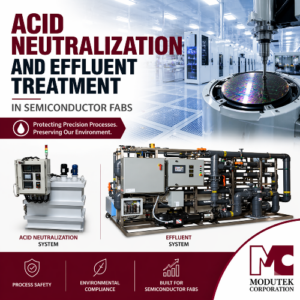
 Acid Neutralization in Semiconductor Fabs: The Infrastructure That Protects Your Permit and Your Uptime
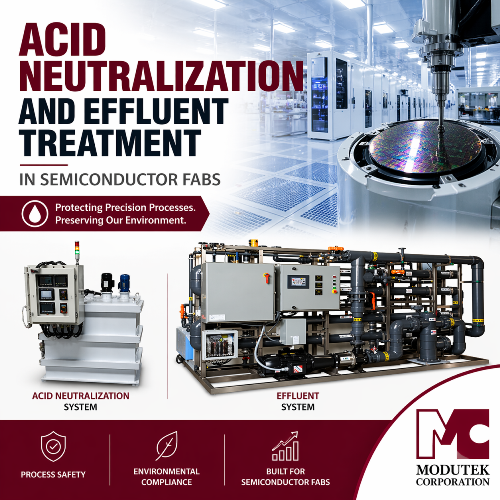
A single permit exceedance can halt production. For semiconductor fabs handling hydrochloric, sulfuric, and nitric acids daily, acid neutralization is not a back-end detail — it is the infrastructure that keeps the wastewater stream compliant, the facility running, and the permit intact. This guide covers how neutralization systems work, how they connect to downstream effluent treatment, and the compliance and operational risks that appear when any link in that chain is missing.
Table of Contents
- Why Acid Neutralization Is Non-Negotiable in Semiconductor Fab Operations
- How Acid Neutralization Systems Work: Step-by-Step
- From Neutralization to Effluent Treatment Plants (ETPs): When pH Adjustment Isn’t Enough
- Regulatory and Environmental Requirements: What the EPA Requires
- System Integration: The Risks of Disconnected Chemical Infrastructure
- Frequently Asked Questions (FAQ)
1. Why Acid Neutralization Is Non-Negotiable in Semiconductor Fab Operations
Wet processing is a cornerstone of semiconductor fabrication. Processes such as etching, cleaning, and surface preparation rely on aggressive chemicals — including hydrochloric acid (HCl), sulfuric acid (H₂SO₄), nitric acid (HNO₃), and other process acids — to achieve the precise material removal and surface conditions required at each stage of wafer production.
Once these chemicals have served their process function, spent acid waste cannot be discharged directly into facility drain systems or municipal wastewater infrastructure. Untreated acid effluent poses serious risks: it corrodes piping and containment systems, creates toxic exposure hazards for facility personnel, and violates environmental discharge regulations enforced by agencies such as the U.S. Environmental Protection Agency (EPA).
Acid neutralization is the first and most critical step in safely managing this waste stream. It involves adjusting the pH of collected acid effluent to an acceptable range — typically between pH 6 and pH 9 — before the waste proceeds to downstream treatment or discharge. Without this step, every subsequent stage of effluent handling carries compounded risk.
But the quality and volume of that waste stream don’t begin at the drain; they begin at the point where process chemicals first enter the facility. Upstream of neutralization, chemical delivery systems play an equally important role. These systems are responsible for safely transporting process chemicals from bulk storage to wet bench systems. A well-designed delivery system minimizes chemical loss, reduces spill risk, and provides the process consistency that facilities need for predictable waste management.
A poorly designed or incompatible upstream delivery system doesn’t just create spill risk; it introduces variability into the waste stream, making neutralization less predictable, increasing reagent consumption, and raising the risk of pH excursions that trigger permit violations.
For facilities engineers and process teams managing semiconductor fabs, understanding this connection — from chemical delivery through to neutralization — is foundational to building a safe, compliant, and efficient operation.
2. How Acid Neutralization Systems Work: Step-by-Step
An acid neutralization system collects spent acid effluent from process tools, adjusts pH through a controlled chemical reaction, and routes the treated waste to the facility drain or an effluent treatment plant. The engineering requirements for a reliable, compliant system are significant — and the cost of getting them wrong shows up in permit exceedances, unplanned downtime, and hazardous chemical incidents.
- Collection: Spent acid waste from wet bench tools is routed through dedicated drain lines into a neutralization tank or sump. Segregating acid and solvent waste streams at this stage is critical. Mixing incompatible waste streams can produce dangerous reactions, generate heat, or create gases that compromise downstream treatment and personnel safety.
- pH Monitoring: Continuous pH sensors monitor the incoming waste stream and tank contents in real time. They provide the data trail required to demonstrate continuous compliance during a regulatory inspection and the control signal needed for accurate reagent dosing.
- Reagent Dosing: A neutralizing reagent — typically sodium hydroxide (NaOH) or sulfuric acid (H2SO4) is automatically dosed into the tank in response to pH readings. Automated systems control dosing to achieve accurate, repeatable neutralization without over- or under-correction.
- Mixing and Reaction: Agitation systems ensure thorough mixing of the acid waste and neutralizing reagent, promoting complete reaction and consistent pH throughout the tank volume.
- Discharge or Transfer: Once pH falls within the permitted discharge range, the treated effluent is either discharged to the municipal sewer system or transferred to a downstream effluent treatment plant for further processing.
Materials of Construction
All wet processing components, including tanks, piping, and fittings, must be chemically compatible with the specific acid streams being handled. The table below summarizes the three most common material options:
| Material | Typical Application | Key Properties | Best For |
| PP | General acid service | Good chemical resistance, cost-effective, lightweight | Standard HCl, H₂SO₄, HNO₃ waste streams |
| HDPE | General acid service | Impact resistant, excellent chemical resistance, FDA-compliant grades available | Higher-volume or outdoor neutralization tanks |
| PVDF | High-purity / demanding applications | Very high chemical resistance, low extractables, temperature-stable | Acid-containing streams, high-purity process requirements |
Fail-safes such as high-level alarms, secondary containment, and redundant pH sensors provide the operational reliability that facilities teams require. Material compatibility must be verified against the full range of chemicals present in the waste stream.
3. From Neutralization to Effluent Treatment Plants (ETPs): When pH Adjustment Isn’t Enough
Acid neutralization addresses pH, but pH adjustment alone does not remove dissolved metals, suspended solids, or other contaminants present in semiconductor fab wastewater. For facilities with more complex waste streams, an Effluent Treatment Plant (ETP) provides the additional treatment stages required to meet discharge permit conditions.
Key ETP Treatment Stages
- Chemical Precipitation: Dissolved contaminants, including heavy metals, fluoride (common in acid-based wet etch processes), and other process-specific compounds, are removed through reagent addition. Lime (calcium hydroxide) is commonly used to raise pH and precipitate metals as insoluble hydroxides; the specific target pH for precipitation varies by metal species.
- Solid-Liquid Separation: Precipitated solids are separated from the liquid waste stream through clarification, sedimentation, or dissolved air flotation (DAF). The resulting sludge is collected for disposal as hazardous waste.
- Filtration and Polishing: The clarified effluent passes through filtration stages such as sand filtration or membrane filtration to remove residual suspended solids and achieve the water quality required for discharge or reuse.
- pH Final Adjustment: A final pH trim ensures the treated effluent consistently meets discharge permit specifications before it leaves the facility.
The connection between neutralization and ETP performance is direct: poorly neutralized influent increases chemical consumption in the ETP, accelerates wear on treatment equipment, and raises the risk of permit exceedances. Chemical handling equipment and systems that safely transport spent process chemicals from tools to the neutralization stage, and from neutralization to the ETP, are therefore integral to the overall treatment infrastructure.
4. Regulatory and Environmental Requirements: What the EPA Requires
Semiconductor fabs operate under a complex and evolving set of environmental regulations governing the discharge of process wastewater. In the United States, the EPA’s Clean Water Act establishes the framework for industrial wastewater discharge through the National Pollutant Discharge Elimination System (NPDES) permit program.
Semiconductor fabs are specifically governed under 40 CFR Part 469 (Electrical and Electronic Components Effluent Guidelines), which covers both direct and indirect dischargers. Under 40 CFR § 401.17, facilities with direct discharges to U.S. waters must maintain effluent pH within the range specified in their applicable effluent limitations guidelines, which is typically between pH 6.0 and 9.0.
Risks of Non-Compliance
- Financial penalties: Regulatory agencies can impose substantial fines for permit exceedances, with repeated violations carrying escalating consequences.
- Operational shutdowns: Serious or repeated violations can require a facility to halt production until compliance is demonstrated, a cost that far exceeds the investment in proper treatment infrastructure.
- Reputational damage: Environmental violations are a matter of public record and can affect relationships with customers, investors, and local communities.
Sustainability and Water Reuse
Beyond compliance, well-designed acid neutralization and ETP systems support broader sustainability goals. Treated effluent reused in cooling towers or in non-critical rinse steps can reduce a facility’s freshwater consumption, a measurable, reportable outcome for facilities with water stewardship or ESG commitments. For fabs operating under water-stressed conditions or reporting under GRI 303 (Water and Effluents), this is infrastructure that feeds directly into sustainability disclosures.
Modutek’s chemical delivery systems for wet processing, and chemical collection and waste-handling systems can be customized to provide an integrated chemical infrastructure.
5. System Integration: The Risks of Disconnected Chemical Infrastructure
Acid neutralization and effluent treatment do not operate in isolation. They are the downstream endpoints of a chemical handling infrastructure that begins the moment process chemicals enter the facility. Understanding the full workflow and the risks that emerge when any part of it is disconnected is essential for facilities teams responsible for safety, compliance, and operational continuity.
The End-to-End Chemical Workflow
Chemical Delivery Systems → Process Tools (Wet Benches) → Chemical Collection Systems → Acid Neutralization → Effluent Treatment Plant → Discharge or Reuse
Disconnected Systems vs. Integrated Infrastructure
| Risk (Disconnected Systems) | Benefit (Integrated Infrastructure) |
| Mismatched materials cause leaks at connection points | Single-spec wetted materials eliminate junction failures |
| Neutralization failure allows continued waste generation with no safe discharge path | Integrated controls halt upstream tools on system fault |
| Fragmented data makes continuous compliance reporting difficult | Unified data stream supports continuous compliance documentation |
| Multiple vendors increase parts inventory, training burden, and service scheduling complexity | Single-source support reduces maintenance complexity and total cost of ownership |
With more than 45 years of experience designing and building chemical handling equipment and systems for semiconductor fabs, Modutek engineers each component — delivery, collection, and neutralization — as part of a single, integrated infrastructure. Every system is built in-house and supported from design approval through installation and final acceptance, with direct engineering access at every stage. Learn more about acid neutralization systems for semiconductor fabs.
6. Frequently Asked Questions (FAQ)
Q1: Why is acid neutralization critical in semiconductor fabs?
Semiconductor wet processing generates significant volumes of spent acid waste from etching, cleaning, and surface preparation operations. Process acids cannot be discharged without treatment. They are corrosive to drain infrastructure, toxic to workers and the environment, and prohibited from being discharged directly by environmental regulations. Acid neutralization adjusts the waste stream pH to a safe, permitted range, making it the first and most essential step in any compliant waste management program.
Q2: How do you size an acid neutralization system for a semiconductor fab?
System sizing depends on the volume and concentration of acid waste generated by process tools, the neutralization capacity required to handle peak flow rates, and the target pH range specified in the facility’s discharge permit. Modutek’s engineers review these parameters during the design phase to specify tank volume, reagent dosing capacity, and monitoring equipment appropriate to the specific facility.
Q3: What is the difference between neutralization and effluent treatment?
Acid neutralization adjusts the pH of spent acid waste to a safe, permitted range. It addresses acidity but does not remove dissolved metals, suspended solids, or other process-specific contaminants. An Effluent Treatment Plant (ETP) performs the additional treatment stages required: chemical precipitation, solid-liquid separation, filtration, and final polishing. For simple waste streams, neutralization alone may be sufficient. For streams containing dissolved metals, high solids loads, fluoride, or other regulated compounds, downstream ETP treatment is required.
Q4: How do chemical delivery and collection systems support waste treatment?
Chemical delivery systems ensure that process chemicals are transported safely and accurately from bulk storage to wet-bench systems, directly affecting the composition and volume of the waste stream entering neutralization. Chemical collection systems provide the dedicated drain infrastructure that segregates spent process chemicals by type and routes them to the appropriate treatment pathway. Together, these systems ensure that neutralization and ETP equipment receive a consistent, well-characterized influent, which is essential for reliable treatment performance and permits compliance.
Q5: What materials of construction are used in acid neutralization systems?
All wetted components — tanks, piping, fittings, and pump internals — must be chemically compatible with the specific acid streams being handled. Polypropylene (PP) and high-density polyethylene (HDPE) are widely used for general acid service. PVDF is specified for higher-purity or more demanding applications that require greater chemical resistance and lower extractables. Material compatibility must be verified against the full range of chemicals present in the waste stream.
Q6: What should fabs look for in an integrated chemical handling system?
- Material compatibility: All wet processing components must be chemically compatible with the specific acids and bases used in the process.
- Automation and monitoring: Automated pH control and alarm systems reduce the operator intervention required to maintain permit compliance, and provide the data trail needed to demonstrate continuous compliance during an inspection.
- System integration: When delivery, collection, and neutralization are specified together, connection-point failures, waste stream mismatches, and compliance data gaps are eliminated before they become permit violations.
- Regulatory compliance support: Systems should be designed and documented to support permit applications and compliance reporting.
- Supplier expertise and support: Given the safety-critical nature of acid handling infrastructure, vendor experience, in-house engineering capability, and post-installation support are significant factors in long-term reliability and total cost of ownership.
Work with a Chemical Handling Equipment and Systems Expert
Acid neutralization is only as reliable as the infrastructure around it. When delivery, collection, and neutralization are designed together, by a single engineering team that stays with your project from design approval to final acceptance, permit risk drops, and operational complexity is reduced.
Modutek has been building integrated chemical handling equipment and systems for semiconductor fabs since 1980. Our in-house engineers work directly with your team to specify, build, and design systems matched to your facility’s exact process requirements. Contact Modutek to discuss your facility’s acid handling and compliance requirements.