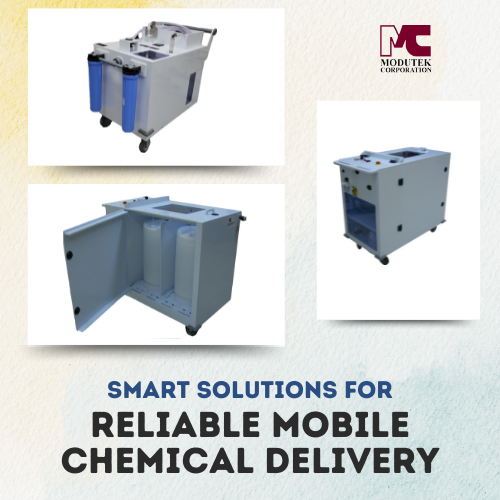
 Summary: Mobile chemical carts deliver fresh chemicals and collect waste in semiconductor wet processing without fixed plumbing infrastructure. Dual-containment systems reduce spill incidents while cutting changeover time from about an hour to under 10 minutes in typical customer deployments.
Table of Contents
- Why Ad-Hoc Chemical Transport Creates Safety Risks and Production Delays
- Six Critical Features Every Chemical Delivery Cart Must Have
- When Mobile Carts Beat Fixed Plumbing Systems
- How to Integrate Chemical Carts with Wet Benches and Safety Programs
- Modutek Chemical Cart Specifications and DOT Compliance Features
- Selection Checklist: Matching Cart Specs to Your Facility Requirements
- Implementation Process: 3 Phases from Site Walk-Through to Testing
1. Why Ad-Hoc Chemical Transport Creates Safety Risks and Production Delays
Facilities without dedicated plumbed chemical delivery and return lines face constant challenges in safely moving chemicals between storage and wet benches. Ad-hoc transport methods—buckets, jugs, or improvised containers—create three critical risks: spills during manual handling, operator exposure to hazardous vapors, and unplanned downtime when operators wait for chemical replenishment or waste removal.
R&D labs, pilot lines, and facilities running frequent multi-chemical changeovers see the greatest impact. Installing permanent piping for every chemical would be prohibitively expensive and inflexible. A well-designed cart delivers fresh chemistry on demand, collects spent solution, and moves to the next station without cross-contamination or regulatory violations.
4 key risks of improvised transport:
- Spill incidents that halt production for hours and trigger cleanup costs
- Operator exposure to corrosive or toxic chemicals, increasing injury risk
- Regulatory non-compliance with DOT and local hazardous-material codes
- Process delays when manual handling becomes a bottleneck can easily add 30-60 minutes per changeover in many facilities
Mobile carts bridge the gap between ad hoc improvisation and fully plumbed infrastructure. They offer containment, traceability, and speed—3 factors that directly affect both safety records and production uptime. For facilities balancing throughput targets with strict environmental, health, and safety (EHS) requirements, the proper cart configuration converts chemical transport from a liability into a controlled, auditable process step.
2. Six Critical Features Every Chemical Delivery Cart Must Have
Chemical delivery equipment must meet exacting standards to protect operators, comply with DOT regulations, and maintain process integrity. A purpose-built chemical cart includes six critical features that distinguish it from general-purpose material-handling equipment.
- Dual-tank architectureseparates fresh supply from collected waste, preventing cross-contamination and simplifying changeover workflows. One tank feeds the process tool; the second captures spent chemistry for proper disposal or recycling. This design eliminates the need to disconnect hoses mid-batch, addressing consistent process requirements for wet bench stations.
- Double containment with DOT-approved internal containersensures that if the primary vessel leaks, secondary containment captures the spill. Compliance with Department of Transportation (DOT) standardsand local fire codes is required for facilities subject to audit or insurance underwriting.
- Pneumatic pumping systemsavoid electrical components that could ignite flammable vapors or fail in corrosive atmospheres. High- and low-level sensors prevent overfills and dry runs, protecting both the cart and the downstream process tool.
- Chemical-resistant construction(polypropylene or equivalent) withstands acids, bases, and solvents without degradation or maintenance-intensive replacement.
- Lockable castersstabilize the cart during dispensing and prevent unintended movement that could disconnect hoses.
- Clear labeling(NFPA diamond, chemical name, hazard class) supports safe handling and emergency response during spill incidents.
3. When Mobile Carts Beat Fixed Plumbing Systems
Fixed chemical delivery systems work well for high-volume, single-chemistry operations where dedicated plumbing justifies the capital expense. But mobile solutions deliver superior ROI in facilities running multiple chemistries or smaller batch volumes.
Cost Comparison: Fixed Plumbing vs. Mobile Carts
| Factor | Fixed Plumbing System | Mobile Chemical Carts |
| Installation Timeline | Often takes 3-6 months (permits, construction) | Usually takes 1-2 weeks (delivery to operation) |
| Flexibility | Locked to specific stations | Move to any compatible station |
| Chemistry Changes | Requires new plumbing installation | On the order of a 10-minute changeover with a well-defined procedure |
| Space Requirements | Permanent ceiling/wall modifications | <1 m² mobile footprint |
The times listed above are typical and not guaranteed.
Three Scenarios Where Mobile Carts Deliver Better ROI
1. Multi-Chemistry Operations
Installing permanent supply and return lines for every chemical at every station requires substantial infrastructure investment. Facilities running multiple chemistries across several stations incur exponentially higher costs , as each chemical-station combination requires dedicated plumbing. Mobile carts serve multiple stations with the same equipment investment.
2. Faster Deployment (3-5x speed advantage)
Plumbed chemical systems require engineering reviews, construction permits, fire department approvals, and utility tie-in shutdowns. Mobile carts arrive ready for operation after basic training and safety sign-off.
3. Process Flexibility
Fixed piping permanently locks each chemical to its specific station. When the product mix changes or equipment is relocated, replumbing requires significant modification costs and downtime. Mobile carts adapt to new layouts in hours, not months.
Four Clear Indicators to Choose Mobile Over Fixed Systems
✓ Pilot and R&D operations with evolving process requirements
✓ Multi-product facilities rotating different chemistries through identical stations
✓ Temporary or leased spaces where permanent modifications aren’t feasible
✓ Budget-constrained projects needing immediate capability without extended capital approval cycles
Key advantage: Mobile systems eliminate ongoing maintenance of permanent chemical distribution networks while providing superior operational flexibility and faster deployment timelines.
4. How to Integrate Chemical Carts with Wet Benches and Safety Programs
Physical Integration Requirements:
Chemical carts must fit into both physical layouts and operational workflows. Key infrastructure requirements:
- Roll-up access points at wet benches for direct hose-and-wand connections to process tanks
- Minimum 1.2-meter aisles accommodate cart maneuvering without obstruction
- Designated staging zones near each bench reduce travel distance and chemical exposure time
Safety Infrastructure Positioning:
Position carts within 10-second walk of eyewash stations and emergency showers. Place spill kits and absorbent materials at each staging zone. Ensure ventilation intakes don’t recirculate chemical vapors into occupied areas. Facilities with vapor-detection alarms should align cart staging with the monitored zones.
Contamination Prevention Protocols:
Color-coded identification distinguishes acid, base, and solvent systems instantly. Clear procedures for hose disconnect, purging, and cap replacement eliminate dangerous chemical mixing during changeover operations.
Four Critical Operational Protocols:
✓ Pre-shift inspections verify containment integrity, label legibility, and sensor function
✓ Documented transfer records capture chemical type, volume, source tank, and destination for audit traceability
✓ Lockout/tagout protocols during maintenance prevent accidental dispensing
✓ Training refreshers every 6 months keep operators current on hazard recognition and emergency response
Regulatory Integration:
Purchasing and EHS teams need specifications aligned with compliance standards: UL listing, NFPA compatibility, and state-specific hazardous-material transport rules. Documentation supports facility safety reviews and insurance audits.
Integration extends beyond the process floor to include procurement workflows, safety training programs, and emergency response procedures that treat mobile carts as permanent facility infrastructure.
5. Modutek Chemical Cart Specifications and DOT Compliance Features
Technical Specifications:
Typical dual-tank configurations provide dedicated fresh-supply and waste-collection tanks in the 5–25 gallon range (≈20–95 liters), with an optional design that accommodates a full 55-gallon drum—all within a compact footprint of under 1 m².
Key Technical Features:
Double Containment System:
- DOT-approved inner containers provide primary chemical storage
- Outer shell captures leaks before reaching floor surfaces
- Meets insurance underwriter requirements and facility audit standards
Pneumatic Operation:
- Compressed air drives pump systems, eliminating electrical spark risks
- Mechanical interlocks prevent overfilling and dry-run damage
- High- and low-level sensors provide real-time operational feedback
Chemical-Resistant Construction:
- Polypropylene construction withstands acids, bases, and most solvents
- Quick-disconnect fittings enable fast, drip-free hose changes
- Lockable casters secure unit during dispensing operations
DOT Compliance Features:
| Component | Specification |
| Inner Containers | DOT-approved for hazardous material transport |
| Labeling | NFPA diamond, chemical identification, hazard class |
| Documentation | Material certifications, P&IDs, operation manuals |
| Construction Standards | Uses DOT-approved containers and construction practices that support applicable federal hazardous-material transport requirements |
Custom Configuration Options:
- Tank material modifications for specialized chemistries
- Redundant sensor systems for critical applications
- Mounting brackets for specialized hose management
- Integration compatibility with existing wet bench systems
All specifications include comprehensive documentation supporting facility safety reviews, regulatory compliance, and maintenance planning requirements.
6. Selection Checklist: Matching Cart Specs to Your Facility Requirements
Use this checklist to evaluate chemical delivery cart options and ensure alignment with your facility’s operational, safety, and regulatory requirements.
Volume and Performance Requirements
☐ Daily chemical consumption to determine appropriate tank capacity
☐ Peak flow and usage rates during highest-load production cycles
☐ Viscosity considerations, including any need for specialized pump types (e.g., progressive-cavity pumps for slurries)
☐ Batch cycle timing and expected changeover frequency
Chemical Compatibility Assessment
☐ Comprehensive chemical inventory cross-checked against tank, hose, and gasket materials
☐ Material compatibility validation:
- Polypropylene suitable for most acids and bases
- PTFE linings for aggressive or oxidizing chemistries
- Stainless steel for select specialty chemicals
☐ Seal and gasket review, ensuring compatibility with oxidizers, solvents, or process-specific reagents
Facility Infrastructure Requirements
☐ Aisle width verification (1.2 meters or facility-specified minimum) for safe maneuvering
☐ Turning radius clearance around existing equipment
☐ Elevator or lift dimensions if carts travel between floors
☐ Staging area accessibility, ensuring hose connections do not obstruct egress routes
☐ Compressed air supply specifications for pneumatic pumping systems, including pressure and flow requirements
Regulatory and Safety Considerations
☐ Local fire-code compliance, including NFPA-referenced requirements
☐ DOT transport compliance for hazardous materials
☐ Alignment with facility EHS programs that reference SEMI S2 guidelines for safe chemical handling (note: carts themselves are not SEMI S2-certified equipment)
☐ Required safety interlocks such as overfill protection and prevention of simultaneous supply/waste valve operation
Maintenance and Support Factors
☐ Spare parts availability, distinguishing between standard components and proprietary items
☐ Recommended on-site spare kits for continuous or 24/7 operations
☐ Quality of training materials, including operator manuals and maintenance guides
☐ Supplier service response times, warranty terms, and availability of on-site commissioning support
Final validation questions:
- Does the cart integrate with existing chemical management systems?
- Can the supplier provide on-site commissioning and operator training?
- What warranty and service response times apply?
7. Implementation Process: 3 Phases from Site Walk-Through to Testing
Deploying chemical delivery equipment successfully requires coordination across procurement, facilities, EHS, and operations teams. A structured process minimizes disruption and ensures regulatory compliance.
Phase 1: Site walk-through and specification confirmation
Facilities and EHS representatives meet with the supplier to verify aisle widths, staging zones, ventilation proximity, and emergency equipment locations. Confirm chemical compatibility, tank sizes, and any custom requirements. Document compressed-air supply specifications.
Phase 2: Delivery, operator training, and documentation handoff
Carts arrive with user manuals, material certifications, and P&IDs. Supplier-led training covers daily operation, pre-shift inspections, hose connection/disconnection, emergency shutdown, and spill response. Operators complete hands-on exercises and sign competency records. Facilities receive maintenance schedules and spare parts lists.
Phase 3: Leak/containment checks and operational sign-off
Before production use, conduct pressure tests on supply tanks, simulate high- and low-level sensor triggers, and verify interlock function. Fill the cart with water or a surrogate fluid, dispense it into a test tank, and inspect all connections for leaks. EHS reviews procedures and issues operational clearance. Document acceptance test results.
Post-implementation review captures lessons learned, identifies any procedural adjustments, and confirms that performance metrics (uptime, incident rates, changeover times) meet targets.
Facilities can typically transition from ad-hoc chemical transport to a controlled, auditable cart-based system within a matter of weeks—much faster than the several months often required to design and install fully plumbed chemical delivery lines.
Take the Next Step Toward Safer Chemical Handling
Mobile chemical delivery balances flexibility, safety, and cost control in ways that fixed systems cannot match. Whether you’re launching a pilot line, managing multi-chemistry operations, or seeking to reduce spill risk, the proper cart configuration provides measurable improvements in both safety records and production efficiency.
Modutek has provided wet-process solutions to semiconductor manufacturers worldwide for over 40 years, and our chemical carts integrate with wet-bench systems and facility safety programs. Our engineering team works directly with you to specify, customize, and commission equipment that meets your process and regulatory requirements.
Ready to evaluate mobile chemical delivery for your facility?
- Schedule a facility assessment call to discuss your chemical delivery requirements with a Modutek process expert.
- Explore our full range of wet process equipment to see how carts integrate with complete chemical management solutions.
Frequently Asked Questions
Q1: What DOT and safety certifications do Modutek chemical carts carry?
Modutek chemical carts use DOT-approved internal containers housed within a double-contained enclosure to support safe transport of hazardous chemicals. The design, labeling practices, and containment features are intended to align with commonly applied NFPA fire-safety expectations and local hazardous-materials handling requirements. While chemical carts are not SEMI S2-certified equipment, they can be configured to support facility EHS programs that reference SEMI S2 guidelines for safe chemical handling in semiconductor environments. Documentation on materials, labeling, and construction is provided to support facility safety reviews and audit needs.
Q2: What is the typical capacity and footprint of chemical delivery carts?
Most Modutek chemical carts are available with tank capacities of 5–25 gallons (approximately 20–95 liters) and have a compact footprint of about 18 × 36 inches—well under 1 square meter of floor space. This small footprint allows carts to maneuver easily within cleanrooms and production bays. Standard aisle-clearance guidance of approximately 1.2 meters helps ensure safe movement, although specific spacing requirements may vary by facility. Tank sizes and configurations, including a full 55-gallon drum option, can be customized to meet process throughput or layout needs.
Q3: Can chemical carts be retrofitted for different chemistries later?
Yes. Carts can be adapted for different compatible chemistries as long as the tank materials, hoses, and gaskets match the properties of the new chemical. Minor changes—such as switching between similar acids—typically require cleaning and validation. More substantial changes (e.g., acid-to-base or solvent transitions) may require replacement of select components to maintain chemical compatibility. Modutek can review chemical requirements and provide retrofit parts where needed.
Q4: What’s included in Modutek’s service and maintenance plans?
Modutek’s support programs generally include preventive maintenance, recommendations for spare parts, and access to engineering assistance for troubleshooting and optimization. Plans may cover periodic inspections, pump and sensor servicing, seal replacement, and calibration tasks. Expanded options can include more frequent inspections or priority availability of parts. All service plans are supported by documentation to help facilities maintain safe, consistent operations.
Q5: How do chemical carts integrate with facility safety and tracking systems?
Carts can incorporate features such as RFID or barcode identifiers, remote-level indicators, and digital flow-logging tools to support traceability and alignment with internal safety programs. Data such as chemical type, dispense volume, operator ID, and timestamps can be captured to help meet documentation requirements. When used in facilities with vapor-monitoring systems, carts are typically staged in areas covered by those sensors to support safe operation.