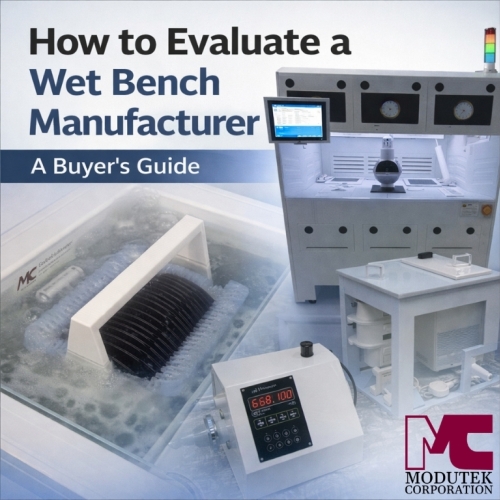
 A poor choice of wet bench manufacturer shows up directly on the production floor: inconsistent etch rates, contamination-driven yield loss, facility integration delays, and equipment that cannot be serviced when it counts. This guide provides semiconductor process engineers, facilities managers, and R&D professionals with a concrete framework for evaluating wet bench suppliers before committing.
Table of Contents
- Why the Right Wet Bench Manufacturer Directly Affects Your Results
- Process Compatibility and System Design Capabilities
- Chemical Compatibility and Contamination Control
- Safety Compliance and Facility Integration Requirements
- Supplier Experience, Technical Support, and Long-Term Performance
- Key Takeaways for Evaluating a Wet Bench Manufacturer
- FAQs
1. Why the Right Wet Bench Manufacturer Directly Affects Your Results
Most yield problems in semiconductor wet processing can be traced back to one of four variables: equipment consistency, contamination control, facility integration, or the supplier’s ability to support the system after delivery. The manufacturer you select determines how well each of these variables is controlled.
Wet benches support processes including wafer cleaning, etching, chemical treatment, and substrate preparation. Each requires precise control over chemical concentration, temperature, timing, and contamination prevention. When any of these variables drift — due to poor material selection, inadequate automation, or weak process control — yield suffers. For R&D labs and universities, the same variables apply: equipment that cannot adapt to experimental chemistries or substrates costs research time and budget.
Selecting an experienced semiconductor equipment manufacturer provides access to:
- Custom system engineering tailored to your specific wafer sizes, chemistries, and throughput
- Chemical compatibility expertise for handling aggressive process chemistries safely
- Facility integration support covering exhaust, plumbing, electrical, and chemical delivery
- Long-term technical assistance that extends beyond initial equipment delivery
Modutek has designed and built custom wet processing systems since 1980, working directly with engineers from design approval through final installation acceptance. That continuity — over 45 years of uninterrupted operation — is a meaningful indicator of supplier stability in an industry that has undergone significant changes over the last 20-30 years.
2. Process Compatibility and System Design Capabilities
Process compatibility is the first filter when evaluating a wet bench manufacturer. Equipment that cannot support your specific requirements forces process adaptation — a compromise that costs yield and efficiency.
Process Compatibility Evaluation Checklist:
- Wafer sizes and substrate types supported
- Required chemical processes (cleaning, etching, treatment)
- Rinse and drying cycle configurations
- Automation level — manual, semi-automated, or fully automated
- Throughput capacity and scalability
- Modular configuration options for future process changes
For production environments, the priority is throughput consistency, repeatable process control, and scalability. Automated wet bench systems reduce contamination risk by minimizing manual wafer handling and allowing programmable management of chemical concentration, temperature, and timing. Modutek’s automated systems use SolidWorks Simulation Professional and SolidWorks Flow Simulation software to model process flow, optimize etch rates, and increase throughput, which supports quantifiable yield improvements, not just automation.
For R&D environments, the priority shifts to flexibility. Research scientists working across diverse substrates and experimental chemistries need equipment with interchangeable process modules, adjustable configurations, and support for a wide range of process chemistries, not a fixed production-line setup. Modutek’s tabletop wet processing systems are specifically designed for research labs and universities that require compact, reconfigurable systems for proof-of-concept and prototyping work.
Modutek’s in-house engineers work directly with customers throughout the design process, producing equipment tailored to specific production, research, and development goals — from manual configurations through fully automated systems built at their San Jose facility.
3. Chemical Compatibility and Contamination Control
Semiconductor wet process equipment must safely and reliably handle aggressive chemistries, including:
- Hydrofluoric acid (HF)
- Hydrochloric acid (HCl)
- Sulfuric acid (H₂SO₄)
- Hydrogen peroxide (H₂O₂) and other aggressive process chemistries
Construction material selection directly determines chemical resistance, contamination risk, and equipment lifespan. The table below summarizes key material options:
| Material | Chemical Resistance | Max Operating Temp | Best Use Case |
| PVDF | Excellent — most acids | ~150°C | High-purity, aggressive chemistries |
| PTFE (Teflon®) | Superior — nearly all chemicals | ~260°C | Harsh chemical processes, HF applications |
| Quartz | Excellent — inert to most acids and salts | ~185°C | High-temperature processes, ultra-clean applications |
| PVC-C (FM4910) | Good for wet benches | ~60°C | Cleanroom-rated, fire-resistant construction |
| Polypropylene (PP) | Good for HF/BOE | Ambient Temperature | General process tanks |
Contamination control features to evaluate include:
- Laminar airflow designs — prevent particle deposition on wafer surfaces during processing
- Enclosed process chambers — limit chemical vapor exposure
- Automated chemical dispensing — consistent delivery and reduced manual handling
- Integrated rinse systems — consistent post-process cleaning
- Particle filtration and cleanroom-compatible construction
Modutek’s quartz tanks use high-purity, flame-polished quartz that is chemically inert to most acids, water, and salts — meaning contamination from the tank material itself is eliminated. The seamless design and sloped housing construction further reduce particle generation by eliminating areas where particles can become lodged.
Modutek’s Teflon® tanks are designed for applications where purity and chemical resistance are the primary requirements, and are ideal for harsh chemical processes, including HF-based applications. They are available in recirculating, static, and ambient configurations, in standard carrier sizes or custom dimensions.
When evaluating any supplier, request documentation on material compatibility for your specific process chemistries, along with contamination-control performance data from comparable installations.
4. Safety Compliance and Facility Integration Requirements
Wet processing systems handle hazardous chemicals in cleanroom environments. Safety compliance and facility integration are non-negotiable evaluation criteria — particularly for facilities managers responsible for permits, electrical coordination, and environmental discharge compliance.
Safety evaluation criteria:
- Chemical fume containment and exhaust ventilation integration
- Emergency shutoff systems and chemical leak detection
- Fire suppression compatibility
- Chemical containment and interlocks
Facility integration verification checklist:
- Exhaust infrastructure compatibility (CFM requirements, duct sizing)
- Plumbing connections (DI water, chemical supply, process drains)
- Electrical requirements (voltage, amperage, control wiring)
- Chemical delivery system integration
- Waste treatment and acid neutralization requirements
Specific standards to verify: Modutek’s wet benches comply with UL 508A, NFPA 70 (NEC), and NFPA 79 as standard certifications. Additional certifications available include SEMI S2/S8, ASHRAE 110, CE Mark, and CSA. For California-based facilities, Structural PE, Seismic PE, and Title 22 certifications are available on request. Third-party evaluations can be arranged.
Modutek’s wet bench systems undergo thorough pre-delivery factory acceptance testing (FAT) using deionized water before shipment. This reduces installation time and confirms the system meets specifications before it arrives at your facility.
The engineering team at Modutek works with customers to address facility integration requirements early in the evaluation process. This includes covering exhaust, plumbing, electrical, and chemical delivery system integration, and confirms compliance with applicable safety standards before equipment delivery. Identifying integration requirements at the design stage prevents the most common sources of installation delays and post-commissioning performance problems.
5. Supplier Experience, Technical Support, and Long-Term Performance
Equipment specifications tell you what a system can do at the time of delivery. Supplier experience and support capability determine how that system performs over its full operational lifespan.
Key evaluation questions for any wet bench manufacturer:
- How long has the company manufactured wet process equipment, and have they operated continuously?
- Is equipment designed, built, and tested in-house, or is manufacturing outsourced?
- What pre-delivery testing protocol is used?
- What installation support and operator training are provided?
- Are preventive maintenance programs and spare parts available?
- What is the warranty coverage and duration?
What reliable suppliers provide:
- In-house design and fabrication — eliminates quality variables from outsourced manufacturing
- Pre-delivery system testing — confirms specifications before shipment
- On-site installation support — reduces startup time and integration risk
- Operator training — covering safe operation, routine maintenance, and basic troubleshooting
- Preventive maintenance programs — with defined schedules, covered components, and response times
- Spare parts availability — minimizing downtime when replacement is needed
- Remote diagnostics and technical support — for ongoing operational issues
Modutek has operated continuously since 1980, with in-house engineers designing and building all systems at their San Jose facility. Every wet bench is tested and certified to meet industry standards and is subject to final approval by the customer’s team before delivery. Modutek’s wet bench equipment is covered under a standard one-year warranty, with extended coverage available depending on the system. Support services include on-site startup, operator training, preventive maintenance programs, remote diagnostics, and responsive technical support.
When evaluating supplier experience, consider their track record in your specific application area — production fab, R&D lab, or university research — and request customer references from comparable installations.
6. Key Takeaways for Evaluating a Wet Bench Manufacturer
When evaluating semiconductor wet process equipment suppliers, apply these five criteria:
- Process compatibility — Confirm the manufacturer can configure equipment for your specific wafer size, chemistry set, and automation level before requesting a quote. This single step eliminates most supplier mismatches.
- Chemical compatibility and contamination control — Verify material selection against your specific chemistries and operating temperatures. Request contamination-control performance data, not just material spec sheets.
- Safety compliance and facility integration — Identify exhaust, plumbing, electrical, and chemical delivery requirements at the design stage, and confirm which specific standards (UL508a, NFPA, SEMI, IEC) the equipment meets with documentation.
- Customization capabilities — Standard configurations rarely fit specialized production or R&D requirements. Manufacturers offering in-house custom design deliver equipment optimized for your process, not adapted from a generic platform.
- Supplier expertise and long-term support — In-house manufacturing, pre-delivery testing, warranty coverage, and responsive maintenance programs are the operational indicators of a supplier who will still be supporting your equipment five years after installation.
Why Companies Choose Modutek
Modutek has designed and built custom semiconductor wet-processing systems at its San Jose facility since 1980 — over 45 years of continuous, specialized operation. Every system is engineered in-house and undergoes factory acceptance testing (FAT) with deionized water before delivery. All wet bench equipment has a standard one-year warranty (extended options available), on-site installation support, operator training, preventive maintenance programs, and remote diagnostics for every system after delivery.
If you are evaluating a wet bench manufacturer for semiconductor fabrication or research applications, working with an experienced supplier helps ensure reliable performance and precise process control from day one.
Request a free consultation with Modutek’s experts → Bring your process requirements, wafer sizes, and chemistry set — Modutek’s engineers will work directly with you from design approval through installation.
7. FAQs
Q1. What does a wet bench manufacturer do in semiconductor fabrication?
A wet-bench manufacturer designs and builds chemical-processing equipment used in semiconductor fabrication. These systems support processes such as wafer cleaning, etching, and chemical treatment while maintaining precise control over timing, chemical concentration, and contamination prevention. Reliable manufacturers design equipment that integrates with cleanroom environments and supports consistent, repeatable wafer processing.
Q2. What factors should semiconductor companies evaluate when selecting a wet bench manufacturer?
Semiconductor companies should evaluate process compatibility, chemical resistance, contamination control, safety compliance, system customization, and supplier experience. Assessing long-term support, installation requirements, and maintenance services helps ensure the equipment performs reliably throughout its lifecycle. Verification of facility integration requirements — including exhaust, plumbing, and electrical specifications — prevents installation problems after delivery.
Q3. Why is chemical compatibility important in semiconductor wet processing equipment?
Wet processing equipment must handle highly corrosive chemicals. Materials such as polypropylene (PP), PVDF, PTFE, and quartz are selected based on their resistance to specific process chemistries and operating temperatures. Proper material selection prevents contamination from tank materials, protects equipment from chemical degradation, and ensures stable processing conditions. The wrong material choice can introduce particle contamination, reduce equipment lifespan, and compromise process yield.
Q4. How do semiconductor manufacturers compare wet bench suppliers?
Manufacturers typically compare suppliers based on engineering expertise, in-house fabrication capability, customization options, process control features, specific safety certifications, and service support. Evaluating whether the supplier has experience in your specific application area — production fab, R&D, or university research — and requesting customer references from comparable installations provides the most reliable basis for comparison.
Q5. What support services should a wet bench manufacturer provide?
A qualified wet bench manufacturer should provide pre-delivery testing, installation support, operator training, preventive maintenance programs, spare parts availability, and ongoing technical assistance. These services ensure the equipment is installed correctly, operates safely, and maintains reliable performance. Warranty coverage terms and remote diagnostics capability are additional indicators of a supplier’s commitment to long-term support.
Q6. Can wet bench systems be customized for R&D applications?
Yes. R&D environments require equipment that supports a wide range of chemistries, substrate types, and experimental configurations. Manufacturers such as Modutek offer modular designs, interchangeable process stations, and tabletop-scale systems that can be reconfigured to meet changing experimental requirements. Custom automation and control features support precise, repeatable results even at low production volumes, without requiring a full production-line footprint.
Q7. How do wet bench systems compare in cost across manual, semi-automated, and fully automated configurations?
Manual wet-bench stations offer the lowest upfront cost and are well-suited for low-volume or early R&D work. Semi-automated systems balance cost and precision using servo-controlled robotics without the overhead of full automation. Fully automated systems carry a higher initial investment but reduce contamination risk, lower per-wafer handling costs, and scale with throughput requirements. Modutek offers all three configurations and works with customers to match system capability to budget constraints.