
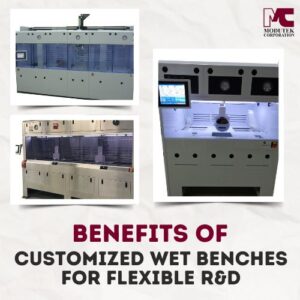
 Summary: Customized wet benches offer R&D labs design-stage flexibility and precision, supporting rapidly evolving experimental needs across academic and industrial research.
Table of Contents
- Introduction: Evolving Needs in R&D Labs
- Why Manual and Semi-Automated Benches Dominate in R&D.
- Customization at Design Stage: Built for Flexibility.
- Supporting Diverse Research: From Startups to Universities.
- Designing for Safety and Sustainability.
- Modutek’s Custom Collaboration Approach.
- Conclusion: Start Your Custom R&D Wet Bench Design.
1. Introduction: Evolving Needs in R&D Labs
Advancing research and development demands equipment that adapts as quickly as scientific progress itself. Wet benches have become essential for semiconductor, materials science, and biotech applications where precision and flexibility are critical to achieving reliable results.
Recent industry analysis projects a 5.8% CAGR in the wet bench sector through 2031, with demand fueled by research and specialty applications, according to Verified Market Research. For advanced projects focused on next-generation integrated circuits and specialized high-end wet process equipment, projected growth is expected to rise to an 8% CAGR by 2033 (Data Insights Market).
This growth reflects a critical reality: Standard, off-the-shelf wet processing equipment rarely meets the evolving needs of today’s research labs. As experimental requirements change and fabrication processes become more sophisticated, labs increasingly rely on customized wet benches designed to fit their exact applications rather than generic, high-volume manufacturing systems.
2. Why Manual and Semi-Automated Benches Dominate in R&D
Research labs prioritize flexibility and direct process control when developing new materials and fabrication techniques. Manual and semi-automated wet benches stand out as the preferred choice for these environments, allowing users to adapt quickly to shifting experimental requirements and achieve greater process insight.
Hands-On Control and Real-Time Responsiveness
- Immediate adjustments: Respond instantly to unexpected results and fine-tune process parameters.
- Direct observation: Monitor reactions and make visual assessments during every trial.
- Process customization: Tailor each step, from chemical formulations to immersion times, for optimal outcomes.
- Efficient troubleshooting: Quickly identify and address deviations or issues as they arise.
- Thorough documentation: Record process variations and results for continuous improvement.
Manual wet process stations enable researchers to follow their intuitions and use real-time feedback, a crucial advantage during early-stage experimentation and process development.
Semi-Automated Systems Offer Consistency with Flexibility
- Programmable routine steps: Achieve repeatable results for pilot trials and protocol validation.
- Uniform bath temperature and flow: Ensure consistent process conditions while freeing researchers to focus on analysis.
- Manual override when needed: Retain complete control by intervening at critical points.
- Integrated data logging: Automatically capture process data for traceability and publication.
- Efficient scaling: Transition smoothly from pure research to development without overcommitting to automation.
Semi-automated wet processing systems effectively bridge the gap between hands-on experimentation and automated repeatability, making them invaluable for pilot processes or evolving project requirements.
Practical Investment for Research Budgets
- Cost-effective acquisition: Avoid unnecessary expense by selecting equipment that matches actual lab usage.
- Adaptable configurations: Use the same platform for diverse projects and fluctuating workloads.
- Sustainable resource allocation: Dedicate more funding to core research activities rather than overspending on automation designed for mass manufacturing.
For many R&D environments, manual and semi-automated wet benches offer the ideal balance of control, adaptability, and value, making them the logical foundation for innovative research.
3. Customization at Design Stage: Built for Flexibility
Customization at the design stage is crucial for laboratories that require wet benches tailored to their unique experimental processes. Rather than adjusting standard equipment after installation, the most effective approach is to work closely with experts early to create a wet bench explicitly designed for your research requirements. This ensures performance, safety, and adaptability from day one.
Key Elements of Specialized Wet Bench Customization
- Optimized bath configuration: Supports unique experiments and workflows.
- Safe material compatibility: Ensures long-term durability with varied chemicals.
- Flexible controls: Allow tight management with manual or programmable options.
- Advanced safety features: Meets hazard requirements at every stage.
- Ergonomic workspace: Fits your lab’s needs and improves productivity.
- Efficient utilities integration: Simplifies facility planning.
- Smart chemical management: Enhances research outcomes while reducing waste.
Modutek’s complete line of wet processing equipment is engineered in close cooperation with R&D teams, ensuring that labs receive exactly what they need with no costly retrofits.
Why Post-Installation Modification is Limited
Once installed, significant changes to a wet bench carry risks and added costs:
- Safety systems: Chemical containment and ventilation are engineered for predetermined substances and volumes. Retrofitting can compromise these safeguards.
- Material mismatch: Unplanned process changes may expose equipment to incompatible chemicals.
- Compliance risks: Modifications can threaten regulatory approval or lab certifications.
- Performance tradeoffs: Unintended interactions between retrofit components may reduce reliability or precision.
Designing a custom wet bench from the outset, based on all detailed requirements, is the best way to ensure safety, efficiency, and process reliability, delivering long-term value while supporting ongoing experimental needs.
4. Supporting Diverse Research: From Startups to Universities
Research laboratories span a wide range of environments, each with unique process requirements, constraints, and goals. Customized research lab wet bench systems are critical for enabling effective research in universities, startups, and dedicated institutes.
Universities
- Versatility: Support multiple user groups and a broad range of experimental projects on a single platform.
- Space efficiency: Fit into existing facilities, even when space is limited.
- Durability: Deliver long service life despite frequent, varied use.
- Enhanced safety: Adapt to labs with varying skill levels and strict academic safety standards.
A university-focused wet bench would typically prioritize versatility, durability, and clear operational design over throughput or automation. These environments benefit from customized manual wet bench stations that accommodate a range of research applications while maintaining strict safety protocols.
Startups
- Rapid iteration: Adapt to fast-paced development cycles where experimentation and change are frequent.
- Capital efficiency: Invest in scalable, flexible systems rather than committing to automation up front.
- Compact design: Optimize resources and lab footprint.
- Future-ready flexibility: Easily reconfigure systems as business and process needs evolve.
Startup labs often select semi-automated wet benches that strike a balance between manual control and repeatable process capabilities, enabling small teams to maintain quality while developing proprietary technologies.
Research Institutes
- Advanced customization: Address specialized, high-precision requirements not met by standard equipment.
- Materials compatibility: Handle novel chemicals and a range of substrates without compromising safety or process integrity.
- Integrated data collection: Capture, analyze, and export high-quality data for publication or commercial validation.
- Robust safety protocols: Incorporate rigorous controls for unique process hazards.
These organizations often collaborate with Modutek to develop customized, semi-automated wet processing systems that incorporate specialized features to support their unique processing needs, which are not available in standard configurations.
Across all these environments, demand for customized wet benches continues to grow, driven by the need for solutions that align with specific experimental protocols, budgetary limitations, and compliance mandates. By supporting flexibility and process innovation, the right system enables progress at every stage of the research process.
5. Designing for Safety and Sustainability
Safety and sustainability are top priorities in today’s R&D labs, and both should be incorporated into the design of customized wet benches. Custom systems not only provide reliable chemical handling but also drive operational efficiency and responsible lab practices well beyond what traditional, off-the-shelf solutions can deliver.
Advanced Safety Integration for Research Precision
- Chemical-specific containment: Engineered for the unique risks and properties of research chemicals.
- Targeted ventilation systems: Matched to anticipated reactions, minimizing emissions and ensuring a safe lab environment.
- Emergency safety features: Custom alarms, interlocks, and automated shutdown protocols for research-specific hazards.
- Operator protection: Integrated shields, splash guards, and ergonomic layout to maximize safety during hands-on work.
Regulatory Compliance & Standards
- Designed to meet SEMI S2, UL/ETL, NFPA 70 & 79, and local EH&S codes
- Ensures safe chemical handling and environmental protection
- Reduces risk of non-compliance and costly retrofits
- Supports uninterrupted, certified lab operations
Sustainability Built-In
- Efficient chemical use: Customized wet benches are designed to minimize waste and increase yield for small-scale R&D batches.
- Recycling and reclamation: Built-in options for chemical recycling and reduced hazardous waste output.
- Water and energy savings: Smaller, research-oriented wet benches use optimized rinse cycles, recirculation, and targeted heating controls.
- Process optimization: Systems are tailored to reduce the overall environmental impact of lab operations.
Comparison: Traditional vs. Custom Wet Bench Systems
| Feature | Traditional Wet Bench Systems | Modutek’s Customized Wet Benches |
| Chemical Compatibility | Generic may require workarounds | Matched to research-specific chemicals and processes |
| Safety Controls | Basic, one-size-fits-all | Tailored to unique lab requirements and protocols |
| Waste Reduction | Standardized, less efficient | Designed for high recycling, low waste, and eco-friendly operation |
| User Ergonomics | Fixed layouts | Configured for user accessibility and comfort |
| Regulatory Compliance | May require post-installation modification for compliance | Meets standards from the outset with integrated compliance features |
| Operational Cost Savings | Less efficient use of chemicals and utilities | Lower operating costs due to resource optimization |
| Adaptability for the Future | Very limited, expensive to modify | May be updated for new experiments and evolving requirements |
Custom wet benches deliver substantial advantages in research settings, ensuring long-term reliability, minimizing lab risk, reducing operational costs, and supporting green chemistry initiatives.
Labs that invest in custom systems position themselves to meet both today’s R&D goals and tomorrow’s compliance and sustainability demands.
6. Modutek’s Custom Collaboration Approach
Achieving exceptional results in research demands more than standard equipment—it requires a true engineering partnership. With over 40 years of experience, Modutek excels at collaborating directly with R&D teams to deliver customized wet benches and wet processing equipment tailored to each lab’s unique requirements.
The Modutek Engineering Partnership
- Direct engagement with researchers: Modutek’s engineers work closely with your scientific and technical staff to understand specific experimental goals and safety needs.
- Detailed process mapping: Every wet bench system is designed based on in-depth documentation of your current and anticipated processing workflows.
- Iterative design collaboration: Feedback and adjustments are incorporated at every stage, ensuring your final system supports both immediate tasks and future projects.
- Integrated safety and compliance: Custom systems are engineered to meet all regulatory protocols and specialized safety requirements from the ground up.
- Turnkey installation and validation: Modutek ensures integration with your existing lab infrastructure and provides final acceptance testing, helping your team reach operational goals faster.
Labs that collaborate with Modutek benefit from equipment that does not compromise on reliability, process control, or regulatory compliance. This collaborative method ensures that your wet bench investments precisely support your research vision today and as your needs evolve.
Customization Without Compromise
Modutek’s four decades of experience enable customization that doesn’t sacrifice system integrity:
- Materials expertise: Selecting appropriate construction materials for specific chemical compatibility
- Control system flexibility: Ranging from basic manual to sophisticated programmable interfaces
- Process integration: Ensuring wet benches work within larger research workflows
- Compliance knowledge: Maintaining regulatory standards while addressing unique requirements
- Future-proofing: Anticipating potential research directions to build in appropriate flexibility
This expertise allows researchers to obtain precisely what they need without compromising on safety, reliability, or performance.
Use Case for Custom R&D Wet Bench Implementation
Modutek’s customized wet benches are relied on in R&D facilities where reliability, precision, and minimal maintenance are essential. Below is an industry scenario that highlights the importance of custom-designed systems.
A leading materials science laboratory required a wet bench system specifically designed for advanced semiconductor research. Off-the-shelf options could not accommodate both established and experimental etchants, nor did they offer the process control or compact footprint the lab required.
Challenges
- Required flexibility to use both standard and experimental etchants
- Needed precise temperature control for sensitive development steps
- Sought clear process monitoring without compromising safety
- Demanded automatic data logging for research validation
- Had limited lab space for new equipment
Modutek’s Solution
- Customized semi-automated wet bench: Provides the option for manual and repeatable process capabilities, allows the R&D team to develop proprietary technologies, and uses a small footprint to accommodate lab requirements.
- Segmented bath design: Enabled simultaneous use of multiple chemistries without contamination risks.
- Transparent, chemical-resistant viewing panels: Allowed safe observation of process steps in real time.
- Integrated temperature monitoring and control: Provided tight thermal accuracy for repeatable results.
- Configurable timing and documentation tools: Supported process optimization and streamlined research reporting.
- Custom utility connections: Ensured seamless integration into the unique lab environment.
Results
- The laboratory accelerated the development of fabrication techniques that would not have been possible with generic benches.
- Researchers gained enhanced process visibility, leading to improved data quality and safer operations.
- The new wet bench minimized downtime and maintenance, supporting high reliability for ongoing R&D activities.
Discover more ways customized wet benches from Modutek can address specific research needs for laboratories and institutes of all sizes.
7. Conclusion: Start Your Custom R&D Wet Bench Design
Standard solutions seldom meet the evolving needs of cutting-edge research. A carefully designed, customized wet bench empowers your lab to achieve the highest levels of precision, safety, and efficiency.
Ready to streamline your processes and support future research initiatives?
Contact Modutek today to collaborate with experienced engineers and design a wet bench solution tailored to your specific protocols, compliance requirements, and long-term R&D goals.
Partnering with Modutek ensures your investment delivers maximum value, operational reliability, and the flexibility to drive innovation as your research advances.
Frequently Asked Questions:
1. Can the wet bench system be fully customized to meet our specific experimental and chemical compatibility requirements?
Answer:
Yes. Modutek’s wet bench systems are fully customizable at the design stage to support unique experimental processes, workflows, and a wide range of chemical compatibilities. This includes optimizing bath configurations, selecting compatible construction materials, and integrating flexible manual or semi-automated controls. Customization ensures that each system precisely fits your application requirements, reduces the risk of costly retrofits, and provides the adaptability needed for evolving research projects.
2. What safety standards and regulatory compliance does Modutek’s custom wet bench equipment meet?
Answer:
Modutek’s wet bench systems are engineered to comply with major industry standards, including SEMI S2, UL/ETL, NFPA 70 & 79, and local Environmental Health & Safety (EH&S) codes. Systems are designed with advanced safety features, including chemical-specific containment, targeted ventilation, emergency shutdown protocols, and operator protection. This approach ensures safe operation, regulatory compliance, and uninterrupted certification for research laboratories.
3. How reliable is Modutek’s wet bench equipment in terms of uptime, maintenance, and support for continuous R&D operations?
Answer:
Modutek’s wet bench equipment is designed for high reliability and minimal maintenance, supporting the continuous uptime required in demanding R&D settings. Each system incorporates durable materials and robust components, and Modutek provides comprehensive support, from installation to routine maintenance and technical troubleshooting. This reliability helps minimize downtime, maximize productivity, and ensure consistent experimental results over the long term.