
Summary:
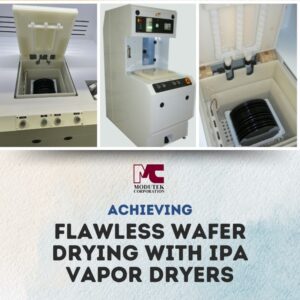 This article explains how IPA vapor dryers provide a superior wafer drying solution by eliminating contaminants, improving yield, and outperforming traditional methods in semiconductor manufacturing.
Table of Contents
- Introduction: The Critical Role of Wafer Drying
- What are IPA Vapor Dryers and How Do They Work?
- Top Benefits of Using IPA Vapor Dryers
- Comparing IPA Vapor Dryers vs. Traditional Drying Methods
- Tailoring to Facility and Process Engineering Needs
- Choosing the Right IPA Vapor Dryer: What to Look For
- The Benefits of Modutek’s IPA Vapor Dryer Solutions
- Conclusion & Next Steps
1. Introduction: The Critical Role of Wafer Drying
High-quality wafer drying has a direct impact on the yield and profitability of semiconductor manufacturing. Residual moisture or particle contamination left on wafer surfaces can lead to defective microchips, resulting in significant economic losses. Traditional drying methods, such as spin-rinse drying, commonly introduce issues including watermarks, contamination from equipment handling, and potential substrate damage.
IPA vapor dryers eliminate these issues by using ultra-pure isopropyl alcohol vapor. This specialized approach significantly reduces surface tension, enabling residual water to drain cleanly without residue, thereby improving wafer cleanliness and consistency. Adopting IPA vapor dryers directly leads to enhanced production yields, reduced contamination risks, and cost efficiency.
This article explains how IPA vapor drying technology outperforms conventional methods, addressing the core requirements of process control, contamination prevention, safety compliance, and operational cost-effectiveness.
2. What are IPA Vapor Dryers and How Do They Work?
IPA vapor dryers are advanced wafer processing equipment designed specifically for efficient drying in semiconductor manufacturing. They employ a unique drying process utilizing high-purity isopropyl alcohol (IPA) in vapor form, providing clear advantages over traditional wafer drying methods.
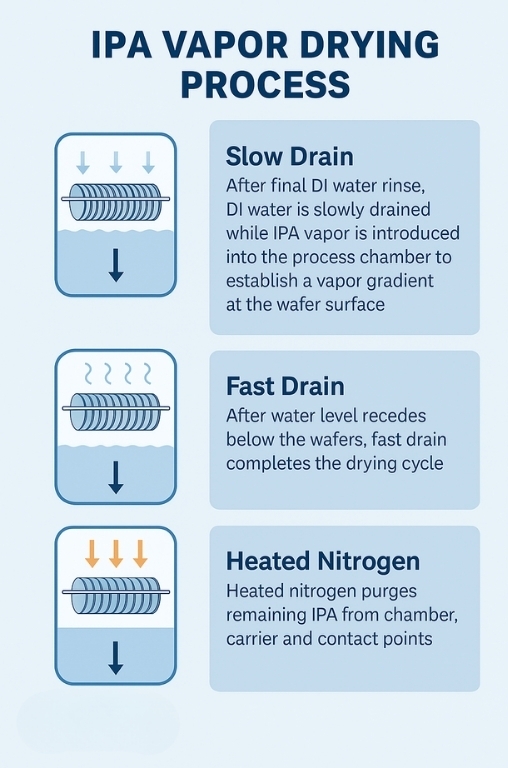 Principle of Operation Using Isopropyl Alcohol (IPA) in Vapor Phase:
In Modutek’s IPA Vapor Dryers, wafers are held in a cassette within a covered process chamber. Following the final rinse in deionized (DI) water, the drying sequence begins with slowly draining the DI water from the process chamber. Simultaneously, high-purity IPA vapor is introduced to the chamber through a dedicated inlet. This controlled vapor backfill establishes a vapor gradient on the wafer surface, removing all water to promote drying.
As the water level gradually recedes below the wafers, a fast drain completes the drying cycle. Heated nitrogen is then used to purge remaining IPA from the chamber, carrier, and contact points. The result is a clean, dry wafer surface without watermarks, particle residues, or handling-induced defects.
This method eliminates the need for spinning or wafer movement, ensuring a contactless and uniform drying process suitable for both standard and fragile wafers.
Integration into Wet Bench Systems:
IPA vapor dryers can be integrated into wet bench systems to enhance the cleaning process and overall effectiveness. As part of comprehensive wafer processing equipment, IPA vapor dryers ensure wafers transition from cleaning to drying in a controlled environment, minimizing contamination risks.
This integration not only enhances drying efficiency but also enables semiconductor manufacturers to achieve superior contamination control and consistently higher yields.
3. Top Benefits of Using IPA Vapor Dryers
IPA vapor dryers provide semiconductor manufacturers with a high-performance, contamination-free drying solution that enhances yield, throughput, and reliability. By replacing traditional drying methods with a non-contact, surface-tension-reducing process, these systems directly address key operational challenges faced by facilities managers and process engineers.
Cleaner Wafers, Higher Yields
IPA vapor dramatically reduces surface tension, allowing residual water to sheet off wafer surfaces without leaving particles or stains. The result is a uniformly dry, ultra-clean wafer surface that reduces defect rates and boosts production yield.
Increased Throughput and Process Efficiency
Shorter drying cycles and seamless integration with wafer cleaning systems minimize downtime and speed up operations. Facilities can process more wafers per shift with fewer interventions, supporting scalable, high-volume manufacturing environments.
Reduced Risk of Contamination
The fully enclosed drying chamber eliminates the need to transfer wafers between tools, significantly lowering particle exposure. This controlled environment ensures particle-free drying and greater process reliability.
Safe, Gentle Drying for Delicate Wafers
With no moving parts and no mechanical handling during the drying process, IPA vapor dryers are ideal for fragile or advanced-node wafers. The gentle drying method preserves structural integrity while maintaining the highest standards of cleanliness.
Lower Operating Costs
Efficient IPA usage, minimal maintenance requirements, and fewer rejected wafers translate to long-term cost savings. IPA vapor dryers provide a strong return on investment (ROI) by enhancing output quality while minimizing chemical and operational waste.
4. Comparing IPA Vapor Dryers vs. Traditional Drying Methods
Traditional wafer drying methods—such as spin rinse drying—introduce multiple risks that impact yield, cleanliness, and wafer integrity. These legacy systems rely on physical movement and open-air exposure, which can lead to watermarks, particle contamination, and mechanical stress on fragile wafers.
IPA vapor dryers offer a fundamentally superior approach. Instead of spinning wafers or transferring them between tools, these systems use ultra-pure isopropyl alcohol vapor in a sealed chamber to displace water. This non-contact, low-surface-tension process ensures even, residue-free drying without the risk of physical damage.
Unlike traditional systems, IPA vapor dryers:
- Eliminate watermarks by avoiding direct contact and spinning
- Reduce contamination risk by keeping wafers stationary in a controlled environment
- Protect fragile wafers through gentle, motionless drying
- Integrate seamlessly with wet benches to streamline post-cleaning workflows
For process engineers focused on yield and consistency, and facilities managers concerned with reliability and safety, IPA vapor dryers clearly outperform older methods in every critical metric.
5. Tailoring to Facility and Process Engineering Needs
Understanding and addressing the distinct requirements of both facilities managers and process engineers is crucial when integrating advanced wafer processing equipment, such as IPA vapor dryers.
Process engineers, focused on achieving consistent process results and high-quality wafer output, prioritize:
- Precise process control ensuring repeatability and reliability
- Equipment chemical compatibility to maintain wafer purity
- Effective contamination prevention methods that secure particle-free drying outcomes
Facilities managers emphasize broader operational and practical concerns, including:
- Equipment compliance with stringent safety standards to minimize risks in daily operations
- Assurance that all custom specifications related to facility space, electrical needs, plumbing, and workflow integration are fully satisfied
- Cost-efficiency driven by ease of maintenance, reliable performance, and minimized total cost of ownership
By meeting both sets of demands, IPA vapor dryers successfully deliver optimal results, ensuring a robust semiconductor wafer drying process that boosts overall facility effectiveness and safety compliance.
6. Choosing the Right IPA Vapor Dryer: What to Look For
Selecting the most suitable IPA vapor dryerfor your semiconductor wafer drying operations requires careful evaluation of several critical factors:
- Automation Capabilities:
Advanced automation ensures precise drying conditions and process repeatability, thereby enhancing consistency and reducing the risk of human error. - Chemical Usage Efficiency:
Efficient use of high-purity IPA reduces operational costs and chemical waste, offering sustainability and cost-effectiveness in daily manufacturing. - Compatibility and Customization Options:
Equipment should be fully compatible with your existing wafer processing equipment and cleaning systems. Seek solutions that suppliers can customize to meet your specific facility requirements, including electrical, dimensional, and operational integrations. - Supplier Credibility and Expertise:
Evaluate suppliers based on their demonstrated industry experience, track record of successful installations, in-house engineering expertise, and responsive support. Partnering with a reputable supplier ensures smooth integration, reliable operation, and access to technical support whenever required.
Keeping these key considerations in mind will help you make an informed choice, ensuring optimal wafer drying results explicitly tailored to your operational needs.
7. The Benefits of Modutek’s IPA Vapor Dryer Solutions
Modutek’s advanced IPA Vapor Dryeroffers semiconductor manufacturers a superior wafer drying solution specifically tailored to address critical facility and process engineering challenges. Key benefits include:
- Very Low IPA Consumption:
Efficient designs significantly reduce IPA usage, resulting in lower operating costs and reduced chemical waste, which aligns perfectly with cost management goals. - No Watermarks:
Utilizing high-purity IPA vapor eliminates the risks of water spots and particle contamination, ensuring consistently clean and defect-free wafers. - No Moving Parts Inside Drying Chamber:
The absence of internal moving components eliminates the risks associated with wafer breakage, making Modutek dryers uniquely suited for fragile wafers and thereby enhancing wafer processing reliability. - Rapid Drying Cycles (10-15 Minutes):
Most drying processes finish within a short, dependable timeframe, contributing significantly to increased throughput and higher manufacturing efficiency. - Customized Equipment Design:
Modutek’s in-house engineering team actively collaborates with facilities managers and process engineers, ensuring the drying system meets specific operational, dimensional, electrical, and plumbing requirements. - Easy Integration into Wet Bench Systems:
Modutek’s drying technology integrates seamlessly into existing wet bench setups. By eliminating the transfer step after wafer cleaning, Modutek streamlines the drying process, substantially reducing contamination risks and enhancing process efficiency.
In addition to these benefits, Modutek further distinguishes its IPA Vapor Dryer solutions through:
- Established Supplier Credibility:
Leveraging more than 40 years of experience, Modutek maintains a proven track record of high-quality wafer processing equipment and exceptional service consistently trusted by semiconductor industry leaders. - Comprehensive Customer Support:
Modutek’s support extends through each phase—from initial consultation and equipment design to installation, training, and ongoing operational support—ensuring reliable equipment operation with minimal downtime.
8. Conclusion & Next Steps
Adopting advanced drying technologies, such as IPA vapor dryers, is no longer optional for semiconductor manufacturers seeking to maximize wafer quality, minimize contamination, and enhance yield. Traditional methods, such as spin-rinse drying, introduce unnecessary risks—from watermarks and particle contamination to mechanical damage and inconsistent results.
IPA vapor drying offers a proven alternative. By using ultra-pure isopropyl alcohol in a sealed, controlled chamber, these systems ensure uniform, residue-free wafer drying, protect delicate substrates, and eliminate the need for manual wafer handling or movement—the result: higher throughput, reduced defects, and improved process reliability.
For process engineers, this means repeatable performance and higher yields. For facilities managers, it means greater safety compliance, cost efficiency, and fewer production delays.
Ready to upgrade your wafer drying process?
→ Contact Modutek’s experts for a free consultation.
Achieve cleaner wafers, higher yields, and a smarter drying solution, backed by over 40 years of industry expertise.