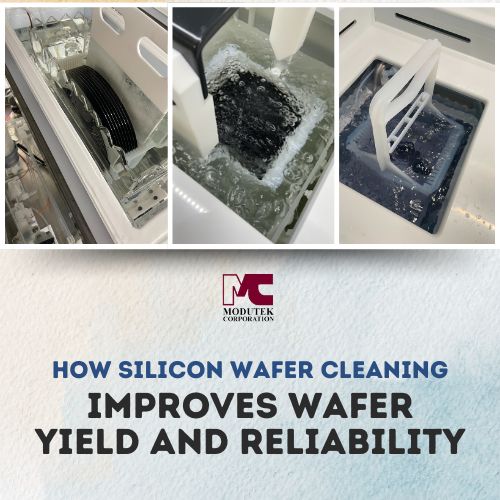
 Summary: Effective silicon wafer cleaning, from established RCA and Piranha methods to advanced megasonic cleaning and the ozone cleaning process, is the foundation for improving yield, reliability, and regulatory compliance in modern fabs.
Table of Contents
- Introduction: The Hidden Threat on Silicon Wafers.
- The Science of Particle Contamination.
- Established Cleaning Techniques: Foundations Still in Use.
- Advanced Cleaning Technologies: Precision Without Compromise.
- Selecting the Right Cleaning Method: Key Considerations.
- The Bottom Line: Clean Wafers, Clean Results.
- Conclusion and Next Steps.
1. Introduction: The Hidden Threat on Silicon Wafers
Silicon Wafer Cleaning: Why Microscopic Particles Create Macroscopic Problems
Semiconductor manufacturing depends on achieving defect-free wafers at every process step, yet the most common source of defects comes from what cannot be seen—microscopic particles. A contaminant smaller than a line width can block etching in a trench, distort a lithography pattern, or cause a thin-film irregularity that evolves into a latent reliability failure. As today’s geometries push below 5 nm and wafer structures become more intricate, the margin for error is virtually zero.
The Risks for Process Teams
For process-focused engineers, particle contamination translates into measurable performance issues:
- Lower yields as defects multiply across lots
- Higher scrap and rework rates when removal is inconsistent
- Repeatability pressure to ensure every recipe and tool delivers the same results
The Pressures for Operations and Facilities Teams
For fab operations and facilities managers, the challenge extends beyond yield:
- High chemical usage from legacy methods drives up consumables cost
- Compliance and waste treatment burdens rise with aggressive chemistries such as SPM
- Operator safety risks increase when handling strong acids and oxidizers
The Dual Challenge
Fabs must now solve a dual challenge:
- Deliver particle-free wafer surfaces to safeguard process precision
- Maintain operational efficiency, safety, and sustainability across the fab
Key Drivers for Better Wafer Cleaning
- Shrinking geometries make particle removal increasingly difficult
- High-aspect-ratio structures trap residues that rinses cannot reach
- Material sensitivity demands selective methods that protect low-κ dielectrics and copper films
- Regulatory and environmental pressure mandate the reduced use of hazardous chemicals
Moving Beyond Legacy Methods
While RCA and Piranha (SPM) cleans remain foundational, advanced technologies like megasonic cleaning and the ozone cleaning process are being adopted. These approaches remove submicron particles and organics more effectively—while reducing chemical load and safety risks.
2. The Science of Particle Contamination
How Particles Adhere: Electrostatic, Chemical, and Mechanical Pathways
Particles that contaminate wafers are not simply “dust” that can be rinsed away. They adhere through complex physical and chemical mechanisms that make them difficult to remove. Understanding how and why they attach is essential for selecting the best cleaning method.
Sources of Particle Contamination
Process-borne residues
- CMP slurry particles
- Etch byproducts
- Photoresist fragments
- Deposition residues
Airborne contaminants
- Dust or metallic particles from tools, carriers, and infrastructure
Cross-contamination
- Handling errors
- Insufficient rinsing
- Re-deposition from baths or carriers
Why Particles Stick
- Electrostatic attraction: Oppositely charged surfaces lock contaminants onto wafer surfaces
- Chemical bonding: Organics and metals form molecular bonds that simple rinses cannot break
- Capillary and van der Waals forces: Liquids in narrow features create “molecular glue” that holds particles in place
Challenges with Advanced Geometries
As device structures shrink, particle removal becomes even more demanding:
- Sub-100 nm particles penetrate trenches and vias beyond the reach of standard rinses
- High-aspect-ratio features trap contaminants that require directed energy, such as megasonic cleaning, to dislodge
- Thin films and sensitive materials are increasingly vulnerable to damage from aggressive chemical cleans, requiring selective approaches like ozone oxidation
Why This Matters to Decision-Makers
For process engineers:
- Even a single particle can cause an open circuit, short, or premature device failure
- Residual contamination impacts film uniformity and overall device performance
- Repeatability is critical—any variation in cleaning creates inconsistent results across lots
For facilities managers:
- Each particle not removed increases the risk of rework, scrap, and tool downtime
- Legacy cleaning methods rely on large volumes of hazardous chemicals, raising costs for purchase, storage, and treatment
- Safety and compliance pressures grow as fabs handle stronger acids and oxidizers
Particles are not passive contaminants. They are actively bonded to wafer surfaces. Effective removal requires engineered energy (like megasonics) and selective chemistry (like ozone) to balance cleaning power with safety, cost, and material compatibility.
3. Established Cleaning Techniques: Foundations Still in Use
RCA and Piranha: Proven Baselines for Silicon Wafer Cleaning
While advanced methods are gaining adoption, RCA cleaning and Piranha (SPM) cleaning remain essential in fabs and research centers. Their long history of effectiveness makes them foundational, but today’s fabs must implement them with modern automation, monitoring, and safety controls to meet current yield, cost, and compliance demands.
3.1 RCA Cleaning (SC1/SC2)
The RCA process is a two-step clean that continues to be a cornerstone of wafer preparation:
- SC1 (NH₄OH/H₂O₂/H₂O): Removes organics and particles via controlled oxidation and micro-etching
- SC2 (HCl/H₂O₂/H₂O): Dissolves metallic contaminants by forming soluble complexes
For process engineers:
- Valued for repeatability and reliability—a trusted standard in silicon wafer cleaning methods
- Tight temperature and concentration control ensure predictable efficiency and reduce batch variability
- Integrates with megasonic cleaning to improve submicron particle removal without damaging delicate features
For facilities managers:
- Requires large chemical volumes, raising ongoing consumables cost and waste treatment load
- Automation is essential to reduce operator exposure and ensure consistent dosing
- Modern wet benches (like Modutek’s) incorporate chemical handling, exhaust management, and safety interlocks to meet compliance and EHS standards
RCA remains indispensable, but its long-term value depends on how it is engineered into automated wet benches with monitoring and integration of advanced modules.
3.2 Piranha (SPM) Cleaning
Piranha cleaning—a 3:1 mixture of sulfuric acid (H₂SO₄) and hydrogen peroxide (H₂O₂)—is widely used for heavy organic removal and photoresist stripping.
For process engineers:
- Provides fast, aggressive oxidation, clearing stubborn organics that resist other methods
- Ensures wafer surfaces are clean before deposition or diffusion, reducing the risk of defects
- Must be applied selectively to avoid damaging thin films or advanced device structures
For facilities managers:
- Significant safety and environmental risks—exothermic reaction requires strict handling protocols
- Frequent chemical replacement increases both cost and downtime
- Automated benches with precise dosing, temperature monitoring, and exhaust systems are critical to minimize operator exposure and maintain compliance
- Disposal of sulfuric acid/peroxide mixtures is compliance-heavy, requiring strict waste management systems
Piranha is still one of the most effective methods for heavy organic removal, but it is also resource-intensive and risk-heavy, demanding robust automation and safety integration.
Comparison Table: RCA vs. Piranha (SPM)
| Aspect | RCA (SC1/SC2) | Piranha (SPM) |
| Primary Targets | SC1: Organics/particles SC2: Metals |
Heavy organics, photoresist residues |
| Strengths | Reliable, repeatable, widely used Integrates with megasonic cleaning |
Extremely effective for stubborn organics Rapid cleaning |
| Process Engineer Value | Baseline standard Supports repeatability and control |
Clears residues that block critical process steps |
| Facilities Manager Value | High chemical use → costly disposal Automation improves safety & compliance. |
High risk, high cost Requires advanced safety & waste handling |
| Risks / Limitations | Chemical-intensive Requires precise control |
Hazardous, exothermic Frequent replacement, compliance-heavy |
| Best Use Cases | Pre-diffusion cleans Mixed contamination Metallic removal |
Post-lithography cleans Stubborn resist removal Heavy organic contamination |
Bottom Line for Legacy Chemistries
- RCA and Piranha remain indispensable, but each carries clear trade-offs.
- For process engineers, they deliver proven effectiveness and predictable results.
- For facilities managers, they present ongoing challenges in cost, safety, and compliance.
- Modern fabs extend their value by integrating automation, monitoring, and complementary methods like ozone and megasonic cleaning—reducing dependency on hazardous chemistries while preserving cleaning performance.
4. Advanced Cleaning Technologies: Precision Without Compromise
Modern Options: Megasonic Cleaning and the Ozone Cleaning Process
As device geometries shrink and environmental pressures increase, fabs are augmenting legacy methods with advanced cleaning technologies. Megasonic cleaning and the ozone cleaning process deliver higher particle removal efficiency, lower chemical usage, and safer operation—addressing both process and facilities requirements simultaneously.
Why These Methods Matter
- For process engineers: Improves yield, repeatability, and material selectivity
- For facilities managers: Cuts chemical costs, reduces compliance risk, and improves workplace safety
- For fab leadership: Balances performance, sustainability, and total cost of ownership
4.1 Megasonic Cleaning
How it works:
Megasonic cleaning applies high-frequency acoustic energy (800 kHz–1 MHz) to create microstreaming and controlled cavitation in process baths. This dislodges submicron particles without the violent bubble collapse seen in ultrasonic systems.
For process engineers:
- Removes sub-100 nm particles that standard rinses and RCA steps often miss
- Contact-free cleaning reduces pattern damage in fragile features and low-κ dielectrics
- Enhances lot-to-lot repeatability and overall yield consistency
- Can be combined with SC1 chemistry for greater removal efficiency
For facilities managers:
- Reduces chemical consumption since energy supplements chemistry
- Lower waste volumes simplify treatment and disposal
- Automates safely within wet benches, minimizing operator involvement
- Compact modules fit into existing bench designs—no costly tool replacements
Megasonic cleaning enhances submicron particle removal while lowering chemical usage and protecting delicate structures.
4.2 Ozone Cleaning Process
How it works:
Ozone (O₃), generated on-site, is dissolved into DI water or mild acidic solutions. Processes such as Coldstrip (ozone + chilled DI) and Organostrip (ozone + acidic DI) oxidize and break down organics without aggressive acids or solvents.
For process engineers:
- Removes organic residues and photoresist remnants effectively
- Gentle enough for advanced thin films and metallization layers
- Provides uniform and repeatable results even with high-density layouts
- Shorter cycle times improve fab throughput
For facilities managers:
- Minimizes hazardous chemistry—ozone naturally decomposes back to oxygen
- Cuts chemical purchase, storage, and handling costs
- Generates minimal hazardous waste, easing compliance burden
- Requires a smaller footprint than solvent-based tools, freeing cleanroom space
The ozone cleaning process achieves high-performance organic removal while reducing chemical hazards, waste, and compliance risks.
Combined Value for Semiconductor Fabs
When fabs integrate megasonic cleaning and the ozone cleaning process, they gain a balanced cleaning stack:
- Megasonic → Removes fine particles, even in deep trenches and vias
- Ozone → Clears stubborn organics without heavy chemical loads
For process engineers: Higher first-pass yield, fewer reworks, and more predictable results
For facilities managers: Lower operating costs, safer chemical handling, and easier regulatory compliance
Side-by-Side Value Comparison
| Aspect | Megasonic Cleaning | Ozone Cleaning |
| Primary Focus | Sub-100 nm particle removal | Organic and resist removal |
| Key Benefit | Gentle, contact-free cleaning | Green, chemical-light cleaning |
| Process Engineer Value | Protects fragile features, boosts yield | Repeatable, selective organic removal |
| Facilities Manager Value | Cuts chemical use, simplifies treatment | Lower cost, minimal waste, smaller footprint |
| Integration Advantage | Fits into existing wet benches | Compact, scalable for modern fabs |
These advanced technologies don’t just clean wafers. They align process control, cost efficiency, safety, and sustainability in ways that legacy chemistries cannot match.
5. Selecting the Right Cleaning Method: Key Considerations
Decision Framework for Silicon Wafer Cleaning Methods
There is no single “best” cleaning method for every wafer or process step. The optimal wafer cleaning process depends on a careful balance of contamination type, material sensitivity, process stage, safety, and cost. Both process engineers and facilities managers must weigh these factors to ensure cleaning supports technical goals while maintaining operational efficiency and compliance.
5.1. Contamination Profile and Process Stage
- Heavy organic residues/photoresist films → Piranha (SPM) remains highly effective, while ozone cleaning is increasingly preferred for faster, greener removal.
- Particle + organic combinations → SC1 with megasonic energy improves dislodging and removal efficiency.
- Metallic contamination → SC2 remains the standard for ionic and metallic species.
Benefit: Matching chemistry and energy to contamination type ensures defect-free surfaces before lithography, deposition, or diffusion.
5.2 Device Materials & Compatibility
- Advanced stacks with copper interconnects and low-κ dielectrics cannot withstand aggressive chemistries.
- Ozone cleaning and carefully tuned megasonic cleaning deliver effective results without material damage.
Benefit: Selectivity prevents yield loss and rework from over-etching or film damage.
5.3 Environmental, Health, and Safety (EHS)
- SPM and RCA: Proven but hazardous, requiring strict controls, exhaust systems, and specialized waste treatment.
- Ozone cleaning: Safer and greener, as ozone decomposes to oxygen with minimal hazardous waste.
- Automation: Essential to reduce operator exposure and ensure repeatability.
Benefit: Lower regulatory risk, improved compliance, and safer cleanroom environments.
5.4 Throughput & Cleanroom Footprint
- Ozone systems: Shorter cycle times and smaller footprint than solvent-intensive alternatives.
- Megasonic modules: Improve particle removal efficiency without extending recipes or requiring costly tool replacements.
Benefit: Faster, more consistent results while maximizing cleanroom utilization.
5.5 Automation, Data & Repeatability
- Automated wet benches ensure consistent dosing, timing, and rinsing.
- Integrated sensors and recipe logging provide traceable data for audits, troubleshooting, and yield optimization.
Benefit: Improved process control, compliance documentation, and reduced operator workload.
5.6 Total Cost of Ownership (TCO)
- Must include chemicals, waste treatment, downtime, rework, and yield loss.
- Advanced methods (ozone + megasonic) reduce chemical consumption, improve yield, and lower operating costs.
Benefit: A well-chosen cleaning method balances yield, safety, cost, and compliance across the fab.
Benefit-Driven Checklist
| Audience | Key Benefits | Why It Matters |
| Process Engineers | – Tailored removal methods by contamination type – Protection for fragile thin films – Consistency via automation & data logging |
Improves yield, reduces defects, and ensures stable process control |
| Facilities Managers | – Reduced hazardous chemical use & lower consumable costs – Safer operation with automated handling systems – Simplified waste management & reduced TCO |
Cuts operating costs, supports compliance, and enhances workplace safety |
Selecting the best cleaning method is not just about removing particles. It’s about engineering a balance between yield performance, material compatibility, environmental impact, and operational efficiency.
6. The Bottom Line: Clean Wafers, Clean Results
From Particle Control to Production Performance
In semiconductor manufacturing, wafer cleanliness directly drives yield, reliability, and cost efficiency. A single particle can distort etching, interfere with lithography, or cause electrical defects that shorten device life—the result: lower yields, more rework, and wasted cleanroom capacity.
By contrast, defect-free wafers support predictable results, higher first-pass yield, and more efficient use of fab resources.
Value for Process Engineers
- Yield assurance: Every particle removed reduces the chance of defects. Effective cleaning ensures downstream steps—diffusion, deposition, lithography—operate without contamination-driven failures.
- Repeatability and control: Integration of megasonic cleaning and the ozone process improves lot-to-lot consistency, minimizing excursions.
- Material selectivity: Advanced cleans protect low-κ dielectrics and copper interconnects, maintaining device integrity without over-etching.
Value for Facilities Managers
- Reduced chemical use: Ozone and megasonic methods cut chemical consumption versus RCA and Piranha, lowering purchase, storage, and disposal costs.
- Safer operation: Automated wet benches limit operator exposure while maintaining tight process control.
- Simplified compliance: Ozone decomposes to oxygen, producing minimal hazardous waste and easing regulatory burden.
- Operational efficiency: Shorter cycle times and fewer reworks free up production capacity.
The Integrated Cleaning Stack
Leading fabs are adopting a layered approach that balances legacy chemistries with advanced methods:
- RCA (SC1/SC2): Baseline removal of particles, organics, and metals
- SPM (Piranha): Heavy organic removal when required
- Megasonic cleaning: Gentle dislodging of submicron particles, even in high-aspect-ratio features
- Ozone cleaning: Fast, environmentally friendly removal of organic residues
This integrated stack ensures wafers enter each process stage in the cleanest possible state, while reducing chemical load, safety risks, and compliance challenges.
Bottom Line:
Cleaner wafers mean:
- Higher yields through fewer particle-driven defects
- Safer operations with less operator exposure to hazardous chemicals
- Lower costs from reduced rework, scrap, and chemical usage
- Improved fab throughput with faster, more consistent cleaning cycles
Advanced cleaning technologies are no longer optional—they are essential for both process success and fab-wide efficiency.
7. Conclusion and Next Steps
Partnering With an Experienced Wet Process Supplier
The move toward smaller geometries, tighter process windows, and more sustainable fabs has made wafer cleaning one of the most critical factors in semiconductor manufacturing. Particles, organics, and metallic contaminants are no longer minor nuisances — they are yield killers, compliance risks, and cost drivers. Addressing them effectively requires a combination of proven chemistries and modern innovations.
Why Partnering Matters
- For process engineers: Reliable contamination control means fewer yield excursions, better process repeatability, and protection for advanced device structures.
- For facilities managers: Smarter cleaning strategies reduce hazardous chemical use, simplify compliance, and lower total cost of ownership while maintaining operator safety.
Modutek’s Advantage
With over 40 years of experience in wet process equipment design and manufacturing, Modutek delivers solutions that balance both perspectives in a single platform:
- Integrated systems that support traditional RCA and Piranha cleaning while adding advanced methods such as megasonic cleaning, ozone cleaning, IPA vapor drying, and precision parts cleaning
- Flexible configurations — manual, semi-automated, or fully automated, to align with throughput, budget, and compliance requirements
- In-house engineering expertise to customize systems for specific contamination profiles and process flows
- Automation and monitoring that improve safety, ensure repeatability, and provide traceable data for audits and yield optimization
Next Steps for Decision-Makers
- Assess contamination modes: Identify whether particles, organics, or metals are driving current yield or reliability challenges.
- Match methods to needs: Combine traditional processes with advanced options such as ozone or megasonic cleaning to balance performance, safety, and cost.
- Automate and monitor: Move beyond manual methods — automation and data logging improve repeatability, enhance safety, and provide audit-ready records.
- Engage with a trusted partner: Work with Modutek’s in-house engineering team to design systems that fit your fab’s exact requirements.
Clean wafers mean cleaner results. Partnering with Modutek ensures you achieve advanced contamination control while improving yield, reducing operating costs, and strengthening compliance across your fab.
Contact Modutek today for a free consultation and learn how our wet process systems and silicon wafer cleaning equipment can be tailored to your specific needs.
Frequently Asked Questions (FAQs)
Q1. Why is particle removal so critical in silicon wafer cleaning?
Particle contamination is the leading cause of wafer defects. Even a sub-100 nm particle can block etching, distort lithography patterns, or cause thin-film irregularities. Effective particle removal ensures higher yields, consistent process performance, and longer device reliability.
Q2. What are the limitations of traditional RCA and Piranha (SPM) cleaning?
RCA and Piranha remain widely used because of their proven effectiveness, but they are chemically intensive and create significant safety and compliance challenges. RCA requires large chemical volumes and strict process controls, while Piranha is highly exothermic and poses higher risks for operators and waste management.
Q3. How does megasonic cleaning improve wafer cleaning results?
Megasonic cleaning uses high-frequency acoustic energy to dislodge submicron particles, even from high-aspect-ratio structures. It provides gentle, contact-free cleaning that protects delicate features like low-κ dielectrics and copper interconnects, while reducing chemical consumption compared to traditional methods.
Q4. What are the benefits of ozone cleaning compared to acid-based cleaning?
Ozone cleaning effectively removes organic contaminants and photoresist residues without relying on aggressive acids. Ozone naturally decomposes to oxygen, which reduces hazardous waste, improves operator safety, and lowers compliance costs — all while maintaining high cleaning efficiency.
Q5. How do fabs decide which wafer cleaning method to use?
The choice depends on the type of contamination, device materials, and process stage. For example, RCA is still the baseline for particles and metals, Piranha is effective for heavy organics, megasonic addresses fine submicron particles, and ozone is ideal for organic residues in advanced structures. Many fabs use a layered cleaning stack that combines multiple methods for best results.
Q6. Can automated wet benches improve safety and consistency?
Yes. Automated wet benches ensure precise dosing, timing, and monitoring of chemistries, which improves repeatability and yield. They also minimize operator exposure to hazardous chemicals and provide data logging for compliance audits and process optimization.
Q7. How do advanced cleaning methods reduce the total cost of ownership (TCO)?
By reducing chemical volumes, cutting hazardous waste, lowering rework rates, and improving throughput, advanced methods like megasonic and ozone cleaning lower both operating costs and compliance expenses. This makes them cost-effective alternatives to relying solely on traditional chemistries.
Q8. Why should fabs consider Modutek for wet process equipment?
Modutek has over 40 years of experience designing and manufacturing wet process systems. Their equipment integrates both traditional and advanced silicon wafer cleaning methods, offers complete automation options, and can be customized by in-house engineers to match each fab’s contamination profile and throughput requirements.