
Enhance Silicon Nitride Etching with Effective Process Controls
Editor’s note: This article was originally published in July 2020 and was updated in October 2026 to add information on etch rate and mask accuracy and on what the steam and overtemperature sensors detect, drawn from a related 2022 post.
The silicon nitride wet etching process uses a phosphoric acid solution in water to etch mask material quickly and reliably, but the process is hard to control. Etch rate depends on solution concentration and bath temperature. Adding water to control concentration is dangerous and can also change the temperature. Controlling such an unstable solution with two interdependent variables is difficult, and without reliable controls, the etch rate is not accurately maintained and silicon nitride removal is not precise.
Why Etch Rate Control Matters for Mask Accuracy
Silicon nitride is used as a mask on silicon wafers, so it has to be etched to a known specification. If the etch rate varies, the mask may be incorrect, and the microscopic structures created in the silicon may not have the right shape or depth. Because the etch rate depends on both temperature and etching-solution concentration, an ideal control strategy holds both at known levels. The etch rate then stays constant, and the mask is etched accurately.
How Silicon Nitride Etching With Phosphoric Acid Works
In the silicon nitride wet etching process, the silicon wafer is masked with a silicon nitride coating that has to be selectively etched. A solution of about 85 percent phosphoric acid and 15 percent deionized water etches the silicon nitride at an optimized temperature of 165 degrees centigrade. To speed up etching, the phosphoric acid solution is heated to its boiling point. As the solution boils, water is lost as steam, and the solution concentration rises. As concentration rises, the solution’s boiling point rises, and the etch rate increases as both temperature and concentration increase. To correct the etch rate, water is added to the bath to bring the concentration and the temperature back down. Adding water to boiling phosphoric acid is dangerous because it can reduce the temperature of the solution below boiling. When the phosphoric acid solution is no longer boiling, the added water can form a thin film on top of the acid instead of mixing in continuously. Eventually, the film will mix with the acid all at once, and a “bump” can result from the exothermic reaction.
To ensure small amounts of water mix into the solution continuously, the solution must be kept at its boiling point. Because the boiling point is variable, standard controls with a fixed temperature set point don’t work. Modutek has developed an innovative silicon nitride etching process control solution that precisely controls temperature, concentration, and etch rate while ensuring safe operation.
Why Conventional Controls Fall Short
A fixed set point cannot follow a boiling point that shifts with concentration. A more complex control system with variable set points can keep operation safe, but it provides poor etch-rate control. Holding the bath at its boiling point and replacing lost water in small amounts, as described below, addresses both safety and etch-rate control.
The Modutek Control Strategy Improves Etching Results
Modutek’s control concept uses an always-on heater to keep the 85 percent phosphoric acid solution at its boiling point. As water is lost to steam, the solution concentration increases, and the temperature rises above the original value. A thermocouple senses the temperature rise and signals the system to add water. A small amount of water is added and is immediately mixed into the solution by the boiling action. The concentration is maintained at the original 85 percent phosphoric acid and 15 percent water, and the temperature stays at the boiling point of 165 degrees centigrade with this concentration. The etch rate remains constant, and the operation is safe.
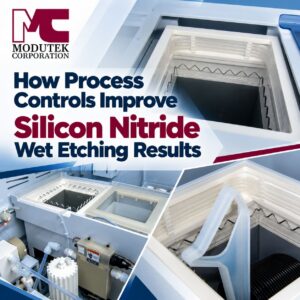
Because the safety of the Modutek control strategy relies on the phosphoric acid solution remaining at a constant boil, the Nb series etching bath uses additional safety interlocks to ensure no water is added when the solution is not boiling. A thermocouple above the solution senses hot steam (from the deionized water) and shuts off the water valve if steam is not present.
To prevent overheating, another thermocouple senses the acid temperature and switches off built-in heaters if the solution temperature rises to 170 degrees centigrade. With this advanced process control system and additional safety interlocks, Modutek’s Nb Series bath improves silicon nitride etching with precise control, accuracy, and increased safety.
Modutek’s Control Strategy Delivers Improved Etching Performance
Modutek has tested and fine-tuned its control strategy with its Nb Series silicon nitride etching baths for customers using manual, semi-automated, and fully automated wet bench stations. Customers using Modutek’s static silicon nitride etching bath equipment have achieved an average etch rate of 65 angstroms per minute while limiting oxide etch, as the controls ensure safe operation at a consistent, optimal operating point. A reliably controlled, constant etch rate delivers predictable etching and silicon nitride removal within product tolerances. When etching varies from batch to batch, product quality suffers, and product lifespan can be reduced. Modutek manufactures a complete range of silicon wet etching equipment, and its innovative control system reduces rejection rates and improves facility output.
Contact Modutek About Your Silicon Nitride Etch Requirements
Modutek works with customers to develop solutions for their specific process problems and ensures delivered etching systems and other equipment meet their requirements. For a wider look at how silicon nitride etching compares with other wet etch chemistries, see our guide to silicon wafer etching processes. To discuss your process, contact Modutek for a free consultation.